

IEC | INDONESIA EXPORT CENTER
Your Global Sourcing Partner
International Crude Palm Oil Procurement from Indonesia
Importing crude palm oil requires careful coordination of supplier qualification, product specifications, commercial contracts, export compliance, international transportation, and destination customs procedures.
For purchasing directors, commodity trading companies, and industrial importers, a structured sourcing process can reduce avoidable risks and improve quotation comparisons.
Indonesia Export Center (IEC) facilitates international B2B inquiries involving potential Indonesian CPO suppliers.
IEC is a sourcing intermediary and does not guarantee direct producer status, cargo availability, pricing, or export authorization.
Who Uses This Sourcing Guide?
This guide is intended for:
- Global commodity importers.
- Palm oil refineries.
- Industrial manufacturers.
- International trading houses.
- Food ingredient distributors.
- Oleochemical procurement teams.
- Purchasing and supply chain managers.
Step 1 – Define the Required Product
Start with an exact product description.
For example:
Product: Crude Palm Oil (CPO)
Do not confuse CPO with refined palm oil, palm olein, palm stearin, or palm kernel oil.
Step 2 – Establish Quality Specifications
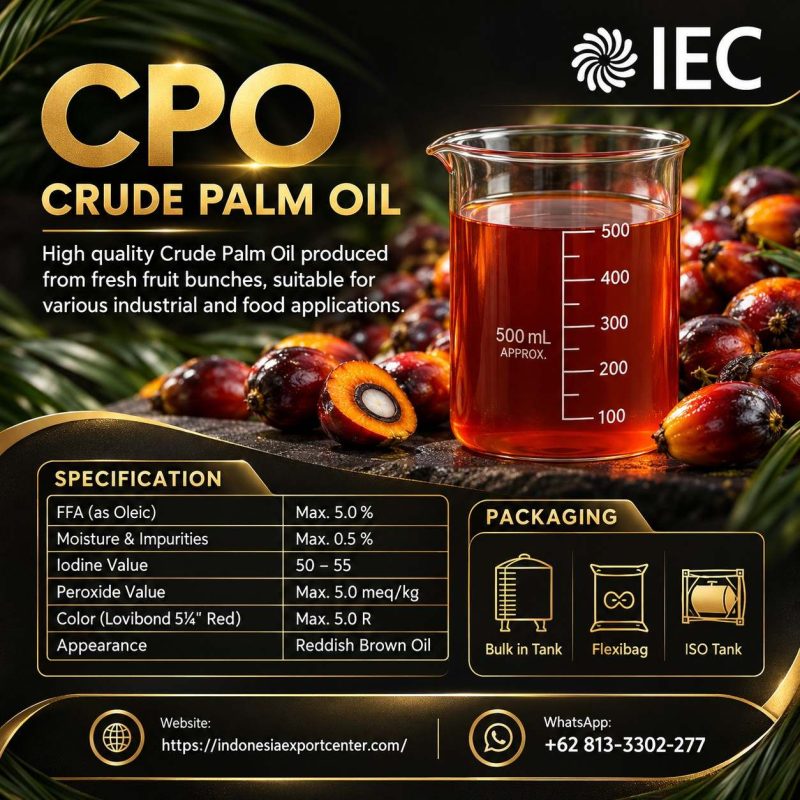
The IEC brochure provides these reference values:
| Parameter | Reference Target |
|---|---|
| FFA, as Oleic | Max. 5.0% |
| Moisture & Impurities | Max. 0.5% |
| Iodine Value | 50–55 |
| Peroxide Value | Max. 5.0 meq/kg |
| Lovibond Color, 5¼-inch Red | Max. 5.0 R |
| Appearance | Reddish Brown Oil |
These targets must be confirmed against the actual proposed cargo.
The buyer should specify the test methods and acceptable tolerances.
Step 3 – Determine Purchase Volume
Provide the expected purchase quantity in metric tons.
For recurring procurement, distinguish between:
- Initial trial quantity.
- Monthly demand.
- Annual demand.
- Minimum shipment requirement.
- Preferred delivery frequency.
Do not assume that a supplier can accommodate every volume.
Step 4 – Select the Destination Port
Identify the intended receiving port and country.
The destination influences freight, customs requirements, handling arrangements, and total landed cost.
Step 5 – Choose Commercial Delivery Terms
Common international trade terms include:
| Incoterm | General Procurement Consideration |
|---|---|
| FOB | Buyer generally arranges main ocean carriage |
| CFR | Seller arranges and pays for main carriage |
| CIF | Seller arranges freight and required insurance under CIF |
These terms should be interpreted under the agreed version of Incoterms and the full contract.
Step 6 – Verify Supplier Identity
Supplier due diligence should cover:
- Registered company identity.
- Contracting seller.
- Actual cargo owner or authorized seller.
- Exporter of record.
- Business legitimacy.
- Product source.
- Available cargo evidence.
- Previous transaction references where verifiable.
Step 7 – Obtain a Dated Quotation
A useful commercial offer should specify:
- Product.
- Quality specification.
- Quantity.
- Currency.
- Price basis.
- Incoterm.
- Named port.
- Shipment period.
- Payment terms.
- Offer validity.
- Inspection requirements.
IEC does not publish an invented live CPO price.
Step 8 – Review Quality Documentation
Request relevant cargo-specific documents, such as a COA, and establish independent inspection requirements.
Supplier documents should be verified for authenticity and applicability.
Step 9 – Evaluate Export and Import Regulations
The responsible exporter must verify Indonesian export requirements.
The buyer must verify destination requirements, including customs classification, permits, duties, taxes, and any applicable sustainability rules.
Step 10 – Agree on the Purchase Contract
The contract should address:
- Parties.
- Product.
- Quantity.
- Quality.
- Price.
- Delivery.
- Payment.
- Inspection.
- Risk allocation.
- Documentation.
- Claims.
- Dispute resolution.
Qualified legal review is advisable for significant commodity transactions.
Step 11 – Plan Logistics
Bulk CPO shipping may involve storage terminals, vessels, pumping systems, inspection, and receiving facilities.
Containerized alternatives require specific technical approval.
Step 12 – Verify Payment Arrangements
Potential payment methods include documentary letters of credit and other negotiated arrangements.
The buyer should independently verify banking details and assess counterparty risk.
Step 13 – Coordinate Shipment Inspection
An inspection program may cover quality sampling, quantity measurement, and loading supervision.
The contract should define which inspection results determine acceptance.
Step 14 – Prepare for Customs Clearance
The importing party should coordinate with its customs broker and receiving terminal.
Applicable documents may include invoices, bills of lading, origin documentation, quality certificates, and regulatory records.
Global CPO Import Risk Matrix
| Risk | Recommended Buyer Review |
|---|---|
| Unverified Seller | Legal identity and authority |
| Unconfirmed Stock | Cargo-specific availability evidence |
| Quality Discrepancy | COA and independent testing |
| Price Changes | Dated quotation and price mechanism |
| Shipping Delays | Logistics and contract planning |
| Documentation Problems | Pre-shipment document review |
| Regulatory Issues | Current official requirements |
| Payment Fraud | Independent banking verification |
| Origin Claims | Documentary traceability review |
Importer RFQ Template
Subject: Indonesian Crude Palm Oil International Sourcing Inquiry
Company: [Name]
Country: [Country]
Business Activity: [Importer / Refinery / Trader]
Product: Crude Palm Oil
Required Quantity: [MT]
Monthly Requirement: [MT]
Specifications: [Details]
Destination Port: [Port]
Preferred Incoterm: [FOB / CFR / CIF]
Payment Preference: [Details]
Shipment Period: [Dates]
Inspection Requirements: [Details]
Origin or Certification Requirements: [Details]
Please advise on potential suppliers and the documentation needed to evaluate a commercial offer.
Frequently Asked Questions
Can IEC help international buyers find Indonesian CPO suppliers?
IEC facilitates sourcing inquiries and communication with potential suppliers.
Does IEC guarantee stock?
No. Stock must be confirmed by the actual seller.
Can buyers request FOB or CIF offers?
Yes. Feasibility and pricing depend on the supplier and logistics arrangements.
Is a COA necessary?
A cargo-specific COA is an important quality document and may be required contractually.
Is a fixed minimum order quantity available?
No universal MOQ is confirmed. It depends on the actual supplier and shipment method.
Can buyers request long-term supply?
Yes. Recurring requirements can be submitted for supplier evaluation.
Are certifications automatically included?
No. Any certification claim must be verified.
Request Indonesian CPO Supplier Information
Begin your Indonesian CPO sourcing process with a detailed RFQ, verified supplier information, and clear commercial requirements.
REQUEST GLOBAL CPO SOURCING INFORMATION
IEC | INDONESIA EXPORT CENTER
Website: https://indonesiaexportcenter.com/
WhatsApp: +62 821-4172-3508
Related Resources
Indonesian CPO Buying Process for Importers
Crude Palm Oil Supplier Due Diligence Indonesia
CPO Request for Quotation Checklist
