

IEC | INDONESIA EXPORT CENTER
Your Global Sourcing Partner
INDONESIAN CPO SOURCING SUPPORT
Supplier Discovery | Buyer Requirements | Commercial Coordination | Documentation Review | Procurement Inquiries
Connect with Potential Indonesian Crude Palm Oil Suppliers
International crude palm oil procurement can involve several different business entities, including producers, traders, agents, storage operators, exporters, and logistics companies.
Understanding each party’s role is essential before entering a transaction.
For overseas importers and trading houses, a sourcing intermediary can help organize purchasing requirements, identify potential supplier channels, and coordinate initial commercial communication.
Indonesia Export Center (IEC) operates as a B2B sourcing intermediary supporting inquiries involving Indonesian crude palm oil.
IEC should not be assumed to be the producer, cargo owner, contracting seller, or exporter of record unless those roles are expressly confirmed for a particular transaction.
What Is a CPO Trading Company?
A CPO trading company may buy and sell crude palm oil under its own commercial arrangements.
Depending on its business model, it may act as a principal, hold inventory, or arrange purchases and sales through other parties.
Its actual contractual responsibilities must be verified.
What Is a CPO Sourcing Agent?
A sourcing agent generally helps a buyer identify and engage potential suppliers.
Services may include:
- Supplier discovery.
- Inquiry preparation.
- Initial commercial communication.
- Specification coordination.
- Documentation requests.
- Quotation comparison.
- Procurement follow-up.
The agent’s authority, compensation, and responsibilities should be defined.
Understanding IEC’s Role
IEC facilitates sourcing inquiries.
This may involve helping international buyers communicate:
- Product requirements.
- Quantity.
- Quality specifications.
- Destination.
- Shipment schedule.
- Commercial terms.
- Documentation needs.
- Inspection preferences.
Any supplier offer must be independently confirmed by the actual responsible commercial party.
Trading Company vs Sourcing Intermediary
| Topic | Trading Company Acting as Principal | Sourcing Intermediary |
|---|---|---|
| Product Ownership | May own or contract to supply cargo | Does not necessarily own cargo |
| Sales Contract | May contract as seller | May facilitate introduction or communication |
| Price Offer | May issue own commercial offer | May relay or coordinate supplier offers |
| Export Responsibility | Depends on transaction | Not automatically exporter of record |
| Cargo Availability | Must be verified | Must be verified with actual supplier |
| Commercial Liability | Defined by contract | Defined by agency or service agreement |
Why Role Transparency Matters
Before making payment or signing a contract, buyers should identify:
- Who owns or controls the cargo.
- Who has authority to sell it.
- Who signs the sales contract.
- Who issues the commercial invoice.
- Who receives payment.
- Who handles export customs procedures.
- Who arranges transportation.
- Who is responsible for quality claims.
These responsibilities should not be inferred from a website or marketing brochure.
Indonesian CPO Product Overview
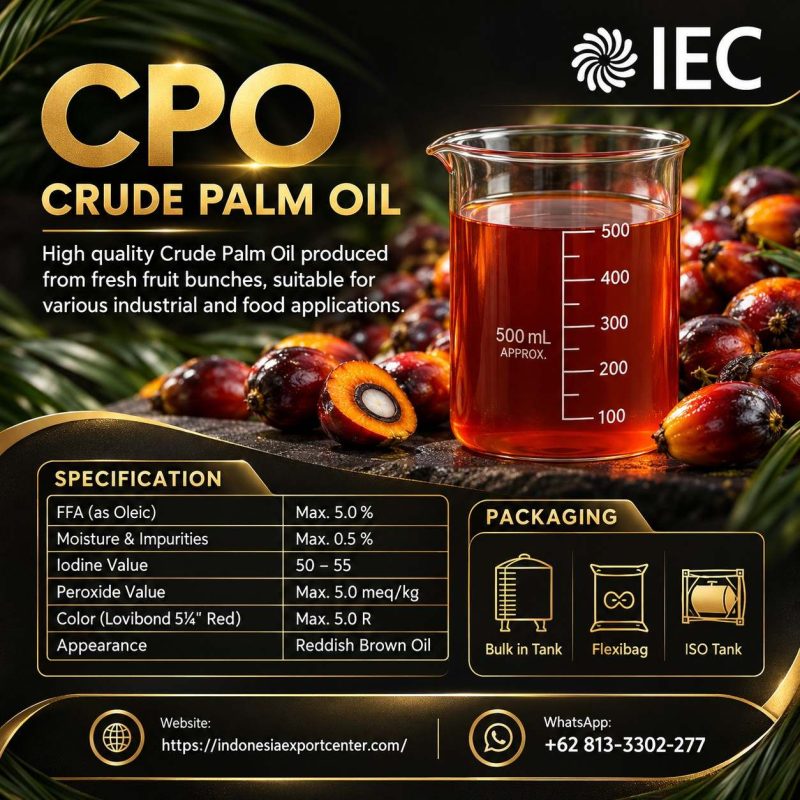
Crude Palm Oil is an unrefined oil produced from oil palm fruit mesocarp.
It is commonly used as refinery feedstock and in suitable industrial processing chains.
IEC Reference CPO Specifications
| Parameter | Reference Target |
|---|---|
| FFA, as Oleic | Maximum 5.0% |
| Moisture & Impurities | Maximum 0.5% |
| Iodine Value | 50–55 |
| Peroxide Value | Maximum 5.0 meq/kg |
| Lovibond Color, 5¼-inch Red | Maximum 5.0 R |
| Appearance | Reddish Brown Oil |
These are reference targets only.
Cargo-specific quality and availability must be confirmed.
The IEC Sourcing Inquiry Process
Step 1 – Buyer Submits Requirements
The buyer provides product specifications, quantity, destination, and commercial preferences.
Step 2 – Initial Requirement Review
The inquiry is reviewed for clarity and the information needed for supplier engagement.
Step 3 – Potential Supplier Communication
Where appropriate supplier channels are available, IEC may facilitate communication.
Step 4 – Commercial Information Review
The buyer evaluates any received product and quotation information.
Step 5 – Supplier Verification
The buyer verifies the seller’s legal identity, commercial authority, and relevant capabilities.
Step 6 – Technical and Quality Review
The parties agree on quality specifications, testing, and inspection.
Step 7 – Contract Negotiation
The responsible commercial parties negotiate their agreement.
Step 8 – Shipment Coordination
The actual seller, exporter, logistics providers, and buyer carry out their contractual responsibilities.
No step should be interpreted as a guarantee that a transaction will proceed.
What IEC Does Not Automatically Guarantee
IEC does not automatically guarantee:
- Physical stock.
- A particular refinery or mill.
- Direct producer relationships.
- Cargo ownership.
- Export licensing.
- Fixed prices.
- Certified sustainability status.
- Plantation-level traceability.
- Shipping capacity.
- Successful customs clearance.
These matters require transaction-specific evidence.
Supplier Verification Checklist
| Requirement | Buyer Verification |
|---|---|
| Legal Seller | Confirmed |
| Contracting Party | Confirmed |
| Cargo Ownership or Authority | Verified |
| Exporter of Record | Identified |
| Cargo Location | Confirmed |
| Product COA | Reviewed |
| Shipment Capability | Verified |
| Payment Beneficiary | Independently Checked |
| Contract Terms | Agreed |
| Inspection | Arranged |
Commercial Transparency and Fees
Where a sourcing service fee, agency commission, or intermediary compensation applies, the arrangement should be disclosed and agreed by the relevant parties.
No specific IEC commission or fee structure is stated here because none has been supplied.
Payment and Fraud Prevention
Buyers should avoid making payments based solely on unverified messages or documents.
Before payment:
- Verify the legal beneficiary.
- Confirm banking details independently.
- Review the contract.
- Establish payment conditions.
- Confirm the actual seller’s authority.
- Evaluate appropriate trade finance safeguards.
CPO Sourcing Agent RFQ Template
Subject: Indonesian CPO Sourcing Agent and Supplier Inquiry
Company: [Name]
Country: [Country]
Business Type: [Importer / Trader / Refinery]
Product: Crude Palm Oil
Quantity: [MT]
Monthly Requirement: [MT]
Required Specifications: [Details]
Destination Port: [Port]
Preferred Incoterm: [Term]
Payment Preference: [Details]
Shipment Period: [Dates]
Supplier Verification Requirements: [Details]
Please advise on the potential sourcing process, available supplier information, and the commercial parties responsible for any proposed transaction.
Frequently Asked Questions
Is IEC a crude palm oil manufacturer?
IEC is described here as a sourcing intermediary, not a manufacturer.
Is IEC automatically the exporter of record?
No. The exporter must be identified for the actual transaction.
Can IEC provide a fixed CPO price?
A current quotation must come from a verified commercial offer.
Does IEC own the cargo?
Cargo ownership should not be assumed.
Can buyers request supplier verification?
Yes. Due diligence requirements should be included in the inquiry.
Can trading houses submit large-volume requirements?
Yes. Volume and shipment schedules should be specified.
Does IEC guarantee a completed purchase?
No. Completion depends on supplier availability, negotiations, verification, and contractual performance.
Connect with Indonesian CPO Sourcing Channels
Submit your crude palm oil procurement requirements and explore potential Indonesian supplier opportunities through a transparent B2B inquiry process.
IEC | INDONESIA EXPORT CENTER
Website: https://indonesiaexportcenter.com/
WhatsApp: +62 821-4172-3508
Related Resources
Crude Palm Oil (CPO) Supplier Indonesia
Crude Palm Oil Supplier Due Diligence Indonesia
Global CPO Importer Sourcing Guide
