

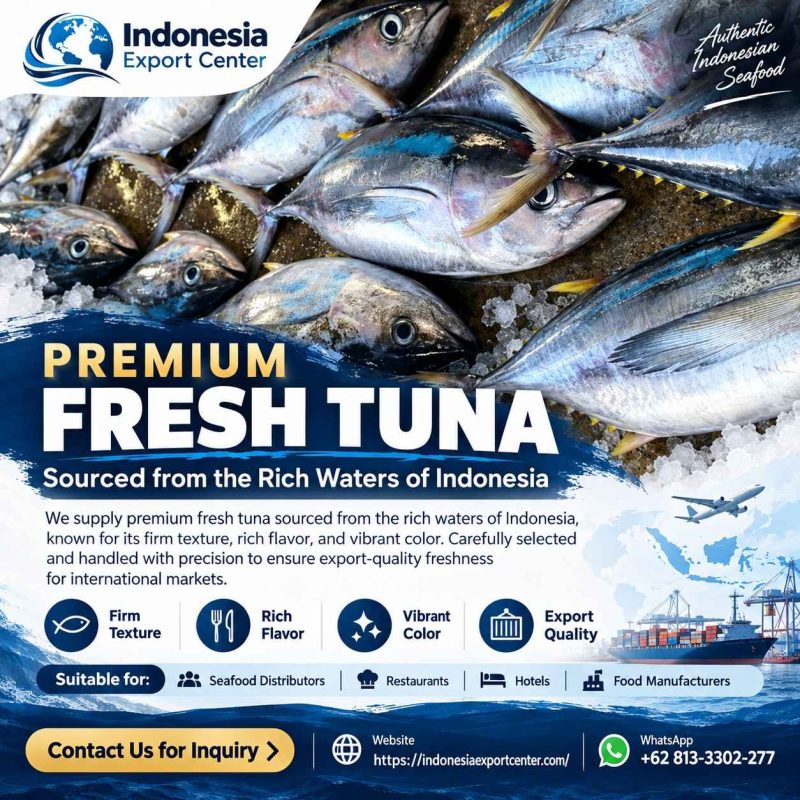
Indonesian Fresh Tuna Sourcing for International Seafood Distributors, Wholesale Buyers, and Foodservice Supply Companies
Are you looking for fresh tuna for seafood distributors to expand your seafood product portfolio or support your existing distribution network?
Indonesia Export Center (IEC) helps international seafood distributors explore sourcing opportunities for fresh Indonesian tuna through supplier coordination and B2B trade facilitation.
Indonesia is an important tuna-producing country with commercially valuable marine fisheries and established seafood supply chains.
For seafood distributors, successful sourcing requires more than competitive pricing. Product consistency, quality specifications, packaging, traceability, temperature management, delivery scheduling, and supplier reliability are all important.
Indonesia Export Center supports discussions between international distribution companies and potential Indonesian tuna suppliers based on their commercial and technical requirements.
Whether your business supplies restaurants, hotels, seafood wholesalers, supermarkets, or foodservice operators, we welcome inquiries for Indonesian fresh tuna sourcing.
REQUEST A FRESH TUNA DISTRIBUTOR QUOTATION
Website: https://indonesiaexportcenter.com/
WhatsApp: +62 813-3302-277
Direct WhatsApp: https://wa.me/628133302277
Fresh Tuna Sourcing Solutions for Seafood Distributors
Seafood distributors operate between producers, importers, wholesalers, and end customers.
Their purchasing requirements often differ from those of individual restaurants or retail consumers.
Distributors may need specific fish sizes, agreed quality standards, suitable packaging, reliable logistics arrangements, and repeat purchasing procedures.
Indonesia Export Center supports inquiries involving:
- Fresh tuna sourcing for seafood distribution
- Supplier identification and communication
- Distributor-specific product specifications
- Commercial quality and grading requirements
- Packaging and labeling discussions
- Order quantity and MOQ verification
- Wholesale quotation coordination
- Cold-chain transportation requirements
- Import documentation inquiries
- Repeat-order planning
- Procurement and commercial term negotiations
Product availability, actual supplier capabilities, and delivery commitments must be verified before order confirmation.
Why Source Indonesian Tuna for Your Seafood Distribution Business?
1. Access to Indonesian Tuna-Producing Regions
Indonesia has extensive marine fisheries associated with commercially important tuna species.
These fisheries support seafood trading and processing activities across several Indonesian regions.
2. Commercially Relevant Tuna Species
Indonesian tuna markets include yellowfin, bigeye, skipjack, and other tuna species.
Different species can serve different foodservice, processing, and wholesale distribution requirements.
3. Multiple Product Forms
Depending on supplier capabilities, fresh tuna may be offered as whole fish, gutted products, loins, steaks, and other commercial presentations.
4. Distributor-Specific Procurement Opportunities
Seafood distributors can request quotations based on their preferred size ranges, grades, order quantities, packaging, and destination.
5. Potential for Recurring Supply Relationships
Qualified suppliers may consider ongoing procurement arrangements, subject to availability and mutually agreed commercial conditions.
6. International Sourcing Coordination
Indonesia Export Center facilitates communication concerning products, export documentation, proposed shipment schedules, and supplier verification.
Indonesian Fresh Tuna Products for Distribution
Indonesia Export Center welcomes distributor inquiries for several commercially important Indonesian tuna species.
Yellowfin Tuna for Seafood Distributors
Scientific Name: Thunnus albacares
Yellowfin tuna is a widely traded species used in various seafood distribution channels.
Potential customers include:
- Restaurant supply companies
- Hotels and hospitality businesses
- Seafood wholesale markets
- Retail seafood businesses
- Foodservice distributors
- Seafood processing facilities
Distribution buyers may request whole yellowfin tuna, gutted tuna, loins, or steaks according to supplier availability.
Bigeye Tuna for Seafood Distributors
Scientific Name: Thunnus obesus
Bigeye tuna is commercially relevant in specialty seafood and selected premium foodservice markets.
Buyers should specify required size, handling history, quality criteria, product presentation, and intended application.
Skipjack Tuna for Commercial Distribution
Scientific Name: Katsuwonus pelamis
Skipjack tuna plays an important role in commercial seafood trading and processing.
Fresh skipjack sourcing may be assessed where suitable availability and temperature-controlled logistics exist. Frozen or processed formats may be more practical for certain distribution models.
Note: Product descriptions represent possible sourcing categories. They do not constitute confirmation of available stock, supplier approvals, or immediate export capability.
Fresh Tuna Specifications for Seafood Distributors
Clear product specifications help distributors manage purchasing, receiving inspections, inventory, and customer expectations.
| Specification | Distributor Procurement Requirements |
|---|---|
| Product | Indonesian Fresh Tuna |
| Country of Origin | Indonesia |
| Species | Yellowfin, Bigeye, Skipjack – subject to availability |
| Condition | Fresh / Chilled |
| Product Forms | Whole, gutted, headed and gutted, loins, steaks |
| Fish Weight | Buyer-defined range, subject to availability |
| Product Grade | Supplier grading and agreed buyer acceptance criteria |
| Appearance | According to product condition and grade requirements |
| Texture | According to agreed quality specifications |
| Packaging | Food-grade packaging suitable for chilled seafood |
| Net Weight | According to agreed packing configuration |
| Labeling | Species, origin, lot identification and applicable required information |
| Storage Conditions | Validated chilled handling requirements |
| Shelf Life | Based on product condition, handling and verified storage conditions |
| MOQ | Subject to supplier confirmation |
| Delivery Frequency | Based on negotiated purchase arrangements |
| Export Documents | Destination-specific requirements |
Buyers should provide detailed technical specifications before requesting firm prices or supply commitments.
Tuna Grading and Quality Requirements for Seafood Distribution
Establishing Clear Acceptance Standards
International seafood distributors frequently manage products across different customer segments.
A product suitable for general seafood processing may not satisfy the specifications of a premium restaurant customer.
For this reason, distributor procurement agreements should establish product-specific acceptance criteria.
Species and Product Identity
The supplied tuna must match the contracted species and product description.
Fish Size and Weight
Buyers may define minimum and maximum weight ranges based on their customer requirements.
Appearance and Physical Condition
Inspection criteria may consider appearance, odor, texture, handling condition, and other relevant freshness indicators.
Temperature and Handling History
Appropriate chilled handling and temperature control are essential throughout the supply chain.
Processing Specifications
For tuna loins and steaks, buyers may establish requirements for trimming, portion size, product presentation, and packaging.
Food Safety Criteria
Relevant food safety requirements may include histamine controls, microbiological criteria where applicable, hygiene requirements, and destination-specific regulations.
Lot Traceability
Batch identification and supply chain records should support product tracking and verification.
Product Acceptance Procedures
Distributors should agree on inspection methods, acceptance criteria, reporting deadlines, and procedures for nonconforming products.
Fresh Tuna Packaging for Seafood Distribution
Packaging Designed Around Distribution Requirements
Packaging plays an important role in seafood handling, product presentation, transport efficiency, and inventory management.
Depending on supplier capability and product condition, distributors may request packaging arrangements suitable for commercial seafood channels.
Whole Fresh Tuna Packaging
Whole fish require packaging that supports appropriate chilling, hygienic handling, and product protection during transportation.
Fresh Tuna Loin Packaging
Processed tuna loins require suitable food-grade packaging and strict handling procedures.
Tuna Steak Packaging
Portioned products may require agreed unit weights, pack configurations, labeling, and protection against contamination.
Wholesale Carton or Container Configuration
Commercial buyers may request packaging details such as:
- Net weight per package
- Gross weight per package
- Number of units
- Packaging material
- Product identification
- Batch number
- Packing date, where applicable
- Storage instructions
- Destination-specific labeling
Final packaging arrangements should be confirmed with the supplier and relevant logistics providers.
Cold Chain Management for Fresh Tuna Distributors
Fresh tuna distribution requires careful temperature management from initial handling through delivery to the receiving customer.
Inadequate temperature control can affect quality and create food safety risks.
Important cold-chain considerations include:
Chilled Product Handling
Fresh tuna should be handled under appropriate validated temperature conditions.
Temperature Monitoring
Monitoring and recording temperatures may help verify compliance with agreed handling requirements.
Histamine Risk Management
Tuna belongs to a group of fish associated with histamine formation when exposed to improper time and temperature conditions. Effective preventive controls are essential.
Packaging Integrity
Packaging should protect the product during shipment and handling.
Transport Duration
Transit times should be evaluated against product condition and validated shelf-life requirements.
Receiving Inspection
Distributors should establish procedures to examine incoming product condition, temperature, packaging, documentation, and lot information.
Cold Storage Procedures
Storage practices should maintain suitable product conditions until the tuna is distributed to customers.
Appropriate cold-chain verification is especially important for international shipments with multiple handling points.
Fresh Tuna Procurement Terms for Seafood Distributors
Commercial Terms That Distributors Should Confirm
Distributor purchasing agreements should clearly define product requirements and the responsibilities of each contracting party.
1. Minimum Order Quantity
MOQ should be based on the supplier’s confirmed commercial and operational capabilities.
2. Product Price
Pricing should identify the species, product form, grade, quantity, currency, and relevant delivery terms.
3. Order Frequency
Buyers may request one-time, weekly, biweekly, monthly, or forecast-based purchasing arrangements.
4. Lead Time
Suppliers should confirm realistic preparation and shipment schedules for each order.
5. Payment Conditions
Payment timing, method, and any security requirements must be agreed between the contracted parties.
6. Delivery Terms
The agreed Incoterms should specify the named place and allocation of transportation responsibilities.
7. Quality Inspection
Buyers and suppliers should agree on inspection standards and acceptance procedures.
8. Product Claims and Rejections
Contracts should specify procedures for quality claims, damaged goods, or products that do not meet the agreed specifications.
9. Export Documentation
The responsible exporter should provide applicable shipment documents as required by the destination market.
10. Repeat-Order Conditions
Where recurring purchases are intended, the parties should establish forecasting, order confirmation, and supply adjustment procedures.
Distributor Supply Programs and Repeat Orders
Supporting Structured Seafood Purchasing
Seafood distributors often need predictable procurement processes to meet their customers’ purchasing schedules.
Depending on supplier capacity and commercial agreement, possible arrangements include:
Trial Shipments
Initial orders to evaluate product specifications, packing performance, documentation, and receiving quality.
Scheduled Purchase Orders
Orders issued according to agreed commercial schedules and confirmed supplier availability.
Forecast-Based Purchasing
Distributors share anticipated demand to assist sourcing and shipment planning.
Recurring Supply Arrangements
Buyers and suppliers may negotiate ongoing purchasing relationships subject to availability and agreed requirements.
Framework Procurement Agreements
Commercial arrangements setting out general quality, pricing, payment, and delivery principles for subsequent orders.
No particular shipment frequency or supply volume is guaranteed without supplier confirmation.
Supply Planning for Seafood Distribution Networks
Aligning Procurement with Downstream Demand
Seafood distributors should consider both supplier capability and the requirements of their own customers.
Important planning factors include:
- Customer order cycles
- Expected product demand
- Fresh tuna shelf life
- Product grading requirements
- Available cold-storage capacity
- Distribution lead times
- Required shipment frequency
- Transport cost per kilogram
- Product loss and quality rejection risks
- Import clearance procedures
- Supplier contingency arrangements
Procurement Forecasting
Buyers may improve planning by sharing estimated demand for future purchasing periods.
However, a purchasing forecast should not be treated as a confirmed supplier commitment unless incorporated into a binding agreement.
Inventory Management
Distributors should align inbound shipments with downstream sales, available storage capacity, and realistic product shelf life.
Supplier Performance Review
For recurring relationships, buyers may assess:
- On-time delivery
- Quantity fulfillment
- Product conformity
- Documentation accuracy
- Packaging performance
- Temperature-control records
- Corrective action responsiveness
These indicators can help strengthen supplier evaluation and commercial decision-making.
Fresh Tuna Export Logistics for International Distributors
Air Freight Shipment Options
Air freight may be appropriate for fresh tuna shipments requiring shorter transit times.
The suitability of a specific shipment depends on cargo availability, product condition, packaging, routing, customs procedures, and the destination country’s requirements.
Temperature-Controlled Transportation
Fresh tuna requires appropriate cold-chain management during handling, storage, and transportation.
Customs and Import Clearance
Buyers should confirm applicable import permits, health documentation, tariff classification, food safety rules, and destination inspections.
Delivery Terms
For international air cargo, buyers and sellers may consider applicable Incoterms such as:
- FCA – Free Carrier
- CPT – Carriage Paid To
- CIP – Carriage and Insurance Paid To
The parties must agree on the precise named place and applicable contractual obligations.
Distribution After Import
Receiving distributors should prepare appropriate cold storage, inspection, inventory identification, and downstream delivery arrangements.
Export Documentation for Seafood Distributors
International seafood distributors should verify documentation requirements before placing an order.
Depending on the destination, relevant documents may include:
- Commercial invoice
- Packing list
- Air waybill or other relevant transport document
- Health certificate, where required
- Certificate of origin, where applicable
- Product specification sheet
- Catch-related documentation, where applicable
- Traceability records
- Applicable food safety documentation
- Supplier and processing establishment approvals, where necessary
- Destination-specific import documentation
Certification and regulatory requirements differ across markets.
The availability and validity of each document must be confirmed for the actual supplier, product, shipment, and importing country.
Indonesian Tuna for Different Distribution Channels
Restaurant Seafood Distributors
Distributors supplying restaurants may require suitable portion sizes, product consistency, and dependable receiving arrangements.
Hotel and Hospitality Suppliers
Hospitality procurement businesses often require documented specifications and coordinated purchasing schedules.
Seafood Wholesale Markets
Wholesale distributors may purchase tuna for resale to smaller seafood merchants and commercial buyers.
Supermarket Seafood Supply
Retail distribution may require additional requirements concerning labeling, packaging, shelf life, and product traceability.
Foodservice Distribution Companies
Foodservice suppliers may require product formats suitable for kitchen operations and institutional procurement.
Seafood Processing Distributors
Distributors supplying processors may prioritize product specifications, yield, and procurement economics.
Each distribution channel has different quality, packaging, and commercial requirements.
Why Work with Indonesia Export Center?
Indonesia Export Center supports international buyers seeking Indonesian seafood sourcing opportunities.
Indonesian Supplier Sourcing
We facilitate introductions and commercial communication with potential Indonesian tuna suppliers.
Distributor-Focused Inquiries
Our sourcing discussions consider buyer requirements relating to product form, grade, order frequency, packing, and destination.
Export Coordination Support
We help communicate requirements concerning product specifications, documentation, and proposed shipment arrangements.
B2B Procurement Communication
We focus on commercial buyers requiring structured purchasing discussions and relevant sourcing information.
Transparent Business Model
Indonesia Export Center operates as a sourcing intermediary.
Actual suppliers, exporters, certifications, product availability, and contractual responsibilities are confirmed individually.
Frequently Asked Questions – Fresh Tuna for Seafood Distributors
1. Can seafood distributors source fresh tuna from Indonesia?
Yes. International seafood distributors can explore sourcing opportunities with Indonesian tuna suppliers, subject to product availability, compliance, and shipment feasibility.
2. What tuna species are commonly sourced from Indonesia?
Indonesia’s tuna industry handles yellowfin, bigeye, skipjack, and other commercially important species.
3. Can distributors order tuna loins and steaks?
Buyers may request whole fish, loins, steaks, or other product forms. Availability depends on supplier processing capability.
4. What is the MOQ for seafood distributors?
MOQ varies according to species, product form, supplier capacity, and transport arrangements.
5. Can I arrange recurring tuna orders?
Recurring purchase arrangements may be negotiated with qualified suppliers, subject to capacity and commercial agreement.
6. How is fresh tuna packaged for international distribution?
Packaging depends on product form, destination requirements, cold-chain needs, and supplier capability.
7. What quality documents can distributors request?
Buyers may request technical specifications, inspection records, applicable food safety documentation, and supplier-specific certificates.
8. Can Indonesian tuna be supplied to restaurant distribution networks?
Indonesian tuna may be suitable for restaurant distribution when the product meets agreed specifications and relevant food safety requirements.
9. What affects distributor pricing?
Price factors include species, grade, fish size, processing form, quantity, packaging, logistics, and commercial terms.
10. How can seafood distributors request a quotation?
Contact Indonesia Export Center with product specifications, purchase volume, destination, order frequency, and required documentation.
Request for Quotation (RFQ) – Fresh Tuna for Seafood Distributors
International Seafood Distributors – Tell Us Your Procurement Requirements
To facilitate a relevant sourcing inquiry, please provide the following details.
Distributor Information
- Company Name:
- Contact Person:
- Country:
- Company Website:
- Email:
- WhatsApp:
- Distribution Market:
Product Specifications
- Required Tuna Species:
- Product Form:
- Fresh / Chilled Requirements:
- Fish Size / Weight:
- Required Grade:
- Quality Specifications:
- Packaging Requirements:
- Labeling Requirements:
- Required Certifications:
Procurement Requirements
- Quantity per Order:
- Estimated Monthly Demand:
- Preferred Order Frequency:
- Trial Order Quantity:
- Target Price, if applicable:
- Required Lead Time:
- Preferred Contract Duration:
Shipping Requirements
- Destination Country:
- Destination Airport / Port:
- Preferred Incoterms:
- Target First Shipment Date:
- Additional Requirements:
Detailed inquiries help us coordinate supplier discussions and evaluate sourcing feasibility.
Contact Indonesia Export Center – Fresh Tuna Supply for Seafood Distributors
Connect with Indonesian Fresh Tuna Sourcing Opportunities
Are you an international seafood distributor looking for fresh Indonesian tuna for your business?
Indonesia Export Center welcomes sourcing inquiries from seafood distribution companies, wholesalers, restaurant suppliers, hotel procurement companies, and other professional B2B buyers.
Contact us to discuss your product requirements, distribution needs, preferred purchase quantities, packaging specifications, and destination market.
INDONESIA EXPORT CENTER (IEC)
Bridging Indonesian Excellence to the World
Official Website: https://indonesiaexportcenter.com/
Landing Page: https://indonesiaexportcenter.com/fresh-tuna-seafood-distributors/
WhatsApp: +62 813-3302-277
Direct WhatsApp Inquiry: https://wa.me/628133302277
REQUEST A DISTRIBUTOR FRESH TUNA QUOTATION TODAY
Explore fresh Indonesian tuna sourcing opportunities for your seafood distribution business.
Product availability, grade, packaging, MOQ, pricing, supply frequency, certifications, export eligibility, and shipping arrangements are subject to supplier verification and commercial agreement.
