

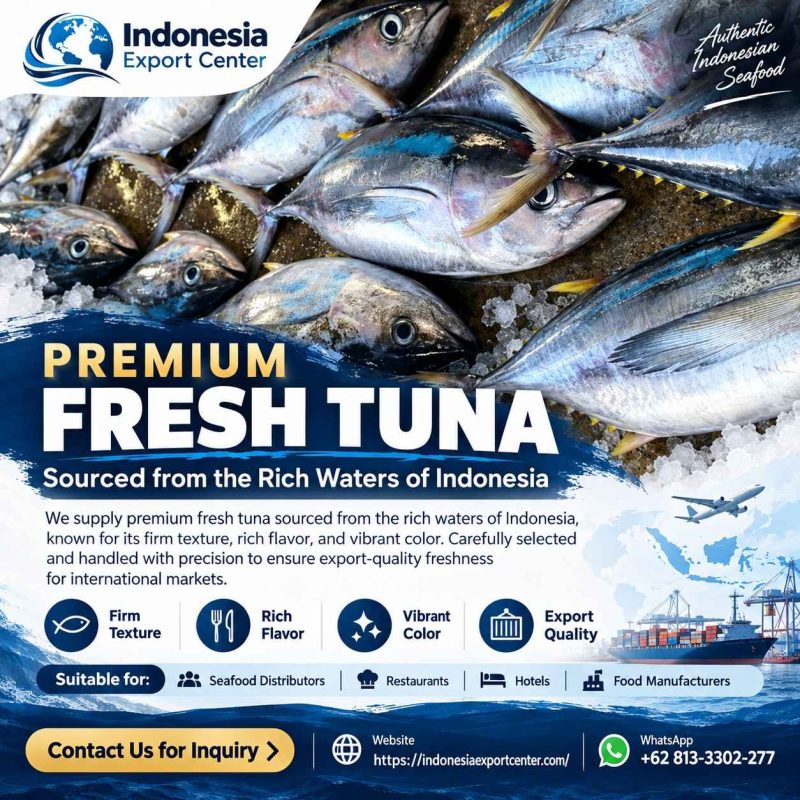
Indonesian Fresh Tuna Sourcing for Large-Volume Importers, Seafood Distributors, and International Procurement Companies
Are you searching for a reliable bulk fresh tuna supplier to support your international seafood procurement operations?
Indonesia Export Center (IEC) helps international seafood buyers explore large-volume fresh tuna sourcing opportunities from Indonesia through supplier identification, product inquiry coordination, and export-related communication.
Indonesia has extensive marine fisheries and an established tuna trading industry, making it an important sourcing destination for international seafood businesses.
For companies requiring substantial quantities of fresh tuna, purchasing decisions involve more than obtaining a competitive price. Buyers must also evaluate supplier capacity, product quality, lead times, delivery schedules, export compliance, cold-chain handling, and continuity of supply.
Indonesia Export Center supports these discussions by connecting potential Indonesian suppliers with international buyers seeking bulk orders, recurring shipments, and negotiated supply arrangements.
Whether you are planning a trial shipment, expanding your seafood distribution business, or evaluating a long-term tuna procurement contract, our team welcomes your sourcing inquiry.
REQUEST A BULK FRESH TUNA SUPPLY QUOTATION
Website: https://indonesiaexportcenter.com/
WhatsApp: +62 813-3302-277
Direct Inquiry: https://wa.me/628133302277
Bulk Fresh Tuna Supply Opportunities in Indonesia
Indonesia’s tuna sector includes fishing operations, landing facilities, traders, processors, cold-storage operators, and export businesses.
These supply-chain participants support commercial tuna trade for domestic and international markets.
International buyers seeking bulk fresh tuna may require:
- Large-volume product sourcing
- Verified supplier production and handling capacity
- Consistent product specifications
- Planned shipment schedules
- Reliable cold-chain management
- Export documentation
- Recurring purchase arrangements
- Long-term commercial contracts
- Supplier diversification
- Shipment and order coordination
Indonesia Export Center facilitates inquiries covering these commercial requirements.
Actual supply capacity, available quantities, delivery schedules, and contractual terms must be confirmed with the relevant supplier.
Why Consider Indonesia for Bulk Fresh Tuna Procurement?
1. Strategic Tuna-Producing Geography
Indonesia is geographically located between the Indian and Pacific Oceans, with extensive fishing waters supporting commercially valuable tuna species.
2. Commercial Tuna Supply Chains
Indonesia has established fisheries and seafood trading activities that can support wholesale and export-oriented sourcing opportunities.
3. Multiple Tuna Product Categories
Commercially important species include yellowfin tuna, bigeye tuna, and skipjack tuna.
4. Potential for Structured Supply Agreements
Qualified suppliers may consider recurring orders or negotiated supply agreements according to their capabilities and commercial policies.
5. International Seafood Trade Infrastructure
Seafood handling facilities, processing businesses, logistics providers, and exporters operate within Indonesia’s tuna supply chain.
6. Supplier Sourcing Flexibility
International buyers may evaluate different potential suppliers based on their required species, volumes, product forms, documentation, and delivery preferences.
Bulk Fresh Tuna Products Available for Sourcing Inquiries
Indonesia Export Center welcomes large-volume procurement inquiries for commercially relevant Indonesian tuna products.
Bulk Yellowfin Tuna
Scientific Name: Thunnus albacares
Yellowfin tuna is widely traded in international seafood markets and may be suitable for various fresh seafood distribution and foodservice applications.
Potential sourcing specifications include:
- Whole yellowfin tuna
- Gutted yellowfin tuna
- Headed and gutted tuna
- Fresh yellowfin tuna loins
- Fresh tuna steaks
- Buyer-specific processing requests
Actual product forms and volume availability depend on supplier capability.
Bulk Bigeye Tuna
Scientific Name: Thunnus obesus
Bigeye tuna is an important commercial species for specialty seafood and selected foodservice markets.
Buyers can submit requirements relating to product condition, size range, handling methods, grade, packaging, and estimated purchase volumes.
Bulk Skipjack Tuna
Scientific Name: Katsuwonus pelamis
Skipjack tuna is widely traded for seafood processing and commercial distribution.
Fresh skipjack inquiries can be evaluated based on supplier availability, logistics feasibility, and buyer specifications. Frozen skipjack may be a more practical option for some long-distance bulk supply programs.
Product availability is subject to confirmation. Species listed here do not represent guaranteed inventory or immediate delivery capability.
Bulk Fresh Tuna Product Specifications
Detailed technical specifications help buyers and suppliers evaluate the feasibility of larger procurement commitments.
| Parameter | Bulk Sourcing Information |
|---|---|
| Product | Fresh Tuna |
| Country of Origin | Indonesia |
| Species | Yellowfin, Bigeye, Skipjack, subject to availability |
| Product Condition | Fresh / Chilled |
| Product Forms | Whole, gutted, headed and gutted, loins, steaks |
| Fish Size | According to buyer specifications and supplier availability |
| Quality Grade | Supplier-specific, subject to agreed acceptance criteria |
| Packaging | Appropriate food-grade export packaging |
| Temperature Requirements | Validated chilled handling and transport conditions |
| Bulk Quantity | Based on confirmed supplier capacity |
| Minimum Order Quantity | Quotation required |
| Repeat Orders | Subject to negotiated supply arrangements |
| Supply Frequency | Subject to availability and supplier agreement |
| Lead Time | Confirmed for each order |
| Shipping | Temperature-controlled transportation |
| Export Documents | According to applicable destination requirements |
| Payment Terms | Subject to negotiation |
Buyers requiring specific size classifications, product yields, or quality grades should include these requirements in their purchasing inquiry.
Bulk Tuna Supply Capacity and Volume Planning
Evaluating Supplier Capacity for Large-Volume Orders
Supplier capacity is one of the most important considerations for international companies purchasing fresh tuna in substantial quantities.
Unlike standardized manufactured products, fresh tuna supply depends on biological, operational, and market factors.
Supply volume can vary due to:
- Seasonal fishing conditions
- Available landings
- Tuna species and size
- Fishing regulations and quotas
- Supplier procurement networks
- Processing and packing capacity
- Quality grading requirements
- Export logistics availability
- Existing contractual commitments
Before negotiating a large-volume purchase, buyers should request evidence supporting the supplier’s proposed capacity.
Important Capacity Information for Buyers
International procurement managers may request:
Available Volume per Shipment
The quantity the supplier can prepare and deliver for a specific confirmed shipment.
Weekly Supply Capability
A supplier-supported estimate of potential weekly availability.
Monthly Supply Capability
An assessment of possible monthly commercial volumes, taking seasonal variation into account.
Processing Capacity
The facility’s ability to prepare, pack, and handle the agreed product form.
Cold Storage and Handling Capability
The ability to maintain appropriate product temperatures before dispatch.
Supplier Network and Contingency Planning
Information about alternative sourcing arrangements if the originally expected volume becomes unavailable.
Indonesia Export Center can help coordinate capacity inquiries. No particular daily, weekly, or monthly tonnage is guaranteed unless independently confirmed for the relevant supplier.
Lead Times for Bulk Fresh Tuna Orders
How Long Does It Take to Arrange Bulk Fresh Tuna Shipments?
Lead time depends on the supplier, current availability, order specifications, documentation, and transportation arrangements.
Fresh tuna requires special attention because extended delays can affect product condition and commercial viability.
Factors Affecting Lead Time
Product Availability
Existing landings or confirmed stock may affect preparation time.
Order Quantity
Large orders may require coordinated sourcing across multiple landings or suppliers.
Product Processing
Whole fish and processed tuna products have different preparation requirements.
Quality Inspection
Inspection, sampling, documentation, and laboratory testing may require additional time.
Export Documentation
Document preparation and regulatory procedures vary by destination.
Transport Availability
Air cargo availability, routing, and destination handling affect shipment schedules.
Recommended Lead-Time Planning
For an accurate delivery quotation, buyers should identify:
- Required quantity
- Product species and form
- Target shipment date
- Preferred delivery frequency
- Destination airport or other agreed delivery point
- Required documentation
- Acceptable delivery window
Lead time should be confirmed in writing before a purchase order becomes binding.
Repeat Fresh Tuna Orders for International Buyers
Structured Procurement for Recurring Tuna Supply
Many international seafood distributors and importers require ongoing purchasing arrangements rather than one-time transactions.
Recurring procurement programs can improve coordination when suppliers and buyers establish clear product specifications, order schedules, and communication procedures.
Potential repeat-order structures include:
Weekly Purchase Orders
Suitable for buyers requiring frequent deliveries, subject to confirmed supplier capacity and available logistics.
Biweekly Orders
An option for businesses coordinating procurement with regional inventory and distribution schedules.
Monthly Supply Programs
Suitable for buyers planning consolidated purchasing requirements over a defined commercial period.
Forecast-Based Procurement
Buyers provide estimated purchase volumes in advance, allowing suppliers to assess sourcing and handling requirements.
Framework Supply Agreements
Commercial arrangements establishing general purchasing conditions, with individual purchase orders issued as required.
Repeat-order acceptance is subject to supplier confirmation, applicable regulations, and an agreed commercial contract.
Long-Term Fresh Tuna Contract Supply
Contract-Based Tuna Procurement from Indonesia
International seafood businesses may seek longer-term purchasing agreements to establish consistent commercial relationships and clearer procurement procedures.
A well-defined supply contract helps buyers and sellers understand their respective responsibilities.
Important contract considerations include:
1. Contract Duration
The agreed period during which purchasing arrangements apply.
2. Product Specifications
The tuna species, product condition, form, size, quality requirements, and applicable grading standards.
3. Contract Quantity
Expected or committed quantities, including any minimum and maximum tolerances.
4. Delivery Schedule
Agreed shipment windows, order frequency, and purchase order procedures.
5. Pricing Mechanism
A fixed price, periodically negotiated price, or other agreed pricing formula.
6. Quality Inspection
Product acceptance criteria, inspection procedures, and treatment of nonconforming goods.
7. Payment Terms
Agreed payment method, payment timing, and any required transaction security.
8. Shipment Responsibilities
Applicable Incoterms, insurance requirements, logistics responsibilities, and documentation obligations.
9. Supply Disruption Procedures
Agreed procedures for delays, shortage conditions, missed quantities, and other operational disruptions.
10. Contractual Remedies
Provisions for disputes, rejected shipments, applicable law, and other commercial safeguards.
Indonesia Export Center may facilitate discussions between buyers and prospective suppliers. Contractual obligations must be established with the actual contracting parties.
Bulk Fresh Tuna Pricing and Contract Negotiations
Factors Affecting Large-Volume Tuna Prices
International bulk buyers should evaluate both unit price and total procurement cost.
Fresh tuna pricing may vary according to:
- Species
- Fish size and grade
- Freshness and handling history
- Product form and processing
- Available supply volume
- Seasonal market conditions
- Order frequency
- Packaging
- Inspection requirements
- Export documentation
- Freight costs
- Destination country
- Currency and payment terms
Bulk Pricing Models
Depending on supplier agreement, possible approaches include:
Shipment-Based Quotations
Prices are confirmed individually for each commercial shipment.
Periodic Price Reviews
Prices are reviewed at agreed intervals during a recurring supply relationship.
Volume-Based Negotiations
Commercial terms are negotiated with reference to order size and total purchasing commitments.
Framework Contract Pricing
A contract establishes an agreed pricing methodology for subsequent purchase orders.
No fixed wholesale price or guaranteed discount is advertised without a current supplier quotation.
Cold Chain and Quality Control for Bulk Fresh Tuna
Effective cold-chain management is essential for fresh tuna procurement, particularly when shipments involve long-distance transportation and substantial commercial quantities.
Temperature-Controlled Handling
Appropriate chilling must be maintained through product handling, packing, storage, and transit.
Product Inspection
Suppliers should evaluate product condition against the agreed specifications and acceptance criteria.
Histamine Risk Control
Tuna is a histamine-forming fish. Effective time and temperature management is essential because histamine formation can create food safety risks.
Hygienic Processing
Processing and packaging operations should comply with relevant hygiene and food safety requirements.
Traceability
Buyers may require lot identification, catch-related records, landing information, and processing records.
Shipment-Level Quality Verification
Commercial buyers may request inspection records, temperature information, laboratory reports where applicable, and supporting documentation.
Packaging Validation
Packaging should be appropriate for the product, shipment duration, and transport method.
Fresh tuna intended for raw consumption requires additional scrutiny of handling controls and buyer-specific safety criteria; commercial grading terminology alone does not establish food safety.
International Shipping for Bulk Fresh Tuna from Indonesia
Air Freight for Fresh Tuna Shipments
Air freight may be suitable for fresh tuna requiring shorter transit times.
The practical shipment volume depends on available cargo capacity, packaging configuration, route options, and temperature-control arrangements.
Chilled Logistics Arrangements
International buyers should confirm that the proposed logistics chain is appropriate for the agreed product condition.
Delivery Frequency
Recurring shipment schedules may be discussed with suppliers and logistics providers, subject to availability and feasibility.
Shipment Documentation
The parties should verify documentation, import permits, customs requirements, and destination inspection obligations before shipment.
Incoterms and Commercial Responsibilities
For applicable air cargo arrangements, parties may negotiate Incoterms such as FCA, CPT, or CIP.
FOB and CIF are reserved for sea and inland waterway transport under Incoterms 2020.
Fresh tuna shipments should not be planned solely around shipping price. Transit time, food safety, regulatory compliance, and product condition are equally important.
Risk Management for Large-Volume Fresh Tuna Procurement
Large-volume seafood sourcing requires careful risk assessment.
Important areas include:
Supply Variability
Fresh tuna availability can fluctuate due to fishing conditions, seasonal patterns, and market demand.
Quality Inconsistency
Differences in handling and product condition may affect acceptance rates.
Temperature Excursions
Cold-chain failures can compromise quality and safety.
Regulatory Delays
Missing or incorrect documentation may delay customs clearance.
Logistics Disruptions
Cargo availability, flight changes, or delays may affect delivery schedules.
Commercial Counterparty Risk
Buyers should verify supplier legitimacy, trading history, and contractual responsibilities.
Contract Performance Risk
Recurring purchases require clearly defined procedures for shortages, delays, nonconforming products, and order adjustments.
International procurement teams should implement appropriate verification and contractual safeguards before making substantial purchase commitments.
Who Needs Bulk Fresh Tuna Supply from Indonesia?
International Seafood Importers
Importers purchasing tuna for domestic distribution and commercial resale.
National Seafood Distributors
Businesses distributing seafood across regional or national markets.
Foodservice Supply Companies
Suppliers serving hotels, restaurants, catering groups, and other hospitality customers.
Seafood Processing Companies
Manufacturers sourcing suitable tuna raw materials for further processing.
Seafood Wholesale Groups
Businesses purchasing significant quantities for redistribution to smaller commercial customers.
Multi-Location Hospitality Procurement
Procurement companies coordinating seafood purchases for multiple restaurant or hotel locations.
International Trading Companies
Trading businesses evaluating Indonesian seafood sourcing opportunities for their customers.
How Indonesia Export Center Supports Bulk Procurement
Step 1 – Buyer Requirement Submission
The buyer sends detailed product, volume, and delivery requirements.
Step 2 – Technical and Commercial Review
We clarify the species, product condition, size, quality specifications, required documents, and commercial parameters.
Step 3 – Potential Supplier Identification
Indonesia Export Center explores supplier sourcing opportunities relevant to the requested product.
Step 4 – Capacity and Availability Confirmation
Potential suppliers are asked to confirm their available quantities, practical delivery schedules, and relevant operational capabilities.
Step 5 – Commercial Quotation Coordination
Pricing, MOQ, proposed delivery terms, packaging, and other commercial conditions may be discussed.
Step 6 – Supplier Due Diligence
Buyers should independently evaluate supplier identity, establishment approvals, relevant certificates, quality records, and export eligibility.
Step 7 – Contract and Purchase Order Agreement
The buyer and contracted seller establish the binding commercial arrangements.
Step 8 – Shipment Coordination
The responsible parties coordinate inspection, documentation, cold-chain handling, and delivery.
Step 9 – Repeat-Order Review
For recurring supply programs, the parties may review delivery performance, quality results, forecast changes, and future purchasing requirements.
Why Work with Indonesia Export Center?
Indonesia Export Center acts as a B2B sourcing intermediary helping international buyers explore Indonesian product supply opportunities.
B2B Sourcing Communication
We support discussions between international commercial buyers and prospective Indonesian suppliers.
Procurement-Oriented Approach
We emphasize product specifications, order quantities, proposed schedules, and export requirements.
Supplier Capability Inquiries
We help buyers request relevant supplier capacity, processing, documentation, and logistics information.
Commercial Coordination
We facilitate communication concerning quotations, purchase arrangements, and potential recurring supply discussions.
Transparent Sourcing Structure
Indonesia Export Center does not claim to own every product inventory, fishing operation, processing facility, or export license associated with potential supply opportunities.
Specific commercial responsibilities and supplier qualifications must be verified for each transaction.
Frequently Asked Questions – Bulk Fresh Tuna Supply from Indonesia
1. Can I source fresh tuna in bulk from Indonesia?
Bulk fresh tuna sourcing may be possible through qualified Indonesian suppliers, depending on species availability, order quantity, handling requirements, and export logistics.
2. What is the minimum quantity for bulk tuna orders?
Minimum order quantities differ between suppliers. Buyers should submit their required quantity and destination for confirmation.
3. Can suppliers arrange weekly fresh tuna shipments?
Weekly shipment arrangements may be discussed, but feasibility depends on supplier capacity, confirmed product availability, cargo access, and commercial agreement.
4. Is monthly contract supply available?
International buyers may request monthly or longer-term supply arrangements. Supplier acceptance and contractual commitments must be confirmed individually.
5. How long is the lead time for bulk fresh tuna?
Lead time depends on the required species, quantity, processing form, documentation, and available logistics. A supplier-specific shipping schedule is needed.
6. Can I request a large-volume tuna supply contract?
Yes. Buyers can submit inquiries for structured procurement or long-term supply discussions. Any contract must be negotiated with the responsible selling party.
7. What determines bulk tuna pricing?
Pricing depends on species, size, grade, market conditions, product form, purchase quantity, logistics, and agreed trade terms.
8. Can Indonesia supply yellowfin tuna for bulk purchasing?
Indonesia has an established yellowfin tuna industry. A particular bulk order requires supplier verification of the requested quantity, grade, and delivery schedule.
9. What documents are required for bulk tuna exports?
Requirements vary by destination and may include commercial documents, health certificates, food safety documentation, and relevant fisheries traceability records.
10. How do I request a bulk tuna quotation?
Contact Indonesia Export Center with detailed product specifications, required quantities, order frequency, destination, and target shipment date.
Request for Quotation (RFQ) – Bulk Fresh Tuna Indonesia
International Procurement Managers and Large-Volume Seafood Buyers
Please submit the following information so we can coordinate your sourcing inquiry.
Buyer Information
- Company Name:
- Contact Person:
- Country:
- Email:
- WhatsApp:
- Company Website:
Product Requirements
- Tuna Species:
- Product Condition:
- Product Form:
- Required Size:
- Required Grade:
- Packaging Requirements:
- Required Certifications:
Bulk Procurement Requirements
- Quantity per Shipment:
- Estimated Weekly Requirement:
- Estimated Monthly Requirement:
- Estimated Annual Requirement:
- Trial Order Quantity:
- Preferred Order Frequency:
- Desired Contract Duration:
- Target Price, if applicable:
Logistics and Commercial Requirements
- Destination Country:
- Destination Airport / Port:
- Preferred Incoterms:
- Target First Shipment Date:
- Required Delivery Frequency:
- Preferred Payment Terms:
- Additional Requirements:
Accurate procurement forecasts and technical specifications help suppliers evaluate the feasibility of proposed bulk supply arrangements.
Contact Indonesia Export Center – Bulk Fresh Tuna Supplier
Plan Your Large-Volume Fresh Tuna Procurement from Indonesia
Are you seeking bulk fresh tuna sourcing opportunities, recurring seafood shipments, or potential long-term tuna supply agreements?
Indonesia Export Center welcomes inquiries from international importers, wholesale distributors, procurement companies, seafood processors, and foodservice businesses.
Contact us to discuss your required species, quantity, quality specifications, expected delivery frequency, and export destination.
INDONESIA EXPORT CENTER (IEC)
Bridging Indonesian Excellence to the World
Official Website: https://indonesiaexportcenter.com/
Bulk Tuna Landing Page: https://indonesiaexportcenter.com/bulk-fresh-tuna-indonesia/
WhatsApp: +62 813-3302-277
Direct WhatsApp: https://wa.me/628133302277
REQUEST YOUR BULK FRESH TUNA SUPPLY QUOTATION TODAY
Explore Indonesian tuna sourcing opportunities for your international procurement requirements.
Supplier capacity, product availability, lead times, repeat-order commitments, pricing, quality documentation, export eligibility, and contractual terms are subject to verification and agreement with the relevant supplier or exporter.
