

IEC | INDONESIA EXPORT CENTER
Your Global Sourcing Partner
EU PALM OIL SOURCING COMPLIANCE
EUDR | Deforestation Due Diligence | Geolocation Evidence | Supply Chain Verification | Indonesian CPO Procurement
Understanding EUDR Requirements for Indonesian Palm Oil
The European Union Deforestation Regulation (EUDR) is an important regulatory consideration for businesses placing certain commodities and products on the EU market or exporting covered products from the EU.
Oil palm is among the commodities addressed by the regulation, and certain palm oil products may fall within its scope.
For European importers sourcing crude palm oil from Indonesia, compliance planning can involve supply chain traceability, geolocation information, deforestation-related assessment, legality evidence, and due diligence procedures.
Indonesia Export Center (IEC) facilitates sourcing inquiries involving potential Indonesian crude palm oil suppliers.
IEC does not guarantee that a particular supplier, shipment, plantation, or cargo satisfies EUDR requirements.
Regulatory notice: EUDR implementation dates, transitional arrangements, procedural requirements, and related rules may change. Buyers must verify the currently effective legal text and official European Commission guidance before relying on this page for a transaction.
What Is the EUDR?
The EUDR is an EU regulatory framework intended to address deforestation and forest degradation associated with certain commodities and products.
Its requirements concern covered products and the relevant economic operators and traders, subject to the legal definitions and applicable provisions.
Why EUDR Matters to CPO Buyers
Potential implications include:
- Additional supplier information requirements.
- Geolocation evidence.
- Supply chain documentation.
- Deforestation risk assessment.
- Legality assessment.
- Due diligence records.
- Compliance responsibilities.
- Commercial contract changes.
The specific obligations depend on the product, transaction, and applicable rules.
1. Determine Whether the Product Is Covered
The first step is to determine whether the product falls within the regulation’s relevant product scope.
Crude palm oil is generally associated with HS subheading 1511.10.
However, buyers should review the applicable EUDR product annex and relevant customs classification rather than relying on a commercial product name alone.
2. Identify the Responsible Economic Operator
The EUDR distinguishes between roles and obligations for different economic actors.
Buyers should establish:
- Who places the product on the EU market.
- Who imports it.
- Who acts as the relevant operator or trader.
- Which due diligence obligations apply.
- Whether any applicable simplified or transitional provisions are relevant.
Legal responsibility cannot be assumed to transfer automatically to an overseas sourcing intermediary.
3. Understand Deforestation-Free Requirements
The EUDR framework includes requirements relating to deforestation-free production and relevant legal compliance.
The applicable definitions, cutoff date, evidence, and assessment procedures must be checked against the current legal text.
A supplier’s general statement that its palm oil is sustainable does not by itself establish compliance.
4. Understand Geolocation Evidence
Geolocation information can be central to traceability and due diligence.
Depending on the production area and applicable requirements, relevant evidence may involve coordinates or polygon data.
The buyer should verify:
- Production area identification.
- Data accuracy.
- Connection to the actual product.
- Completeness.
- Source reliability.
- Applicable legal requirements.
5. Traceability to Production Areas
Supply chain documentation may need to link the product to relevant production areas.
Potential records include:
- Plantation information.
- Supplier identities.
- Mill records.
- Delivery information.
- Transaction records.
- Storage records.
- Export documents.
- Geolocation evidence.
The level of detail must satisfy the applicable regulatory framework.
6. Address Mixed-Origin Cargo
Bulk CPO may be aggregated from different upstream sources.
Where products are mixed, the buyer must evaluate how the relevant due diligence requirements apply to the contributing sources.
An incomplete source list may create compliance difficulties.
7. Review Legality Evidence
Relevant legality information may concern compliance with applicable laws in the country of production, as defined by the regulation.
Buyers should work with qualified legal and compliance professionals to determine which records are required.
8. Conduct Risk Assessment
Depending on the applicable EUDR provisions, a due diligence process may require evaluation of risks associated with the relevant supply chain.
Potential factors may include:
- Source information.
- Data reliability.
- Deforestation-related evidence.
- Supply chain complexity.
- Mixing.
- Supplier history.
- Documentation discrepancies.
- Other legally relevant factors.
9. Risk Mitigation
Where the applicable legal framework requires risk mitigation, the responsible party should establish appropriate measures.
These may involve additional information, independent verification, supplier engagement, or other suitable actions.
The precise legal threshold and required measures should be verified against current official guidance.
10. Due Diligence Statements and Reporting
The EUDR includes procedural requirements relating to due diligence and relevant declarations or statements.
The responsible economic actor should verify current submission procedures, timing, system requirements, and applicable exceptions.
11. RSPO Certification and EUDR
RSPO certification may provide useful supporting information, depending on its scope and model.
However:
RSPO certification is not automatically equivalent to EUDR compliance.
The buyer must separately assess all applicable legal requirements.
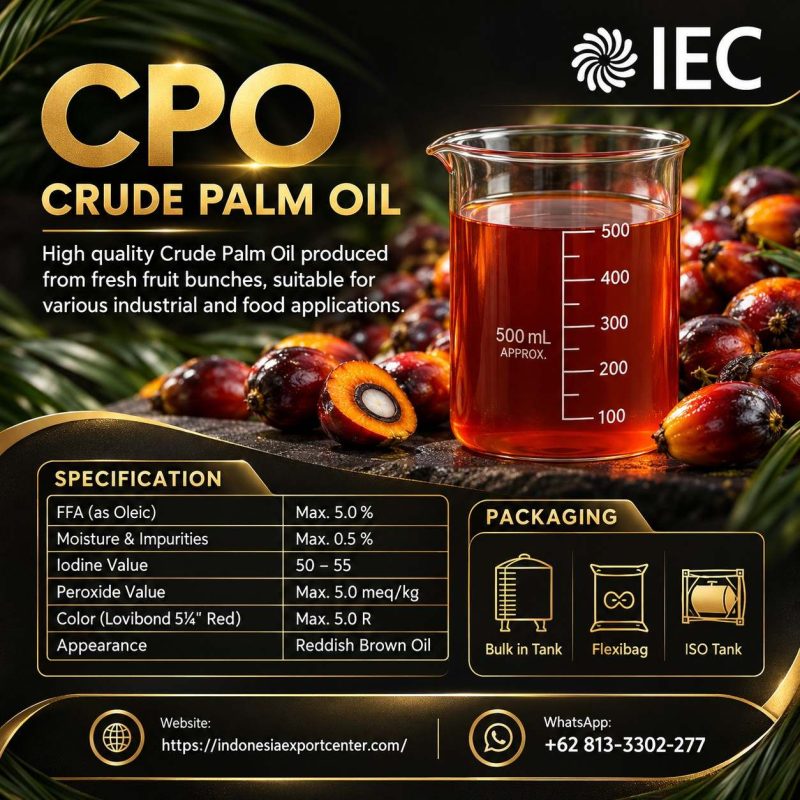
12. Reference CPO Technical Specifications
Regulatory compliance does not replace product quality verification.
The IEC reference specification includes:
| Parameter | Reference Target |
|---|---|
| FFA, as Oleic | Maximum 5.0% |
| Moisture & Impurities | Maximum 0.5% |
| Iodine Value | 50–55 |
| Peroxide Value | Maximum 5.0 meq/kg |
| Lovibond Color, 5¼-inch Red | Maximum 5.0 R |
| Appearance | Reddish Brown Oil |
These are brochure-derived reference targets, not verified results.
13. EUDR Procurement Checklist
| Compliance Question | Buyer Action |
|---|---|
| Is the product covered? | Verify relevant product classification |
| Who is the responsible operator? | Establish legal role |
| What effective date applies? | Check current official rules |
| Is the source identified? | Review traceability |
| Is geolocation evidence available? | Verify relevant records |
| Are production areas linked to the cargo? | Review chain of custody |
| Is legality evidence sufficient? | Obtain legal assessment |
| Has risk assessment been completed? | Follow applicable requirements |
| Are risk mitigation measures needed? | Determine and document |
| Are statements or submissions required? | Verify official procedures |
| Are records retained appropriately? | Establish documentation controls |
14. Supplier Questions for EUDR-Oriented Procurement
Before accepting an offer, buyers may ask:
- Can the supplier identify the upstream production sources?
- Are relevant mill records available?
- Is production-area geolocation information available?
- Can the supplier explain how cargo mixing is documented?
- What legality evidence is available?
- Are records linked to the proposed cargo?
- Can the information be independently verified?
- Are any certifications claimed?
- What is the scope of those certifications?
- Can the supplier support additional documentation requests?
15. Official Information Sources
For current information, buyers should consult:
European Commission – Deforestation Regulation
EUR-Lex – EU Legal Documents
The current regulation, amendments, official guidance, and applicable dates should be checked before publication or contractual reliance.
16. EUDR-Oriented CPO RFQ Template
Subject: Indonesian Crude Palm Oil Sourcing – EUDR Documentation Inquiry
Company: [Name]
Country: [EU Country]
Product: Crude Palm Oil
Quantity: [MT]
Destination Port: [Port]
Required Shipment Period: [Dates]
Required Traceability Level: [Details]
Geolocation Evidence: [Requirements]
Legality Documentation: [Requirements]
Supply Chain Records: [Requirements]
Certification Requirements: [If Applicable]
Quality Specifications: [Details]
Preferred Incoterm: [Term]
Please advise whether potential Indonesian suppliers can provide documentation relevant to the proposed EU importer’s due diligence requirements.
Frequently Asked Questions
Does EUDR concern palm oil?
Yes. Oil palm and specified relevant products fall within the framework.
Does every palm oil shipment have identical EUDR obligations?
No. Obligations depend on product scope, legal roles, applicable dates, and other relevant provisions.
Does Indonesian origin alone establish EUDR compliance?
No. Country of origin alone is insufficient.
Can RSPO certification replace EUDR due diligence?
No. Certification is not an automatic substitute for legal compliance.
Does IEC guarantee EUDR-compliant CPO?
No. IEC facilitates inquiries and does not guarantee regulatory compliance.
Can buyers request plantation geolocation evidence?
Yes, where relevant, but availability and sufficiency must be verified.
Should importers check the latest EUDR deadlines?
Yes. The applicable dates and transitional rules must be confirmed using official sources.
Who is responsible for legal compliance?
The relevant economic actors have obligations under the applicable legal framework; their roles should be assessed by qualified advisers.
Request Indonesian Palm Oil Traceability Information
Explore Indonesian CPO sourcing opportunities while communicating the origin, geolocation, and due diligence evidence required for your EU procurement process.
REQUEST EUDR-ORIENTED CPO SOURCING INFORMATION
IEC | INDONESIA EXPORT CENTER
Website: https://indonesiaexportcenter.com/
WhatsApp Inquiry: +62 821-4172-3508
Related Resources
CPO Traceability and Origin Documentation Indonesia
Sustainable Palm Oil Sourcing and RSPO Verification
CPO Export Rules and Regulatory Verification Indonesia
