

IEC | INDONESIA EXPORT CENTER
Your Global Sourcing Partner
Understanding Indonesian Crude Palm Oil Export Regulations
Crude palm oil is a commercially important commodity that may be subject to specific export regulations, licensing requirements, customs procedures, fiscal obligations, and government policy measures.
For international importers, understanding these requirements is essential before accepting a supplier offer or committing to a shipment schedule.
Export regulations can change, sometimes affecting eligibility, cost, documentation, and timing.
Indonesia Export Center (IEC) facilitates inquiries involving potential Indonesian CPO suppliers and export partners.
IEC does not guarantee that any proposed seller currently holds the approvals needed to export a particular cargo.
Important: This page provides a verification framework, not a statement that a particular Indonesian regulation, rate, quota, deadline, or approval is currently in force. The responsible exporter and qualified advisers must check the latest effective rules before contracting and shipment.
Why Regulatory Verification Is Essential
A buyer may receive a commercially attractive CPO offer but still encounter problems if the exporter cannot legally complete the transaction.
Potential issues include:
- Missing business authorization.
- Incorrect customs classification.
- Unfulfilled export conditions.
- Unpaid duties or levies.
- Incomplete declarations.
- Destination import restrictions.
- Insufficient origin documentation.
- Inconsistent shipping documents.
Regulatory verification should therefore begin before a purchase contract becomes binding.
1. Identify the Actual Exporter of Record
The first step is to determine which company will legally export the cargo.
The exporter of record may differ from:
- The manufacturer.
- The storage facility operator.
- The commodity broker.
- The sourcing intermediary.
- The commercial seller.
These roles must be clearly documented.
The responsible exporter should demonstrate its eligibility to perform the proposed export transaction.
2. Confirm Product Classification
The parties must determine the correct customs classification for the product.
Crude palm oil is generally associated with HS subheading 1511.10, but the full national tariff code and classification must be verified.
Classification may affect:
- Export requirements.
- Duties.
- Levies.
- Reporting obligations.
- Import tariffs.
- Statistical declarations.
3. Verify Export Licensing Requirements
The responsible exporter should confirm whether the transaction requires any particular license, registration, approval, or supporting authorization.
Relevant questions include:
- Is the exporting company eligible?
- Is a product-specific approval required?
- Does the approval cover the actual product?
- Is the authorization valid for the shipment date?
- Are additional conditions applicable?
Requirements must be checked against currently effective official regulations.
4. Review Applicable Export Duties
Export duties may affect the seller’s cost structure and the final quotation.
Buyers should establish:
- Whether a duty applies.
- Applicable product classification.
- Effective date.
- Calculation basis.
- Responsible paying party.
- Required payment documentation.
No current duty rate is asserted here.
5. Review Export Levies and Other Fiscal Measures
Export-related levies or charges may be distinct from customs duties.
Their applicability, amount, and calculation method must be verified independently.
A supplier quotation should clearly identify which charges are included.
6. Check Other Export Conditions
Depending on currently effective policies, additional export conditions or administrative requirements may apply.
Buyers should ask the actual exporter to identify all conditions relevant to the proposed cargo.
Do not assume that a regulation described in an older article remains applicable.
7. Confirm Customs Procedures
Export customs procedures may involve:
- Product classification.
- Export declaration.
- Supporting documents.
- Regulatory verification.
- Fiscal obligations.
- Customs review or inspection where applicable.
- Shipment release.
The responsible exporter and customs representative should confirm the required sequence.
8. Review Destination Country Regulations
Indonesian export compliance does not automatically establish import eligibility in another country.
Importers must separately verify:
- Customs classification.
- Import duties.
- Taxes.
- Product standards.
- Food or industrial requirements.
- Origin documentation.
- Sustainability rules.
- Applicable trade restrictions.
9. Evaluate Sustainability and Traceability Requirements
Some destination markets or customers may require additional supply chain evidence.
Examples include:
- Origin traceability.
- Supplier identification.
- Chain-of-custody records.
- Certification verification.
- Deforestation-related due diligence.
- Geolocation information where required.
For EU-related transactions, the applicable EUDR obligations, scope, effective dates, and transitional arrangements must be verified using current official guidance.
No claim is made that a particular IEC-sourced cargo meets those requirements.
10. Verify the Product Specification
Regulatory compliance and product quality are separate matters.
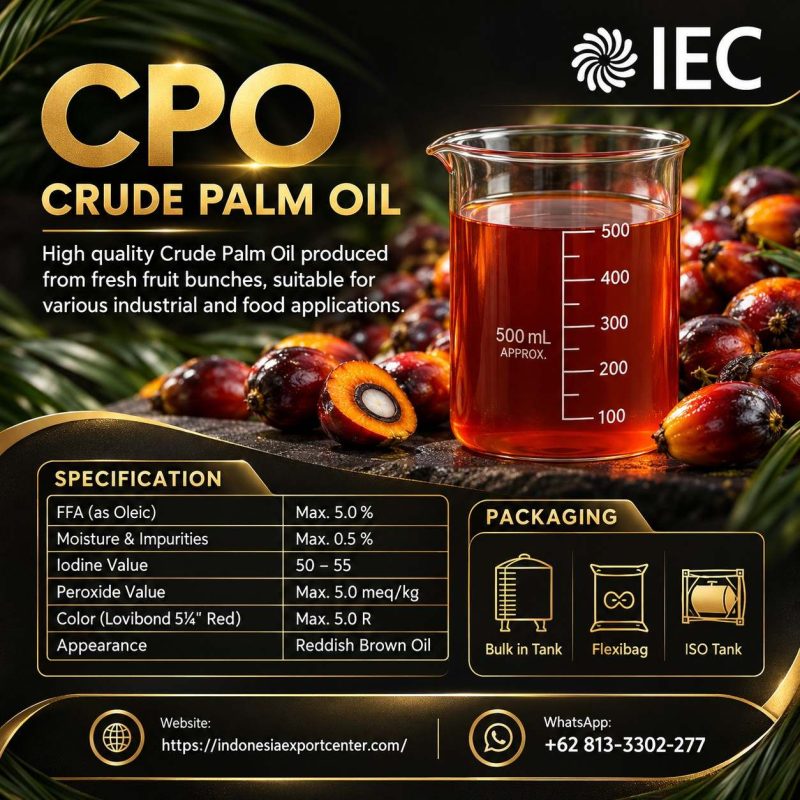
The IEC reference CPO specification is:
| Parameter | Reference Target |
|---|---|
| FFA, as Oleic | Max. 5.0% |
| Moisture & Impurities | Max. 0.5% |
| Iodine Value | 50–55 |
| Peroxide Value | Max. 5.0 meq/kg |
| Lovibond Color, 5¼-inch Red | Max. 5.0 R |
| Appearance | Reddish Brown Oil |
These targets require cargo-specific verification.
11. Check Official Regulatory Sources
For current Indonesian requirements, relevant official sources may include:
- Ministry of Trade of the Republic of Indonesia: https://www.kemendag.go.id/
- Directorate General of Customs and Excise: https://www.beacukai.go.id/
- Indonesian National Legal Documentation Network: https://jdihn.go.id/
Buyers should verify that any referenced regulation is currently effective and applies to the specific transaction.
12. Regulatory Verification Checklist
| Compliance Area | Verification Question |
|---|---|
| Exporter Identity | Who is the exporter of record? |
| Product Classification | What is the applicable national tariff code? |
| Licensing | What authorizations are required? |
| Export Duties | What current obligations apply? |
| Export Levies | Are separate levies applicable? |
| Customs | What declaration procedures are required? |
| Origin | What origin evidence is necessary? |
| Quality | What standards and tests apply? |
| Sustainability | What buyer or destination obligations apply? |
| Import Rules | Can the buyer legally import the cargo? |
| Shipment Timing | Are approvals valid for the planned date? |
13. Managing Regulatory Changes
A prudent contract may address the consequences of changes affecting:
- Export eligibility.
- Duties and levies.
- Shipping schedules.
- Import restrictions.
- Documentation.
- Additional compliance costs.
The allocation of these risks should be reviewed with qualified legal advisers.
14. Regulatory Inquiry Template
Subject: Indonesian CPO Export Compliance and Sourcing Inquiry
Company: [Name]
Country: [Country]
Product: Crude Palm Oil
Quantity: [MT]
Destination Country: [Country]
Destination Port: [Port]
Preferred Incoterm: [Term]
Shipment Period: [Dates]
Proposed Exporter: [If Known]
Required Origin Documentation: [Details]
Sustainability Requirements: [Details]
Other Compliance Requirements: [Details]
Please advise on potential suppliers and request confirmation from the responsible exporter regarding current export eligibility, applicable permits, customs procedures, and fiscal obligations.
Frequently Asked Questions
Can every Indonesian trading company export CPO?
Not necessarily. Eligibility depends on applicable laws and company-specific circumstances.
Does IEC guarantee export licensing?
No. The responsible exporter must confirm its authorization.
Are Indonesian CPO export duties fixed?
No. Applicable measures and rates may change.
Is HS 1511.10 the complete customs code everywhere?
No. Countries may use additional national tariff digits.
Does a previous export prove present eligibility?
No. Current rules and company status must be checked.
Do buyers need to verify destination-country rules?
Yes. Export and import compliance are separate obligations.
Can an export quotation become invalid after a regulatory change?
The commercial effect depends on the contract and applicable law.
Request Indonesian CPO Export Compliance Information
Explore CPO sourcing opportunities with a clear understanding of exporter identity, current regulatory obligations, and destination import requirements.
REQUEST CPO EXPORT SOURCING INFORMATION
IEC | INDONESIA EXPORT CENTER
Website: https://indonesiaexportcenter.com/
WhatsApp Inquiry: +62 821-4172-3508
Related Resources
CPO Export Documentation Checklist Indonesia
Crude Palm Oil HS Code Classification Guide
Crude Palm Oil Export Sourcing from Indonesia
