

IEC | INDONESIA EXPORT CENTER
Your Global Sourcing Partner
Understanding the HS Code for Crude Palm Oil
Correct customs classification is an important part of international crude palm oil procurement.
Importers and exporters use Harmonized System (HS) codes to identify traded goods for customs, tariff, regulatory, and statistical purposes.
For crude palm oil, the commonly relevant international six-digit classification is HS 1511.10.
However, the correct national tariff code must be confirmed according to the product’s actual characteristics and the customs schedule applicable in the exporting and importing countries.
Indonesia Export Center (IEC) facilitates CPO sourcing inquiries. IEC does not issue binding customs classification decisions.
What Is an HS Code?
The Harmonized Commodity Description and Coding System is an international framework for classifying traded goods.
It provides a standardized structure at the six-digit level.
Individual countries may add further digits to create national tariff codes.
These additional digits can affect customs declarations, duties, regulatory conditions, and trade statistics.
HS Code 1511: Palm Oil and Its Fractions
HS heading 1511 covers palm oil and its fractions, whether or not refined, but not chemically modified.
The main international subheadings include:
| HS Code | General Description |
|---|---|
| 1511.10 | Crude palm oil |
| 1511.90 | Other palm oil and its fractions |
The correct classification depends on the actual product and applicable customs rules.
What Is Crude Palm Oil?
Crude Palm Oil (CPO) is an unrefined oil derived from the fleshy portion of oil palm fruit.
It is commonly used as feedstock for refining and industrial processing.
CPO should be distinguished from other palm-derived products.
CPO Versus Other Palm Oil Products
| Product | General Distinction |
|---|---|
| Crude Palm Oil | Unrefined palm oil from fruit flesh |
| Refined Palm Oil | Palm oil that has undergone refining |
| Palm Olein | Liquid fraction obtained through fractionation |
| Palm Stearin | Higher-melting fraction obtained through fractionation |
| Palm Kernel Oil | Oil obtained from the kernel rather than the fruit flesh |
Different products may fall under different tariff classifications.
Do not use the CPO code automatically for palm kernel oil or other palm derivatives.
Why Correct Classification Matters
Classification can affect:
- Import duties.
- Export duties or levies.
- Import and export restrictions.
- Licensing.
- Customs declarations.
- Trade statistics.
- Origin-related treatment.
- Documentation requirements.
- Customs risk assessment.
Understanding National Tariff Codes
Although the HS system is harmonized internationally at six digits, national tariff schedules can provide additional distinctions.
For example, a buyer should confirm the full code used in the destination country’s current tariff database.
An Indonesian classification should not automatically be copied into another country’s import declaration without verification.
How to Verify the Correct CPO HS Code
Step 1 – Identify the Product
Determine whether the cargo is crude, refined, fractionated, or another palm-derived product.
Step 2 – Review Product Documentation
Examine the product description, specification, and available technical information.
Step 3 – Consult the Current Tariff Schedule
Review the relevant country’s official customs classification.
Step 4 – Check Explanatory Notes and Legal Rules
Classification should follow the applicable legal framework, not just a commercial product name.
Step 5 – Consult a Customs Specialist
For uncertain cases, seek advice from a qualified broker or an official classification determination where available.
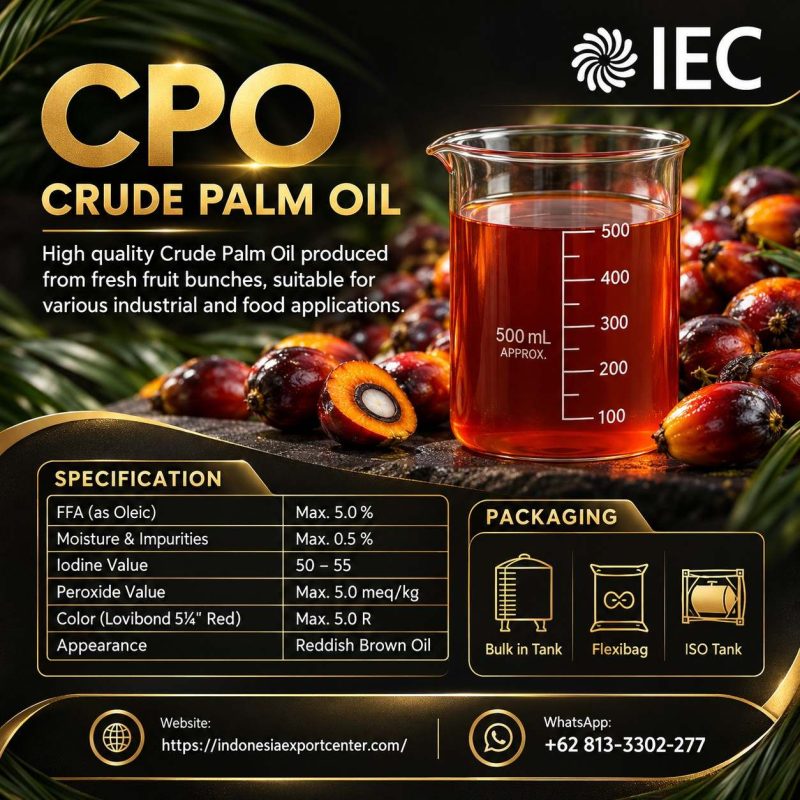
CPO Reference Product Specifications
The IEC marketing material provides:
| Parameter | Reference Target |
|---|---|
| FFA, as Oleic | Maximum 5.0% |
| Moisture & Impurities | Maximum 0.5% |
| Iodine Value | 50–55 |
| Peroxide Value | Maximum 5.0 meq/kg |
| Lovibond Color, 5¼-inch Red | Maximum 5.0 R |
| Appearance | Reddish Brown Oil |
These specifications are useful for commercial product description but do not independently establish a legally binding tariff classification.
HS Code and Export Compliance
Before shipping from Indonesia, the responsible exporter should verify:
- Correct national tariff code.
- Current export eligibility.
- Applicable licenses or approvals.
- Duties and levies.
- Customs declarations.
- Required supporting documents.
HS Code and Import Compliance
Overseas buyers should verify:
- Destination tariff classification.
- Import duty rate.
- Applicable taxes.
- Product restrictions.
- Origin documentation.
- Preferential tariff eligibility where relevant.
- Customs valuation requirements.
Common HS Classification Mistakes
Confusing Palm Oil with Palm Kernel Oil
These products are derived from different parts of the oil palm fruit and should not be treated as identical.
Confusing Crude and Refined Products
Processing status can affect classification.
Using Only the Six-Digit Code
The importing country may require additional national digits.
Relying on an Outdated Tariff Schedule
Tariff rules and rates can change.
Treating Supplier Marketing as Legal Classification
A commercial description is not a customs ruling.
HS Code Verification Checklist
| Question | Buyer Action |
|---|---|
| Is the product crude palm oil? | Verify product identity |
| Is the international subheading 1511.10 relevant? | Review classification rules |
| What national tariff code applies? | Check official customs schedule |
| Are duties or levies applicable? | Verify current rates |
| Are import permits required? | Consult destination authority |
| Are origin documents required? | Confirm with customs broker |
| Are special regulatory conditions applicable? | Review current requirements |
HS Classification Inquiry Template
Subject: Indonesian Crude Palm Oil HS Code and Sourcing Inquiry
Company: [Name]
Country: [Country]
Product: Crude Palm Oil
Proposed HS Subheading: 1511.10
Required National Tariff Code: [To Be Verified]
Product Description: [Details]
Quantity: [MT]
Destination Country: [Country]
Destination Port: [Port]
Required Documentation: [Details]
Shipment Period: [Dates]
Please advise on potential Indonesian suppliers and available product information for customs classification review.
Frequently Asked Questions
What is the HS code for crude palm oil?
HS 1511.10 is the commonly relevant international six-digit subheading.
Is HS 1511.10 sufficient for customs clearance?
Not necessarily. National tariff codes may contain additional digits.
Is crude palm oil classified the same as palm kernel oil?
No. They are different products.
Does the HS code determine the import duty?
It is an important input, but the applicable rate also depends on the destination, origin, and other rules.
Can IEC issue an official tariff classification?
No. Classification should be confirmed with the appropriate customs authority or qualified adviser.
Can the classification change if the product is refined?
Processing status can affect the applicable classification.
Request Indonesian CPO Product and Classification Information
Explore potential Indonesian CPO suppliers while preparing accurate customs descriptions and verifying the appropriate tariff classification.
REQUEST CPO SOURCING INFORMATION
IEC | INDONESIA EXPORT CENTER
Website: https://indonesiaexportcenter.com/
WhatsApp Inquiry: +62 821-4172-3508
Related Resources
CPO Export Rules and Regulatory Verification Indonesia
CPO Export Documentation Checklist Indonesia
CPO Import Documentation for Overseas Buyers
