

IEC | INDONESIA EXPORT CENTER
Your Global Sourcing Partner
Understanding Indonesian Crude Palm Oil Traceability
Traceability is increasingly important in international palm oil procurement.
Buyers may need to understand where crude palm oil originates, which entities handled the product, and what documentation supports its movement through the supply chain.
For some transactions, general country-of-origin information may be sufficient for a particular commercial purpose. Other buyers may require mill-level, plantation-level, or geolocation-based evidence to meet internal policies or applicable legal requirements.
Indonesia Export Center (IEC) facilitates inquiries involving potential Indonesian CPO suppliers.
IEC does not guarantee that every proposed supplier can provide complete origin traceability, plantation records, or certified chain-of-custody documentation.
What Is CPO Traceability?
Traceability refers to the ability to follow a product or its relevant components through defined stages of production, processing, storage, and distribution.
For crude palm oil, the upstream supply chain may involve:
Oil Palm Production → Fresh Fruit Bunch Collection → Palm Oil Mill → CPO Storage → Trading or Aggregation → Export Terminal → Overseas Buyer
The actual chain can be more complex.
Traceability to Mill
Traceability to mill generally involves identifying the palm oil mill or mills associated with the supplied material.
Potential information includes:
- Mill name.
- Location.
- Operator.
- Relevant identifiers.
- Supplier relationship.
- Production or transaction records.
Mill-level traceability does not automatically establish plantation-level traceability.
Traceability to Plantation
Plantation-level traceability involves more detailed upstream information.
Depending on the supply chain and legal requirements, relevant evidence may include:
- Production unit identity.
- Plantation location.
- Land-use information.
- Geolocation data.
- Supplier relationships.
- Production and delivery records.
The appropriate level of detail must be determined by the buyer’s compliance obligations.
1. Identify the Contracting Supplier
The buyer should establish the legal identity of the company offering the CPO.
Relevant documents may include business registration, contract records, and authorized representative information.
2. Identify the Exporter of Record
The exporter may differ from the producer or seller.
Buyers should confirm which entity is responsible for export clearance and related documents.
3. Identify the Cargo Source
Ask the supplier what evidence links the proposed cargo to its claimed source.
Potential records may include:
- Mill information.
- Storage records.
- Supplier declarations.
- Transfer records.
- Cargo identification.
- Quantity reconciliation.
- Chain-of-custody documents.
The buyer should evaluate the authenticity and completeness of the evidence.
4. Review Product Aggregation
CPO may be aggregated from multiple sources.
Aggregation can make origin attribution more complex.
Buyers should ask whether:
- Multiple mills contributed material.
- Cargoes were mixed.
- Source quantities are recorded.
- Physical segregation is maintained.
- The documentation supports the proposed origin claim.
5. Understand Country of Origin
A country-of-origin document may support customs origin requirements.
However, customs origin and plantation-level traceability are different concepts.
A document stating Indonesian origin does not necessarily identify the specific plantations from which the oil palm fruit was harvested.
6. Verify Chain-of-Custody Evidence
Chain-of-custody documentation may help demonstrate how material was handled between entities.
Relevant questions include:
- Who transferred the product?
- When did the transfer occur?
- What quantity was transferred?
- Was the material segregated or mixed?
- What records support the transaction?
- Are the entities identifiable?
7. Understand Certification and Traceability
Certification may provide a structured framework for defined sustainability claims.
However, the existence of a certificate does not automatically prove every origin attribute a buyer may require.
The certification model and scope should be reviewed separately.
8. Traceability and Regulatory Compliance
Some markets require specific due diligence concerning deforestation, origin, and legality.
For EU-bound products, buyers should verify applicable EUDR obligations and the evidence required under currently effective law.
A general supplier declaration may not be sufficient for every regulatory purpose.
9. Protect Data Integrity
Traceability records should be:
- Relevant.
- Consistent.
- Current.
- Linked to the cargo.
- Verifiable where possible.
- Retained appropriately.
- Protected from unauthorized alteration.
The buyer should establish how discrepancies will be investigated.
10. Traceability Documentation Matrix
| Supply Chain Stage | Potential Evidence |
|---|---|
| Plantation | Location and production records |
| Collection | Delivery and supplier records |
| Mill | Mill identity and processing records |
| Storage | Tank and inventory records |
| Trading | Transaction and transfer documents |
| Export | Exporter and customs records |
| Shipping | Bill of lading and cargo records |
| Import | Customs and receiving documentation |
The availability of each document must be confirmed.
11. Technical Quality and Traceability
Origin documentation does not establish product quality.
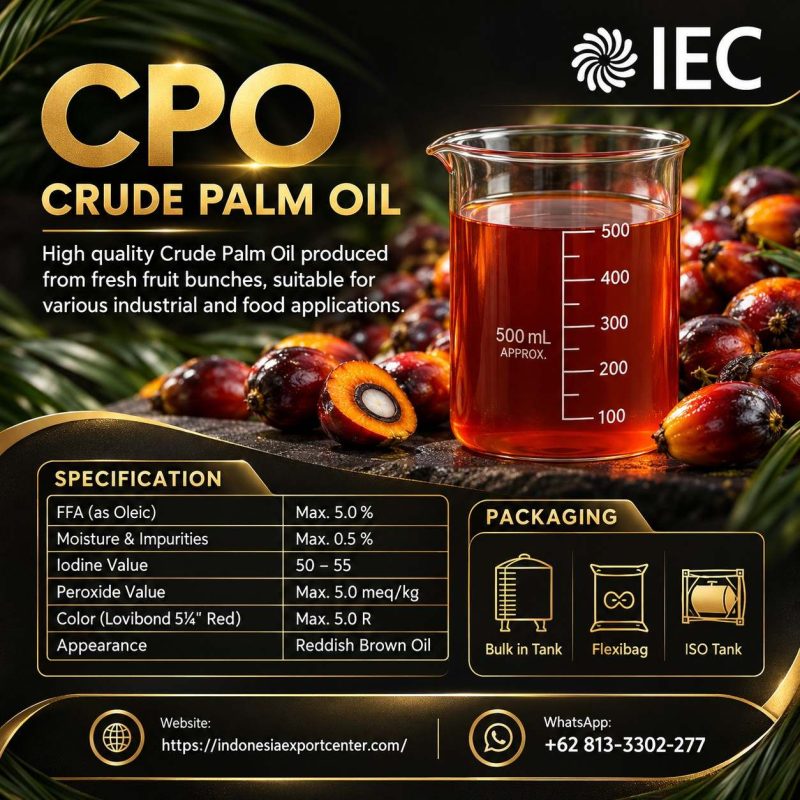
The IEC reference CPO specification includes:
| Parameter | Reference Target |
|---|---|
| FFA, as Oleic | Max. 5.0% |
| Moisture & Impurities | Max. 0.5% |
| Iodine Value | 50–55 |
| Peroxide Value | Max. 5.0 meq/kg |
| Lovibond Color, 5¼-inch Red | Max. 5.0 R |
| Appearance | Reddish Brown Oil |
These targets require cargo-specific verification.
12. Traceability Due Diligence Checklist
| Question | Buyer Review |
|---|---|
| Is the seller identified? | [Yes / Pending] |
| Is the exporter identified? | [Yes / Pending] |
| Is the mill source documented? | [Yes / Pending] |
| Are plantation records required? | [Yes / No] |
| Are relevant geolocation records available? | [Yes / Pending] |
| Has aggregation been disclosed? | [Yes / Pending] |
| Are quantity records consistent? | [Yes / Pending] |
| Are certifications verified? | [Yes / Pending] |
| Are legal requirements addressed? | [Yes / Pending] |
| Are documents linked to the cargo? | [Yes / Pending] |
Common Traceability Mistakes
- Assuming Indonesian origin means full plantation traceability.
- Treating a COA as an origin document.
- Confusing certification with complete physical traceability.
- Ignoring cargo mixing.
- Accepting unverified geolocation data.
- Failing to reconcile quantities.
- Using documents unrelated to the actual shipment.
- Publishing unsupported sustainability statements.
Traceable CPO RFQ Template
Subject: Indonesian CPO Traceability and Origin Documentation Inquiry
Company: [Name]
Country: [Country]
Product: Crude Palm Oil
Quantity: [MT]
Required Traceability Level: [Country / Mill / Plantation]
Required Origin Documents: [Details]
Geolocation Requirements: [If Applicable]
Certification Requirements: [If Applicable]
Quality Specifications: [Details]
Destination Port: [Port]
Preferred Incoterm: [Term]
Shipment Period: [Dates]
Please advise whether potential suppliers can provide the requested origin and supply chain documentation for the actual proposed cargo.
Frequently Asked Questions
Is Indonesian country of origin the same as plantation traceability?
No. They provide different levels of information.
Can CPO be sourced from multiple mills?
Yes, depending on the supply arrangement.
Does aggregation affect traceability?
It may increase the complexity of linking the cargo to upstream sources.
Is a COA proof of origin?
No. A COA primarily reports analytical findings.
Can IEC guarantee full traceability?
No. Actual documentation must be verified with the supplier.
Can buyers request geolocation information?
Yes, where appropriate and legally required, subject to actual record availability.
Does RSPO certification automatically prove EUDR compliance?
No. The applicable legal requirements must be assessed separately.
Request Indonesian CPO Origin Documentation
Communicate your traceability requirements before purchasing crude palm oil from Indonesia.
REQUEST CPO TRACEABILITY INFORMATION
IEC | INDONESIA EXPORT CENTER
Website: https://indonesiaexportcenter.com/
WhatsApp Inquiry: +62 821-4172-3508
Related Resources
Sustainable Palm Oil Sourcing and RSPO Verification
EUDR Considerations for Indonesian Palm Oil Buyers
CPO Export Documentation Checklist Indonesia
