

IEC | INDONESIA EXPORT CENTER
Your Global Sourcing Partner
CPO QUALITY DOCUMENTATION AND LABORATORY VERIFICATION
Certificate of Analysis | Sampling | Independent Inspection | Cargo Approval
Why a CPO Certificate of Analysis Matters
A Certificate of Analysis (COA) is a key document in crude palm oil procurement because it records analytical results for a defined sample or product lot.
For international buyers, a COA can help assess whether a proposed CPO cargo meets the agreed technical specification.
However, a COA is only useful when its origin, authenticity, analytical methods, and relationship to the actual cargo are understood.
Indonesia Export Center (IEC) facilitates sourcing inquiries and can help buyers request quality documentation from potential Indonesian suppliers.
IEC does not claim to operate a laboratory or independently certify CPO quality.
What Is a CPO Certificate of Analysis?
A COA is a document reporting test results for specified quality parameters.
Depending on the testing arrangement, it may be issued by a supplier laboratory, independent laboratory, or another authorized testing organization.
The buyer should establish whether the document relates to a production batch, storage tank, pre-loading sample, or shipped cargo.
Information a CPO COA Should Include
A well-documented COA may identify:
- Product name.
- Supplier or submitting organization.
- Laboratory.
- Report number.
- Lot or tank number.
- Sample identification.
- Sampling date.
- Date of receipt.
- Testing date.
- Analytical parameters.
- Test methods.
- Results.
- Units.
- Authorized signatory or report validation.
- Relevant qualifications or limitations.
Reference CPO Quality Parameters
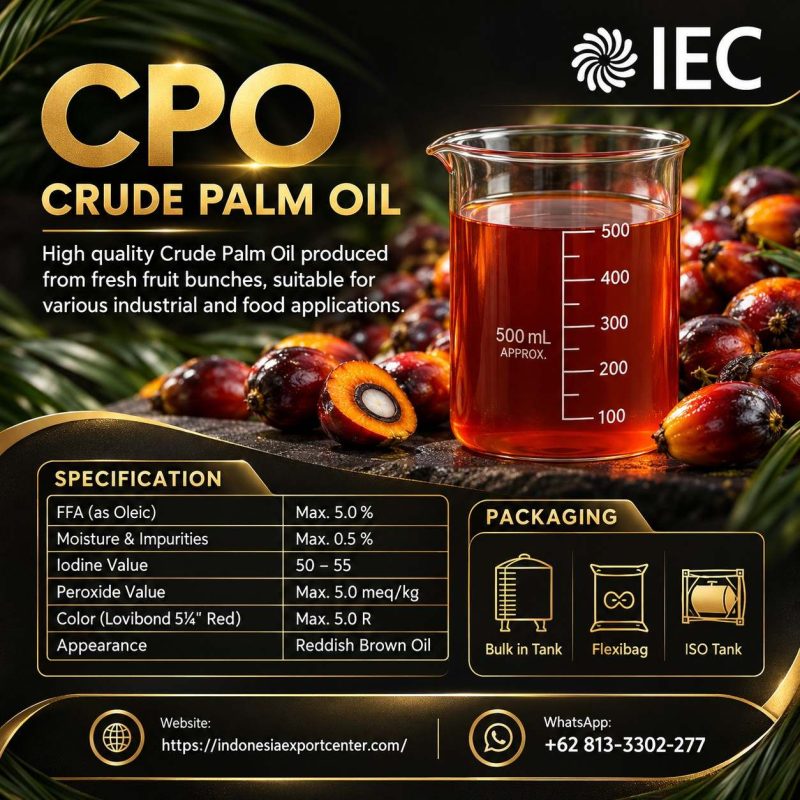
| Parameter | IEC Marketing Reference | Evidence to Request |
|---|---|---|
| FFA as Oleic | Max. 5.0% | Actual result, basis, method |
| Moisture & Impurities | Max. 0.5% | Actual result and reporting method |
| Iodine Value | 50–55 | Actual result and method |
| Peroxide Value | Max. 5.0 meq/kg | Actual result and method |
| Lovibond Color, 5¼-inch Red | Max. 5.0 R | Actual result and cell specification |
| Appearance | Reddish Brown Oil | Inspection record where relevant |
These are reference targets. They are not laboratory findings.
Supplier COA Versus Independent Laboratory COA
Supplier Laboratory COA
A supplier laboratory report may provide useful preliminary information.
Buyers should verify the laboratory’s procedures and the report’s relationship to the offered cargo.
Independent Laboratory COA
Independent testing may provide additional assurance where the buyer and seller agree on the sampling and testing arrangements.
Independence alone does not resolve issues of sample representativeness.
Sampling for Bulk CPO
Bulk liquid cargo sampling requires appropriate procedures.
Potential sampling points include:
- Shore storage tanks.
- Transfer lines.
- Loading operations.
- Vessel tanks.
- Discharge operations.
The parties should establish the sampling method, responsibility, timing, and sample identification before shipment.
Chain of Custody
A documented chain of custody helps demonstrate how a sample was collected, labeled, transferred, stored, and tested.
Buyers may request:
- Sample identification records.
- Sampling location.
- Date and time.
- Responsible personnel.
- Container details.
- Seal numbers.
- Transfer records.
- Laboratory receipt information.
Testing Methods and Reporting Units
A result cannot be interpreted correctly without its analytical context.
For example, FFA must specify whether the result is expressed as oleic acid, palmitic acid, or another basis.
Similarly, iodine value, peroxide value, moisture, and color should use agreed methods and units.
COA Authenticity Verification
Buyers may verify a report by:
- Checking the laboratory identity.
- Confirming the report number.
- Reviewing signatures or digital verification.
- Confirming the sample code.
- Comparing the report date with the transaction.
- Contacting the issuing organization through independently verified channels.
- Checking the laboratory’s stated testing scope.
- Confirming that the report applies to the offered cargo.
Pre-Shipment Inspection
Where agreed, independent inspection may cover:
- Cargo identification.
- Tank condition.
- Sampling.
- Quality testing.
- Quantity measurement.
- Loading supervision.
- Documentation.
- Retained samples.
The scope should be clearly described in the inspection contract.
Loading Versus Discharge Quality
CPO quality may be assessed at different points.
The buyer and seller should agree on:
- Which location determines contractual acceptance.
- Which sampling procedure is used.
- Which laboratory’s results are binding.
- How differences are resolved.
- What happens if the cargo fails specifications.
Laboratory Approval Workflow
Step 1: Buyer submits technical specifications.
Step 2: Supplier provides preliminary product information.
Step 3: Parties agree on sampling and test methods.
Step 4: Representative samples are obtained.
Step 5: Laboratory testing is performed.
Step 6: Buyer reviews the COA.
Step 7: The parties address any deviations.
Step 8: Shipment proceeds according to the contract.
COA and Laboratory Testing RFQ
Subject: CPO Certificate of Analysis and Laboratory Testing Inquiry
Company: [Name]
Country: [Country]
Product: Crude Palm Oil
Required Quantity: [MT]
Required Quality Parameters: [Details]
FFA Basis: [Oleic / Other]
Required Test Methods: [Details]
COA Type: [Supplier / Independent]
Sampling Point: [Loading / Storage / Other]
Independent Inspection: [Required / Not Required]
Retained Samples: [Requirement]
Destination Port: [Port]
Shipment Period: [Dates]
Please advise on potential suppliers, available COA documentation, testing arrangements, and commercial quotation.
Frequently Asked Questions
Is a COA required for every CPO transaction?
Requirements depend on the contract, destination, and applicable regulations. Professional buyers commonly request analytical evidence.
Does IEC issue CPO laboratory certificates?
No laboratory issuing capability is established here. IEC can facilitate documentation inquiries.
Can buyers request independent testing?
Yes, subject to agreement and laboratory availability.
Can an old COA be used for a new cargo?
It should not be treated as proof of the new cargo’s quality without appropriate verification.
Does a COA prove cargo ownership?
No. Ownership and selling authority require separate evidence.
Does a COA guarantee the entire shipment?
A COA describes the tested sample within the stated scope. Sampling and cargo representativeness remain important.
Can buyers specify their own testing methods?
Yes, subject to agreement and technical feasibility.
Request CPO COA and Quality Verification Information
Protect your procurement process through traceable samples, clearly defined test methods, and supplier-confirmed quality documentation.
REQUEST CPO COA AND LABORATORY INFORMATION
IEC | INDONESIA EXPORT CENTER
Website: https://indonesiaexportcenter.com/
WhatsApp Inquiry: +62 821-4172-3508
Related Resources
CPO Technical Specifications and Quality Parameters
Crude Palm Oil FFA 5 Percent Specification
Crude Palm Oil (CPO) Supplier Indonesia
