

INDONESIA EXPORT CENTER | IEC
COCOPOT – COCONUT FIBER PLANT POT
A Practical Nursery Pot Comparison for Horticultural Buyers and Sustainability Procurement Teams
Material Selection | Nursery Performance | Reuse | Waste Management | Lifecycle Considerations | Wholesale Sourcing
Coir Pots vs Plastic Pots: Which Is Better for Your Nursery?
Choosing between coir pots vs plastic pots involves more than selecting a natural or synthetic material.
Commercial nurseries, garden centers, horticultural distributors and sustainability procurement teams must evaluate how each pot performs throughout its intended use.
Important considerations include growing conditions, irrigation, handling, product durability, reuse, disposal infrastructure, total cost and environmental impacts.
Plastic nursery pots are widely used in horticulture because many designs offer durability, predictable dimensions and opportunities for repeated use.
Coconut coir pots offer an alternative material approach, using coconut-derived fibers in the pot structure.
However, natural raw materials do not automatically make a finished product biodegradable, compostable, plastic-free or environmentally superior.
Indonesia Export Center (IEC) facilitates sourcing and export enquiries for coconut fiber plant pots from Indonesia.
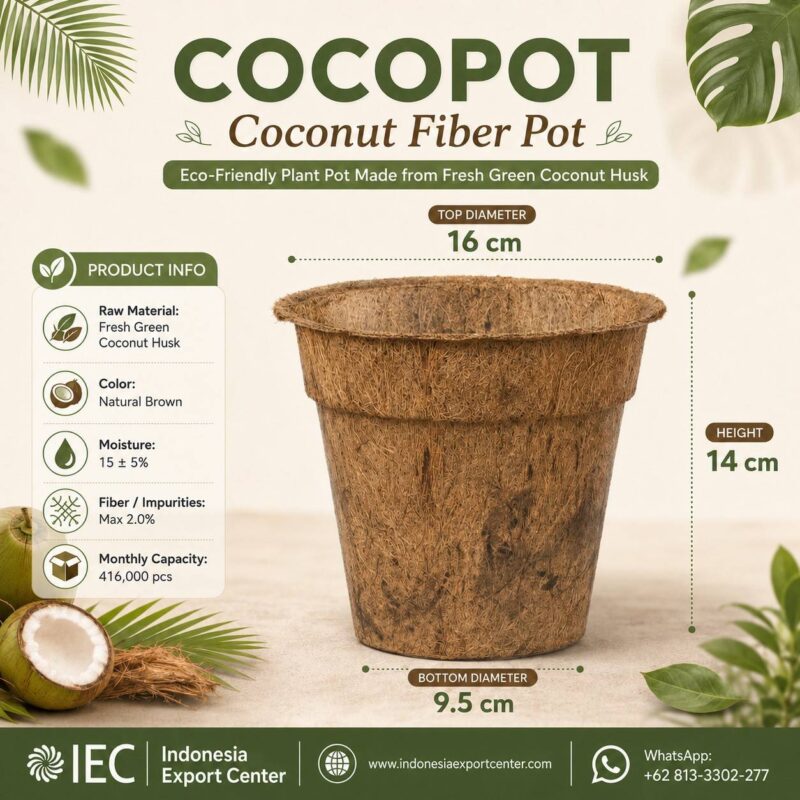
The supplied COCOPOT reference is made using fresh green coconut husk and has the following dimensions:
- Top Diameter: 16 cm
- Height: 14 cm
- Bottom Diameter: 9.5 cm
This guide explains the practical tradeoffs between coconut fiber pots and conventional plastic nursery pots so buyers can select a product based on their actual requirements.
EXPLORE COCOPOT SPECIFICATIONS AND REQUEST SOURCING INFORMATION
WhatsApp: https://wa.me/628133302277
Website: https://indonesiaexportcenter.com/
Product suitability and environmental performance depend on the finished-product formulation, manufacturing process, nursery conditions and end-of-life pathway.
1. Coir Pots vs Plastic Nursery Pots: Quick Comparison
| Comparison Factor | Coconut Coir Pots | Plastic Nursery Pots |
|---|---|---|
| Main Material | Coconut-derived fiber, with finished composition dependent on formulation | Commonly polypropylene, polyethylene or other polymers |
| Material Origin | Plant-derived raw material | Usually fossil-derived, although recycled or bio-based variants exist |
| Typical Appearance | Natural fiber texture | Smooth or textured manufactured surface |
| Structural Durability | Depends on formulation, moisture and handling | Often designed for durable handling and repeated use |
| Reusability | Must be evaluated for the specific product | Many rigid designs can be reused |
| Water Interaction | Depends on fiber structure, binder and product design | Generally less water-absorbent as a material |
| Dimensional Consistency | Depends on manufacturing tolerances | Often tightly controlled in moulded products |
| Automated Handling | Requires compatibility testing | Many established formats are designed for automation |
| Planting with Pot | Must be validated for the finished product | Conventional plastic pots are normally removed before planting |
| Biodegradability | Not established without product-specific evidence | Conventional PP/PE pots are not generally biodegradable |
| Compostability | Requires product-specific testing and applicable acceptance criteria | Conventional PP/PE pots are not generally compostable |
| Recycling | Depends on finished composition and available recovery pathways | Depends on resin type, contamination and local collection systems |
| Reuse Potential | Requires application-specific testing | Often suitable for multiple cycles if cleaned and maintained |
| End-of-Life | Depends on composition and actual disposal route | Reuse, recycling where available, or disposal |
| Environmental Performance | Requires lifecycle evidence | Requires lifecycle evidence |
| Wholesale Price | Request Supplier Quotation | Depends on supplier, design, resin and order quantity |
Key point: Neither material is automatically the best option for every nursery or sustainability objective.
2. What Are Coconut Coir Pots?
Coconut coir pots are plant containers made using coconut-derived fibers.
They may be produced using different manufacturing methods and formulations.
Depending on the product, finished coir pots may contain binders or other additives.
Therefore, buyers should request a complete finished-product material declaration rather than assume the pot contains only coconut fiber.
3. What Are Plastic Nursery Pots?
Plastic nursery pots are containers manufactured using polymer materials.
Common materials include:
- Polypropylene (PP)
- Polyethylene (PE)
- Other polymer formulations
Plastic nursery pots may be designed for:
- Seed propagation
- Nursery production
- Growing-on
- Plant transport
- Retail presentation
- Repeated nursery use
Performance depends on resin, wall thickness, design and manufacturing quality.
4. Raw Material Comparison
Coconut Coir Pots
Coconut fiber is obtained from coconut husk.
It provides a plant-derived material input.
However, the overall environmental profile also depends on processing, binders, energy use and transport.
Plastic Nursery Pots
Conventional plastic pots are generally produced using polymer resins.
Some products incorporate recycled content, while others use virgin materials.
Material sourcing and manufacturing processes influence their environmental profile.
5. Natural Material Does Not Automatically Mean Sustainable
A natural raw material may support certain procurement objectives.
However, a complete sustainability assessment should consider:
- Material sourcing
- Manufacturing energy
- Chemical inputs
- Product lifespan
- Transport
- Reuse
- Waste management
- End-of-life conditions
A natural-material product can have disadvantages in some categories and advantages in others.
6. Durability and Structural Strength
Durability is a significant purchasing consideration.
Coir Pots
Strength may depend on:
- Fiber structure
- Binder formulation
- Wall thickness
- Moisture exposure
- Manufacturing quality
Plastic Pots
Many rigid plastic nursery pots are designed for repeated handling and transport.
However, durability varies with design, resin, UV exposure and handling conditions.
Buyers should evaluate the actual products under equivalent conditions.
7. Reusability
Reusability can substantially affect cost and environmental performance.
Plastic pots may support repeated nursery cycles when they remain serviceable and appropriate cleaning procedures are available.
Coir pots may be intended for different handling and growing arrangements, but their ability to withstand repeated use must be tested.
A single-use coir pot should not automatically be compared with a reusable plastic pot as though both deliver the same number of service cycles.
8. Irrigation Compatibility
Irrigation can influence pot performance.
Potential systems include:
- Overhead irrigation
- Drip irrigation
- Misting
- Hand watering
- Subirrigation
Coir pot performance may change with moisture exposure depending on formulation and design.
Plastic pots generally do not absorb water through the polymer material in the same way, although drainage and growing media remain important.
9. Moisture Management
Water behaviour should be evaluated at the complete nursery system level.
Relevant factors include:
- Pot material
- Pot wall structure
- Growing medium
- Drainage
- Irrigation frequency
- Air movement
- Crop requirements
Neither coir nor plastic pots should be assumed to improve moisture management without application-specific evidence.
10. Root Development
Root growth depends on many factors.
These include:
- Plant species
- Container geometry
- Growing medium
- Irrigation
- Nutrition
- Temperature
- Root-zone aeration
- Production duration
Claims that coconut coir pots automatically produce better root growth require controlled comparative testing.
11. Root-Zone Aeration
Some coir pot designs may have different wall permeability characteristics than conventional plastic pots.
However, permeability depends on the actual finished-product structure.
Buyers should evaluate whether these differences produce measurable benefits for the intended crop.
12. Transplanting
Transplanting procedures may differ between products.
Plastic Pots
Conventional plastic nursery pots are generally removed before transplanting.
Coir Pots
Some products may be marketed for planting with the pot.
However, whether the finished COCOPOT can be planted directly into soil without adverse effects has not been established.
Buyers should test transplanting suitability and request appropriate supporting evidence.
13. Planting with the Pot
Before adopting a plant-with-pot procedure, buyers should assess:
- Finished-product composition
- Binder behaviour
- Root penetration
- Pot wall breakdown
- Soil conditions
- Crop establishment
- Relevant environmental requirements
Do not assume a coconut-derived pot will break down at a suitable rate in every soil or climate.
14. Nursery Automation Compatibility
Commercial nurseries may use automated:
- Pot dispensers
- Filling machines
- Conveyors
- Transplanters
- Handling systems
Plastic pots often have established compatibility with specific equipment formats.
Coir pots require verification of:
- Dimensional consistency
- Stacking
- Separation
- Feeding
- Handling strength
- Equipment compatibility
15. Dimensional Consistency
Consistent dimensions may be important for automation and packaging.
The supplied COCOPOT reference has nominal dimensions, but no dimensional tolerances have been provided.
Buyers should request tolerances and evaluate samples against the intended equipment.
16. Handling and Transport
Transport performance depends on:
- Product strength
- Packing configuration
- Stacking
- Humidity
- Cargo handling
- Shipping duration
Plastic pots may offer handling advantages in certain repeated-use systems.
Coir pots should be evaluated for the intended logistics process.
17. Storage Conditions
Storage requirements may differ.
Buyers should assess:
- Humidity exposure
- Temperature
- Sunlight
- Stacking pressure
- Storage duration
- Packaging protection
No verified COCOPOT shelf-life or storage-life figure has been supplied.
18. Retail Presentation
Retail presentation can influence purchasing decisions.
Coconut fiber pots offer a natural-material appearance.
Plastic pots are available in a wide range of colours, finishes and designs.
The preferred option depends on the retailer’s positioning and customer expectations.
19. Product Branding and Sustainability Messaging
Brands may wish to highlight coconut-derived raw materials.
However, claims should distinguish between:
- Natural material content
- Renewable material sourcing
- Recycled content
- Biodegradability
- Compostability
- Plastic-free composition
- Carbon footprint
- Overall environmental impact
These are different claims and require different supporting evidence.
20. Biodegradability Comparison
Biodegradability refers to biological breakdown under specified conditions.
A product’s biodegradability depends on its complete formulation and the environment in which it is tested.
The supplied COCOPOT information does not establish certified biodegradability.
Conventional PP and PE nursery pots are generally not biodegradable.
21. Compostability Comparison
Compostability is not the same as biodegradability.
Compostability claims may involve requirements for:
- Biodegradation
- Disintegration
- Residue quality
- Ecotoxicity
- Defined composting conditions
A pot made using coconut fiber should not be called compostable without appropriate product-specific evidence.
22. Plastic-Free Claims
The supplied COCOPOT information identifies coconut husk as a raw material.
It does not disclose the complete binder or additive formulation.
Therefore, a plastic-free claim cannot be confirmed from the supplied information alone.
Buyers should request a finished-product composition declaration.
23. Recycling Considerations
Plastic nursery pot recycling depends on:
- Resin identification
- Collection systems
- Contamination
- Local recycling infrastructure
- Processor acceptance
Coir pot recovery options depend on the finished composition and the actual available treatment pathways.
Neither product should be assumed to have a guaranteed recycling or composting route.
24. Waste Management
Buyers should identify what happens after the pot has served its intended purpose.
Potential pathways include:
- Reuse
- Material recycling
- Composting where technically appropriate and accepted
- Other approved waste treatment
- Disposal
The actual pathway should be confirmed for the destination market.
25. Lifecycle Assessment: Why It Matters
A Life Cycle Assessment (LCA) evaluates environmental impacts across defined stages of a product’s lifecycle.
Potential stages include:
- Raw material acquisition
- Material processing
- Manufacturing
- Packaging
- Transport
- Product use
- Reuse or cleaning
- End-of-life management
An LCA can help avoid conclusions based on only one product characteristic.
26. Define a Functional Unit
A meaningful comparison should use a common functional unit.
For example:
The number of pot-use cycles required to produce and deliver a defined quantity of saleable plants under specified nursery conditions.
The exact functional unit should match the buyer’s application.
Comparing one coir pot against one reusable plastic pot without considering reuse cycles may be misleading.
27. Environmental Impact Categories
An LCA may consider:
- Climate change impacts
- Energy demand
- Water use
- Land use
- Resource consumption
- Waste generation
- Other relevant environmental categories
A product may perform better in one category and worse in another.
28. Carbon Footprint Comparison
A product’s carbon footprint depends on:
- Material production
- Manufacturing energy
- Packaging
- Transport
- Product lifespan
- Reuse
- End-of-life
No verified product carbon footprint or comparative LCA has been supplied for COCOPOT.
Therefore, IEC does not claim that COCOPOT has a lower carbon footprint than plastic nursery pots.
29. Transportation and Freight
Transport impacts depend on:
- Manufacturing origin
- Destination
- Shipping mode
- Product weight
- Packing density
- Container utilisation
- Shipment frequency
Natural-material products are not automatically lower impact when freight is considered.
30. Reuse Cycles and Environmental Performance
If a plastic pot can be reused multiple times, its manufacturing impacts may be distributed across those uses.
However, washing, collection, breakage and transport also need consideration.
A coir pot’s environmental performance should be evaluated over the same functional requirement.
31. End-of-Life Assumptions
Environmental comparisons can change depending on the end-of-life scenario.
For example:
- A plastic pot may be reused or recycled in one market but discarded in another.
- A coir pot may have access to an appropriate organic waste treatment pathway in one market but not another.
Buyers should use realistic destination-specific scenarios.
32. Sustainability Claims Evidence Checklist
| Claim | Evidence to Request |
|---|---|
| Made from Coconut Fiber | Raw material and finished-product composition declaration |
| Renewable Material Content | Sourcing and material documentation |
| Plastic-Free | Complete formulation evidence |
| Binder-Free | Manufacturer formulation declaration and appropriate verification |
| Biodegradable | Relevant finished-product test evidence |
| Compostable | Applicable finished-product testing and acceptance evidence |
| Lower Carbon Footprint | Comparable product-specific LCA or footprint study |
| Recyclable | Material information and actual collection/recycling pathway |
| Suitable for Organic Production | Applicable certification or buyer-specific approval, where required |
| Directly Plantable | Application-specific testing and finished-product evidence |
33. COCOPOT Reference Specifications
| Specification | Supplied Information |
|---|---|
| Product | COCOPOT – Coconut Fiber Pot |
| Raw Material | Fresh Green Coconut Husk |
| Colour | Natural Brown |
| Top Diameter | 16 cm |
| Height | 14 cm |
| Bottom Diameter | 9.5 cm |
| Moisture | 15 ± 5% |
| Fiber / Impurities | Max. 2.0%, definition to be confirmed |
| Stated Monthly Capacity | 416,000 Pieces |
| Binder Composition | To Be Confirmed |
| Unit Weight | To Be Confirmed |
| Wall Thickness | To Be Confirmed |
| Biodegradability Evidence | Not Supplied |
| Compostability Evidence | Not Supplied |
| Product Carbon Footprint | Not Supplied |
| Comparative LCA | Not Supplied |
| MOQ | To Be Confirmed |
| Wholesale Price | Request Quotation |
34. Procurement Comparison: Coir vs Plastic Pots
| Procurement Criterion | Coir Pots | Plastic Pots |
|---|---|---|
| Product Specifications | Verify with supplier | Verify with supplier |
| Unit Price | Request quotation | Request quotation |
| MOQ | Confirm | Confirm |
| Durability | Test | Test |
| Reuse Cycles | Test | Test |
| Irrigation Compatibility | Test | Test |
| Automation Compatibility | Test | Test |
| Packing Efficiency | Measure | Measure |
| Freight Cost | Calculate | Calculate |
| Waste Management | Verify pathway | Verify pathway |
| Environmental Claims | Require evidence | Require evidence |
| Total Cost per Plant | Calculate | Calculate |
35. Total Cost of Ownership
Total cost should account for more than the purchase price.
Potential factors include:
- Unit price
- Freight
- Storage
- Handling
- Potting labour
- Breakage
- Cleaning
- Reuse
- Disposal
- Product loss
Buyers should calculate costs for the complete nursery process.
36. Cost per Successful Plant
A useful operational metric is:
Cost per Successful Plant = Relevant Total Pot-System Cost ÷ Number of Plants Meeting the Defined Success Criteria
The success criteria might relate to transplant readiness, saleability or another measurable production outcome.
This calculation should use actual trial results.
37. Controlled Nursery Trial
A comparative nursery trial can help buyers evaluate real-world performance.
A useful trial may include:
- Select the crop.
- Define the production period.
- Select comparable pot sizes.
- Use an agreed growing medium.
- Establish irrigation conditions.
- Record handling procedures.
- Measure plant outcomes.
- Record pot damage.
- Record labour and cost.
- Evaluate disposal or reuse.
38. Trial Performance Metrics
Potential metrics include:
- Germination or establishment rate
- Plant survival
- Growth uniformity
- Root development
- Pot integrity
- Watering frequency
- Handling time
- Breakage
- Transplant success
- Cost per saleable plant
The trial should control relevant variables as far as practical.
39. Which Pot Is Better for Seedlings?
The answer depends on the crop, production duration, irrigation and transplanting method.
Coir pots may be worth evaluating where buyers want a coconut-derived material alternative.
Plastic pots may be preferable where durability, repeat use or existing automation compatibility is important.
A controlled trial is recommended.
40. Which Pot Is Better for Commercial Nurseries?
Commercial nurseries should prioritise:
- Crop performance
- Equipment compatibility
- Labour efficiency
- Durability
- Reuse potential
- Supply reliability
- Total cost
- Waste management
The best choice depends on the nursery’s operating model.
41. Which Pot Is Better for Sustainability Procurement?
Sustainability procurement teams should compare:
- Verified material composition
- Product lifespan
- Reuse cycles
- Manufacturing information
- Transport impacts
- End-of-life pathways
- Product-specific environmental evidence
A natural-material claim alone is not sufficient to establish environmental superiority.
42. When Coconut Coir Pots May Be Worth Evaluating
Coconut coir pots may be worth considering when:
- A buyer wants to evaluate coconut-derived materials.
- Natural fiber appearance supports retail positioning.
- The intended production cycle is compatible with the product.
- The product meets handling requirements.
- Relevant environmental claims can be substantiated.
- The total procurement cost is commercially acceptable.
These are evaluation criteria, not guaranteed product advantages.
43. When Plastic Nursery Pots May Be Preferable
Plastic nursery pots may be preferable when:
- Multiple reuse cycles are required.
- Existing equipment is designed around a specific plastic pot format.
- High durability is essential.
- Established collection and reuse systems are available.
- The product meets performance requirements at a lower total cost.
The decision should be based on actual operational data.
44. Buyer Decision Checklist
Product and Performance
-
Product dimensions compared
-
Unit weight compared
-
Wall thickness reviewed
-
Material composition verified
-
Durability evaluated
-
Irrigation compatibility tested
-
Transplanting suitability tested
-
Automation compatibility assessed
Commercial Evaluation
-
Unit price compared
-
MOQ confirmed
-
Packaging compared
-
Freight calculated
-
Reuse costs considered
-
Total cost per plant calculated
Sustainability Evaluation
-
Material declarations obtained
-
Binder composition verified
-
Environmental claims substantiated
-
Reuse cycles considered
-
Destination waste pathways reviewed
-
Comparable lifecycle evidence assessed
COCOPOT vs Plastic Nursery Pots – Buyer RFQ Template
Subject: RFQ – Coconut Coir Pots for Nursery Pot Comparison
Dear Indonesia Export Center Team,
We are evaluating coconut fiber plant pots as a potential alternative to conventional plastic nursery pots.
Please provide the available technical, commercial and material information for the COCOPOT reference product.
Buyer Information
Company Name: [Company Name]
Country: [Country]
Business Type: [Nursery / Importer / Distributor / Garden Center / Other]
Contact Person: [Name]
Email: [Email]
WhatsApp: [Number]
Intended Application
Crop or Plant Type: [Details]
Nursery Production Period: [Duration]
Irrigation Method: [Details]
Growing Medium: [Details]
Current Plastic Pot Type: [Details]
Required Pot Dimensions: [mm]
Estimated Order Quantity: [Pieces]
Technical Requirements
Dimensional Tolerances: [Details]
Unit Weight: [Required / To Be Quoted]
Wall Thickness: [Required / To Be Quoted]
Material Composition Declaration: Required
Binder Information: Required
Dry Handling Testing: [Required / Not Required]
Wet Handling Testing: [Required / Not Required]
Transplanting Trial: [Planned / Not Planned]
Automation Compatibility: [Required / Not Required]
Sustainability Documentation
Biodegradability Evidence: [Required / Not Required]
Compostability Evidence: [Required / Not Required]
Plastic-Free Verification: [Required / Not Required]
Product Carbon Footprint: [Required / Not Required]
LCA Documentation: [Required / Not Required]
Other Documentation: [Details]
Commercial Requirements
Initial Order Quantity: [Pieces]
Estimated Annual Demand: [Pieces]
Destination Country: [Country]
Destination Port: [Port]
Preferred Incoterm: [FCA / FOB / CFR / CIF / Other]
Target Delivery Period: [Month / Year]
Please provide:
- Actual manufacturer information
- Product specifications
- Finished-product composition
- Binder and additive information
- Dimensional tolerances
- Unit weight and wall thickness
- Available performance test information
- Available environmental test evidence
- Sample availability
- MOQ
- Wholesale unit price
- Packaging specifications
- Container loading information
- Production lead time
- Contractual seller and exporter of record
- Payment terms
- Quotation validity
We look forward to receiving your technical and commercial proposal.
Kind regards,
[Your Name] [Company Name] [Country]SEND YOUR COCOPOT PRODUCT COMPARISON ENQUIRY
WhatsApp: https://wa.me/628133302277
Frequently Asked Questions – Coir Pots vs Plastic Pots
Are coir pots better than plastic pots?
Not necessarily. The best option depends on durability, reuse, crop performance, handling, total cost and environmental evidence.
What is the main difference between coir and plastic nursery pots?
Coir pots use coconut-derived fibers, while conventional plastic nursery pots use polymer materials.
Are coconut coir pots biodegradable?
Biodegradability depends on the complete finished-product formulation and test conditions. No product-specific biodegradability evidence has been supplied for COCOPOT.
Are coconut coir pots compostable?
Compostability has not been established for the supplied COCOPOT reference.
Are coconut coir pots plastic-free?
The supplied information does not identify the complete binder or additive formulation, so plastic-free status cannot be confirmed.
Can coir pots be planted directly into soil?
Direct planting suitability requires product-specific testing. It has not been established for the supplied reference.
Are plastic nursery pots reusable?
Many rigid plastic nursery pots can be reused, depending on their design, condition and cleaning requirements.
Do coir pots improve root growth?
No verified comparative root growth data has been supplied for COCOPOT.
Which pots are better for automated nurseries?
Compatibility depends on the equipment and product dimensions. Buyers should test the actual pot design.
Which pots have a lower carbon footprint?
No comparative product-specific carbon footprint data has been supplied. A valid comparison requires appropriate lifecycle evidence.
Are coconut fiber pots suitable for commercial nurseries?
They may be evaluated for commercial nursery applications, subject to operational testing and supplier confirmation.
What are the supplied COCOPOT dimensions?
16 cm top diameter, 14 cm height and 9.5 cm bottom diameter.
What is the stated monthly production capacity?
416,000 pieces, subject to manufacturer verification.
Can I request COCOPOT samples?
Sample enquiries may be submitted, subject to availability and applicable conditions.
Does IEC manufacture COCOPOT directly?
IEC facilitates sourcing and export enquiries and should not automatically be considered the physical manufacturer.
How can I compare COCOPOT with my current plastic nursery pots?
Request samples and specifications, then conduct a controlled nursery trial using comparable production conditions.
Explore COCOPOT as an Alternative to Plastic Nursery Pots
Compare Coconut Fiber and Plastic Nursery Pots Using Practical Performance and Sustainability Criteria
Indonesia Export Center (IEC) welcomes enquiries from international horticultural buyers, commercial nurseries, garden distributors, sustainability procurement teams and importers.
Product: COCOPOT – Coconut Fiber Pot
Country of Sourcing: Indonesia
Raw Material: Fresh Green Coconut Husk
Colour: Natural Brown
Reference Top Diameter: 16 cm
Reference Height: 14 cm
Reference Bottom Diameter: 9.5 cm
Reference Moisture: 15 ± 5%
Reference Fiber / Impurities: Max. 2.0%, Definition Subject to Confirmation
Stated Monthly Capacity: 416,000 Pieces, Subject to Verification
Finished-Product Composition: To Be Confirmed
Binder Information: To Be Confirmed
Biodegradability Evidence: Not Supplied
Compostability Evidence: Not Supplied
Comparative LCA: Not Supplied
MOQ: To Be Confirmed
Wholesale Price: Request Quotation
Production Lead Time: To Be Confirmed
Contact IEC to request COCOPOT technical information, discuss sample evaluation and explore wholesale sourcing from Indonesia.
INDONESIA EXPORT CENTER | IEC
Your Export & Sourcing Partner from Indonesia
Website: https://indonesiaexportcenter.com/
WhatsApp: +62 813-3302-277
REQUEST COCOPOT SPECIFICATIONS AND WHOLESALE SOURCING INFORMATION
Please include your company name, intended nursery application, required pot dimensions, order quantity and destination.
Product Comparison and Sustainability Disclaimer: This guide provides general procurement considerations, not a verified product performance study or comparative lifecycle assessment. Environmental performance depends on finished-product composition, manufacturing, reuse, transport and actual end-of-life conditions. IEC does not claim that COCOPOT is universally superior to plastic nursery pots or that it has verified biodegradability, compostability, plastic-free status or a lower carbon footprint. Technical specifications, commercial terms and manufacturing capability require supplier confirmation.
