

INDONESIA EXPORT CENTER | IEC
COCOPOT – COCONUT FIBER POT
A Practical Comparison Guide for Commercial Nurseries, Horticultural Buyers and Purchasing Teams
Material Differences | Watering Behaviour | Wet Strength | Root Development | Transplanting | Nursery Trials | Sustainability Procurement
Coir Pots vs Peat Pots: Which Should Your Nursery Choose?
Comparing coir pots vs peat pots is an important purchasing decision for nurseries seeking suitable plant containers for propagation, growing-on and transplanting.
Both product categories are commonly associated with plant-derived materials, but they should not be treated as interchangeable.
Their performance may differ depending on the actual finished-product formulation, pot dimensions, wall structure, growing medium, irrigation schedule and production environment.
For commercial nursery purchasing teams, the most useful comparison is not simply whether a pot is made from coconut fiber or peat.
It is whether the product can support the required nursery operation at an acceptable total cost.
Indonesia Export Center (IEC) facilitates sourcing and export enquiries for coconut fiber plant pots from Indonesia.
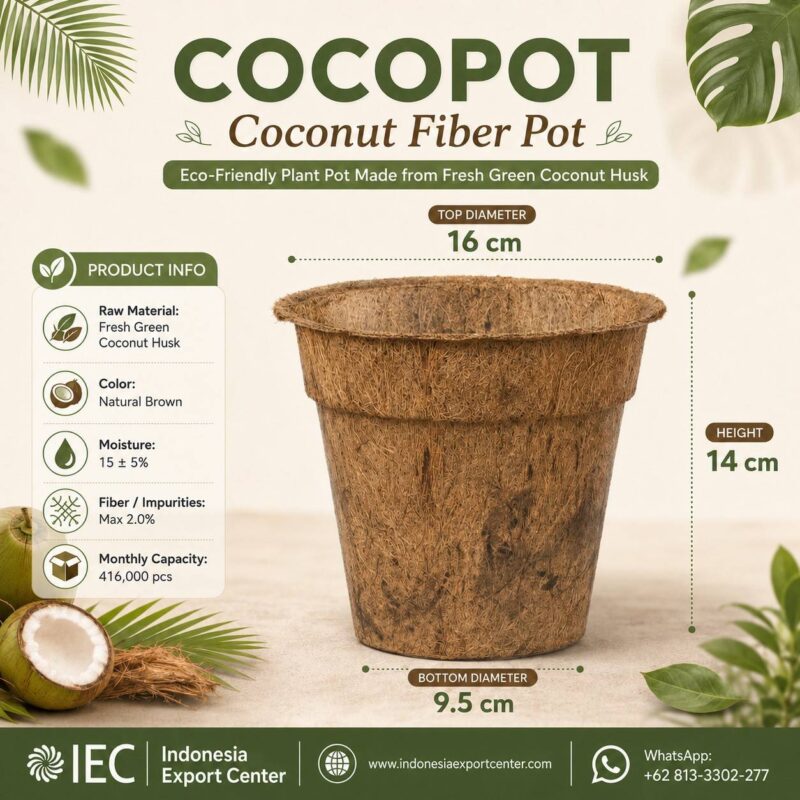
The supplied COCOPOT reference is a natural brown plant pot made using fresh green coconut husk.
Its nominal dimensions are:
- Top Diameter: 16 cm
- Height: 14 cm
- Bottom Diameter: 9.5 cm
This guide explains how to compare coconut coir pots and peat pots using measurable nursery performance criteria.
REQUEST COCOPOT SPECIFICATIONS AND WHOLESALE SOURCING INFORMATION
WhatsApp: https://wa.me/628133302277
Website: https://indonesiaexportcenter.com/
Performance characteristics vary by manufacturer and product formulation. The supplied COCOPOT reference has not been established as universally superior to peat pots.
1. Coir Pots vs Peat Pots – Quick Comparison
| Comparison Factor | Coconut Coir Pots | Peat Pots |
|---|---|---|
| Primary Material | Coconut husk-derived fiber | Peat-derived material, depending on formulation |
| Material Origin | Coconut processing stream | Peatland-derived material |
| Finished Composition | May include binders or additives | May include fibers, binders or additives |
| Typical Appearance | Natural fibrous texture | Formed fibrous or pulp-like texture |
| Water Absorption | Depends on finished formulation and structure | Depends on finished formulation and structure |
| Water Movement Through Walls | Requires testing | Requires testing |
| Wet Structural Strength | Requires testing | Requires testing |
| Dry Handling Strength | Requires testing | Requires testing |
| Root Penetration | Requires crop-specific testing | Requires crop-specific testing |
| Transplanting with Pot | Requires finished-product validation | Requires finished-product validation |
| Breakdown in Soil | Depends on formulation and conditions | Depends on formulation and conditions |
| Nursery Automation | Requires dimensional and feeding tests | Requires dimensional and feeding tests |
| Storage Stability | Depends on humidity, formulation and packaging | Depends on humidity, formulation and packaging |
| Compostability | Not established without product-specific evidence | Not established without product-specific evidence |
| Environmental Impact | Requires lifecycle assessment | Requires lifecycle assessment |
| Wholesale Price | Request quotation | Request quotation |
Buyer takeaway: Select the pot that meets your crop, watering, handling and transplanting requirements—not simply the one with the preferred raw material.
2. What Are Coconut Coir Pots?
Coconut coir pots are plant containers manufactured using coconut husk-derived fiber.
Their characteristics may vary according to:
- Fiber preparation
- Fiber size and distribution
- Moulding process
- Wall thickness
- Density
- Binder formulation
- Drying process
Not all coir pots have the same physical or environmental properties.
3. What Are Peat Pots?
Peat pots are plant containers made using peat-based materials.
Depending on the manufacturer, the finished product may contain other fibers, binders or processing additives.
The term peat pot does not guarantee a single universal formulation.
Buyers should request a technical specification from each supplier.
4. Coconut Fiber vs Peat: Material Origin
Coconut Fiber
Coconut fiber originates from coconut husk.
It can be obtained from material generated during coconut processing.
Peat
Peat is accumulated organic material formed in peatland environments over long periods.
Peat extraction raises environmental considerations associated with peatland ecosystems and carbon storage.
However, comparing finished pots requires more than examining material origin.
5. Finished-Product Composition
Buyers should obtain material declarations for both product categories.
Relevant questions include:
- What percentage of the product is the stated raw material?
- Are binders present?
- Are synthetic additives used?
- Are coatings applied?
- Are other plant fibers included?
- Are composition test reports available?
The supplied COCOPOT reference does not disclose the complete finished-product formulation.
6. Water Absorption
Water absorption can influence pot weight, handling and growing conditions.
Both coir and peat-based materials may interact with water, but the behaviour of a finished pot depends on its formulation and structure.
Buyers should measure:
- Initial dry weight
- Weight after controlled wetting
- Water uptake
- Water loss over time
- Visible structural changes
7. Watering Frequency
Neither coir nor peat pots should automatically be assumed to require more or less watering.
Watering frequency depends on:
- Plant species
- Growing medium
- Pot geometry
- Irrigation system
- Air movement
- Temperature
- Relative humidity
- Crop growth stage
A controlled nursery trial is the most useful way to establish differences.
8. Wall Permeability
Pot wall structure may influence movement of water and air.
However, wall permeability should be measured rather than inferred from the raw material alone.
Potential evaluation methods include:
- Controlled wetting observations
- Moisture loss measurements
- Water passage tests
- Growing-medium moisture monitoring
9. Evaporation and Growing-Medium Moisture
If water moves through or evaporates from the pot wall, growing-medium moisture may be affected.
The magnitude and practical importance depend on the complete growing system.
Buyers should compare both pot types under equivalent environmental conditions.
10. Drainage Performance
Drainage is influenced by:
- Pot base design
- Wall structure
- Growing medium
- Irrigation volume
- Bench surface
- Container positioning
Buyers should test drainage rather than assume one material always drains better.
11. Wet Structural Strength
Wet strength is particularly important for nursery operations involving frequent irrigation.
Potential evaluation criteria include:
- Shape retention
- Rim integrity
- Sidewall strength
- Base stability
- Resistance to handling damage
No verified COCOPOT wet-strength data has been supplied.
12. Dry Handling Strength
Dry strength may affect:
- Warehouse handling
- Pot filling
- Stacking
- Transport
- Machine feeding
- Retail handling
Both coir and peat pots should be tested under comparable conditions.
13. Pot Wall Thickness
Wall thickness can affect:
- Structural strength
- Water interaction
- Pot weight
- Root penetration
- Manufacturing consistency
No wall thickness value has been supplied for COCOPOT.
Buyers should request measurements at defined locations.
14. Dimensional Consistency
Commercial nurseries may require consistent dimensions for trays, pot fillers and transport systems.
Buyers should compare:
- Top diameter
- Height
- Bottom diameter
- Wall thickness
- Dimensional tolerances
- Shape consistency
The supplied COCOPOT dimensions are nominal reference values without stated tolerances.
15. Root Development
Root development is affected by many variables beyond pot material.
These include:
- Crop species
- Growing medium
- Irrigation
- Nutrition
- Container volume
- Temperature
- Production duration
Claims of superior root growth should be supported by controlled testing.
16. Root Penetration
Some buyers evaluate whether roots can penetrate pot walls during transplanting.
Root penetration depends on:
- Wall thickness
- Fiber structure
- Binder formulation
- Moisture
- Crop species
- Growing duration
- Soil conditions
Neither coir nor peat pots should be assumed to allow unrestricted root penetration.
17. Root Restriction
If a pot remains intact after transplanting, its walls may affect root expansion.
Buyers should monitor:
- Root penetration
- Root distribution
- Root deformation
- Plant establishment
- Growth after transplanting
Testing should continue long enough to observe relevant crop outcomes.
18. Transplanting with the Pot
Some plant-derived pots are marketed for planting directly into the ground.
However, planting with the pot should be validated for the actual finished product.
For COCOPOT, direct-planting suitability has not been established.
Buyers should not assume the pot will break down at a suitable rate in every growing environment.
19. Pot Breakdown in Soil
Breakdown depends on:
- Finished-product composition
- Binder formulation
- Soil moisture
- Temperature
- Microbial activity
- Pot thickness
- Time
The presence of coconut fiber or peat does not establish a specific breakdown period.
20. Seedling Establishment
A useful nursery comparison should evaluate:
- Germination
- Plant survival
- Growth uniformity
- Root development
- Transplant readiness
- Plant losses
The comparison should use equivalent crop management conditions.
21. Vegetable Seedling Applications
Nurseries growing vegetables may evaluate coir and peat pots for:
- Tomato seedlings
- Chili or pepper seedlings
- Cucumber seedlings
- Other vegetable crops
Suitability depends on pot size, crop duration and production practices.
The supplied 16 cm COCOPOT reference should not be assumed appropriate for every seedling stage.
22. Flower Nursery Applications
Flower nurseries may evaluate:
- Pot appearance
- Growing-medium compatibility
- Irrigation response
- Handling durability
- Transplanting performance
Product selection should reflect the specific flower crop and production schedule.
23. Ornamental Plant Nurseries
For ornamental plant production, buyers may consider:
- Container stability
- Presentation
- Growing duration
- Root development
- Handling requirements
- Retail display
The appropriate pot depends on the intended application.
24. Greenhouse Propagation
Greenhouse conditions may include:
- Controlled humidity
- Frequent irrigation
- Misting
- Automated handling
- Defined growing cycles
Buyers should test coir and peat pots under the greenhouse’s actual operating conditions.
25. Outdoor Nursery Production
Outdoor nursery conditions may involve:
- Rainfall
- Wind
- Sunlight
- Temperature changes
- Extended moisture exposure
Performance should be evaluated under representative local conditions.
26. Nursery Automation Compatibility
Automated nurseries may use:
- Pot dispensers
- Filling machines
- Conveyors
- Transplanting equipment
- Tray systems
Compatibility depends on:
- Product dimensions
- Dimensional tolerances
- Stacking
- Separation
- Shape consistency
- Handling strength
Equipment compatibility must be tested.
27. Pot Nesting and Separation
Some formed pot designs may be nestable.
However, actual nesting efficiency and separation performance vary.
Buyers should measure:
- Stack height
- Number of pots per stack
- Ease of separation
- Product damage during separation
- Compatibility with equipment
No verified nesting data has been supplied for COCOPOT.
28. Storage and Shelf-Life Considerations
Storage conditions can influence product condition before use.
Buyers should evaluate:
- Humidity
- Temperature
- Packaging
- Stacking
- Storage duration
- Product handling
No verified COCOPOT shelf-life figure has been supplied.
29. Packaging and Freight
Packaging affects:
- Shipping volume
- Product protection
- Freight cost
- Warehouse handling
- Inventory storage
Buyers should request:
- Pieces per carton
- Carton dimensions
- Carton gross weight
- Packing configuration
- Container loading estimate
These values have not been supplied for the COCOPOT reference.
30. Environmental Considerations: Coconut Fiber
Coconut fiber is a plant-derived material obtained from coconut husk.
Potential sustainability considerations include:
- Raw material sourcing
- Processing energy
- Water use
- Binder formulation
- Transport
- Product lifespan
- End-of-life
Environmental advantages should be evaluated using evidence.
31. Environmental Considerations: Peat
Peat extraction may affect peatland ecosystems and stored carbon.
However, the environmental impact of a finished peat pot also depends on:
- Material sourcing
- Manufacturing
- Product formulation
- Transport
- Use
- End-of-life
A fair comparison should evaluate both finished products using a consistent method.
32. Biodegradability and Compostability
Biodegradability and compostability are different characteristics.
The finished product must be evaluated under relevant conditions.
No verified biodegradability or compostability certification has been supplied for COCOPOT.
Buyers should not assume that all coir or peat pots are certified compostable.
33. Lifecycle Assessment
A lifecycle assessment may examine:
- Raw material sourcing
- Processing
- Manufacturing
- Packaging
- Transportation
- Nursery use
- Transplanting
- End-of-life
The assessment should use a common functional unit.
34. Functional Unit for Nursery Comparison
A useful functional unit might be:
The pot system required to produce a defined number of saleable plants through a specified nursery production cycle.
This allows buyers to consider:
- Pot consumption
- Plant survival
- Labour
- Watering
- Transport
- Product losses
- Waste management
35. Total Cost of Ownership
The lowest unit price may not deliver the lowest total cost.
Potential cost components include:
- Pot purchase price
- Freight
- Storage
- Filling labour
- Irrigation
- Handling
- Breakage
- Transplanting
- Disposal
- Plant losses
The appropriate comparison depends on actual nursery operations.
36. Cost per Saleable Plant
A useful metric is:
Cost per Saleable Plant = Relevant Total Pot-System Cost ÷ Number of Saleable Plants Produced
This may provide a more meaningful comparison than unit price alone.
37. Controlled Nursery Trial Design
A practical comparison trial may follow these steps:
- Select a crop.
- Define the production period.
- Choose comparable pot sizes.
- Use the same growing medium.
- Apply equivalent nutrient management.
- Define irrigation procedures.
- Record environmental conditions.
- Measure plant performance.
- Record pot integrity.
- Evaluate transplanting outcomes.
- Record labour and material costs.
- Compare results.
Where practical, use replication and randomised placement to reduce bias.
38. Nursery Trial Measurement Table
| Performance Metric | Coir Pot Result | Peat Pot Result |
|---|---|---|
| Initial Pot Weight | [Value] | [Value] |
| Water Uptake | [Value] | [Value] |
| Growing-Medium Moisture | [Value] | [Value] |
| Irrigation Frequency | [Value] | [Value] |
| Wet Strength | [Result] | [Result] |
| Dry Strength | [Result] | [Result] |
| Germination / Establishment | [Value] | [Value] |
| Plant Survival | [Value] | [Value] |
| Root Development | [Result] | [Result] |
| Transplanting Performance | [Result] | [Result] |
| Pot Damage Rate | [Value] | [Value] |
| Labour Time | [Value] | [Value] |
| Cost per Saleable Plant | [Amount] | [Amount] |
39. Watering Trial Procedure
A watering trial may include:
- Recording initial pot weight
- Applying a controlled water volume
- Measuring water uptake
- Monitoring growing-medium moisture
- Recording drainage
- Repeating under defined conditions
- Documenting pot condition
The trial should use equivalent growing media and environmental conditions.
40. Wet Strength Trial Procedure
A wet strength trial may include:
- Condition samples.
- Record initial condition.
- Apply the agreed wetting procedure.
- Allow the defined exposure period.
- Conduct the agreed handling test.
- Record deformation or damage.
- Compare with acceptance criteria.
Test conditions and pass/fail limits should be established before testing.
41. Transplanting Trial Procedure
A transplanting trial may evaluate:
- Root penetration
- Pot wall condition
- Plant survival
- Root establishment
- Growth after transplanting
- Remaining pot structure
The observation period should be appropriate to the crop and growing conditions.
42. COCOPOT Reference Product Specifications
| Specification | Supplied Information |
|---|---|
| Product | COCOPOT – Coconut Fiber Pot |
| Country of Sourcing | Indonesia |
| Raw Material | Fresh Green Coconut Husk |
| Colour | Natural Brown |
| Top Diameter | 16 cm |
| Height | 14 cm |
| Bottom Diameter | 9.5 cm |
| Moisture | 15 ± 5% |
| Fiber / Impurities | Max. 2.0%, definition to be confirmed |
| Stated Monthly Capacity | 416,000 Pieces |
| Unit Weight | To Be Confirmed |
| Wall Thickness | To Be Confirmed |
| Dimensional Tolerances | To Be Confirmed |
| Binder Composition | To Be Confirmed |
| Water Absorption Data | Not Supplied |
| Wet Strength Data | Not Supplied |
| Root Penetration Data | Not Supplied |
| Biodegradability Evidence | Not Supplied |
| Compostability Evidence | Not Supplied |
| MOQ | To Be Confirmed |
| Wholesale Price | Request Quotation |
43. Which Pot Is Better for Seedling Nurseries?
The answer depends on:
- Crop type
- Growing duration
- Irrigation
- Pot dimensions
- Handling requirements
- Transplanting method
- Total cost
Both coir and peat pots should be evaluated against the nursery’s actual requirements.
44. Which Pot Is Better for Frequent Watering?
Neither material can be declared universally superior without testing.
Buyers should compare:
- Water uptake
- Structural strength after wetting
- Growing-medium moisture
- Pot deformation
- Handling performance
45. Which Pot Is Better for Transplanting?
Transplanting suitability depends on finished-product composition, pot structure, crop species and soil conditions.
Buyers should test the actual products before adopting a plant-with-pot procedure.
46. Which Pot Is Better for Sustainability Procurement?
Sustainability procurement teams should review:
- Material sourcing
- Complete product formulation
- Manufacturing
- Transport
- Product performance
- Waste management
- Environmental evidence
Material origin is an important factor but not a complete lifecycle comparison.
47. Buyer Selection Checklist
Material
-
Raw material identified
-
Finished-product composition reviewed
-
Binder information obtained
-
Additives and coatings reviewed
Product Performance
-
Dimensions compared
-
Tolerances compared
-
Water absorption tested
-
Wet strength tested
-
Dry strength tested
-
Root development evaluated
-
Transplanting performance evaluated
Nursery Operations
-
Irrigation compatibility assessed
-
Equipment compatibility assessed
-
Storage requirements reviewed
-
Packaging evaluated
-
Labour requirements compared
Commercial Evaluation
-
Unit price compared
-
MOQ confirmed
-
Freight calculated
-
Production lead time confirmed
-
Total cost per saleable plant calculated
Sustainability Evaluation
-
Environmental claims verified
-
Biodegradability evidence reviewed
-
Compostability evidence reviewed
-
End-of-life pathways evaluated
-
Lifecycle evidence reviewed
Coir Pots vs Peat Pots – Nursery Buyer RFQ Template
Subject: RFQ – Coconut Coir Pots for Nursery Product Comparison
Dear Indonesia Export Center Team,
We are evaluating coconut coir pots as a potential alternative to peat-based nursery pots.
Please provide the available technical and commercial information for the COCOPOT reference product.
Buyer Information
Company Name: [Company Name]
Country: [Country]
Business Type: [Nursery / Importer / Wholesaler / Distributor / Other]
Contact Person: [Name]
Email: [Email]
WhatsApp: [Number]
Nursery Application
Crop Type: [Details]
Production Duration: [Duration]
Growing Medium: [Details]
Irrigation System: [Details]
Current Peat Pot Specification: [Details]
Required Pot Dimensions: [mm]
Initial Order Quantity: [Pieces]
Estimated Annual Demand: [Pieces]
Technical Requirements
Dimensional Tolerances: [Details]
Unit Weight: [Required / To Be Confirmed]
Wall Thickness: [Required / To Be Confirmed]
Material Composition Declaration: Required
Binder Information: Required
Water Absorption Testing: [Required / Not Required]
Wet Strength Testing: [Required / Not Required]
Dry Strength Testing: [Required / Not Required]
Root Penetration Testing: [Required / Not Required]
Transplanting Trial: [Planned / Not Planned]
Sustainability Requirements
Biodegradability Evidence: [Required / Not Required]
Compostability Evidence: [Required / Not Required]
Material Sourcing Information: [Required / Not Required]
Lifecycle Assessment Documentation: [Required / Not Required]
Commercial Requirements
Sample Quantity: [Pieces]
Initial Commercial Order: [Pieces]
Destination Country: [Country]
Destination Port: [Port]
Preferred Incoterm: [FCA / FOB / CFR / CIF / Other]
Target Delivery Period: [Month / Year]
Please provide:
- Actual manufacturer information
- Product specifications
- Finished-product material composition
- Binder and additive information
- Dimensional tolerances
- Unit weight and wall thickness
- Available water absorption data
- Available wet strength data
- Available root penetration data
- Available transplanting performance information
- Available environmental test evidence
- Sample availability and cost
- MOQ
- Wholesale unit price
- Packaging specifications
- Container loading information
- Production capacity confirmation
- Production lead time
- Contractual seller and exporter of record
- Payment terms
- Quotation validity
We look forward to receiving your technical and commercial proposal.
Kind regards,
[Your Name] [Company Name] [Country]SEND YOUR COCOPOT NURSERY COMPARISON ENQUIRY
WhatsApp: https://wa.me/628133302277
Frequently Asked Questions – Coir Pots vs Peat Pots
What is the difference between coir pots and peat pots?
Coir pots use coconut husk-derived fiber, while peat pots use peat-based materials. Their finished formulations and performance vary by manufacturer.
Are coir pots better than peat pots?
Not universally. The better option depends on watering, durability, crop performance, transplanting and total cost.
Do coir pots need more watering than peat pots?
There is no universal answer. Watering requirements depend on the complete nursery system and should be tested.
Which pot has better wet strength?
Wet strength depends on the finished-product formulation and design. No verified comparative results have been supplied.
Can roots grow through coir pots?
Root penetration depends on the pot structure, formulation and crop conditions. It should be evaluated through testing.
Can peat pots be planted directly into soil?
Suitability depends on the specific finished product and growing conditions. Buyers should verify the manufacturer’s instructions and relevant test evidence.
Can COCOPOT be planted directly into soil?
Direct-planting suitability has not been established for the supplied COCOPOT reference.
Are coir pots biodegradable?
Biodegradability requires appropriate finished-product evidence. No verified biodegradability certification has been supplied for COCOPOT.
Are peat pots compostable?
Not all peat pots have identical formulations. Compostability should be verified for the specific finished product.
Are coir pots more sustainable than peat pots?
Coconut fiber and peat have different sourcing considerations, but a complete environmental comparison requires lifecycle evidence.
Are coir pots suitable for commercial nurseries?
They may be evaluated for commercial nursery applications, subject to crop-specific performance testing.
What are the supplied COCOPOT dimensions?
16 cm top diameter, 14 cm height and 9.5 cm bottom diameter.
What is the raw material of COCOPOT?
The supplied reference identifies fresh green coconut husk.
What is the stated monthly production capacity?
416,000 pieces, subject to manufacturer verification.
Can I request COCOPOT samples?
Sample enquiries may be submitted, subject to availability and applicable conditions.
Does IEC manufacture COCOPOT directly?
IEC facilitates sourcing and export enquiries and should not automatically be considered the physical manufacturer.
How can I request a quotation?
Contact IEC with your required specifications, nursery application, order quantity and destination.
Compare COCOPOT with Peat Pots for Your Nursery
Evaluate Coconut Fiber Plant Pots from Indonesia Using Practical Nursery Performance Criteria
Indonesia Export Center (IEC) welcomes enquiries from international nursery purchasing teams, commercial growers, horticultural distributors and importers.
Product: COCOPOT – Coconut Fiber Pot
Country of Sourcing: Indonesia
Raw Material: Fresh Green Coconut Husk
Colour: Natural Brown
Reference Top Diameter: 16 cm
Reference Height: 14 cm
Reference Bottom Diameter: 9.5 cm
Reference Moisture: 15 ± 5%
Reference Fiber / Impurities: Max. 2.0%, Definition Subject to Confirmation
Stated Monthly Capacity: 416,000 Pieces, Subject to Verification
Finished-Product Composition: To Be Confirmed
Binder Information: To Be Confirmed
Water Absorption Data: Not Supplied
Wet Strength Data: Not Supplied
Root Penetration Data: Not Supplied
Biodegradability Evidence: Not Supplied
Compostability Evidence: Not Supplied
MOQ: To Be Confirmed
Wholesale Price: Request Quotation
Production Lead Time: To Be Confirmed
Contact IEC to discuss technical specifications, nursery trials, product samples and wholesale sourcing requirements.
INDONESIA EXPORT CENTER | IEC
Your Export & Sourcing Partner from Indonesia
Website: https://indonesiaexportcenter.com/
WhatsApp: +62 813-3302-277
REQUEST COCOPOT SPECIFICATIONS AND WHOLESALE SOURCING INFORMATION
Please include your company name, nursery application, current peat pot specifications, required dimensions, order quantity and destination.
Product Comparison Disclaimer: This guide provides general nursery procurement considerations and does not represent verified comparative performance testing. Watering behaviour, strength, root penetration, transplanting suitability and environmental performance depend on finished-product formulation and use conditions. No universal superiority claim is made for coir or peat pots. Product specifications, manufacturing capability and commercial terms require supplier confirmation.
