

INDONESIA EXPORT CENTER (IEC)
Indonesian Coconut Sugar for International Food Ingredient Distribution
Food ingredient importers need products that meet technical specifications, destination-market requirements, and customer expectations.
When evaluating Indonesian coconut sugar, importers should consider ingredient identity, particle size, moisture, food safety, batch consistency, certification, packaging, and shipping documentation.
Indonesia Export Center (IEC) facilitates B2B sourcing inquiries involving potential Indonesian coconut sugar suppliers.
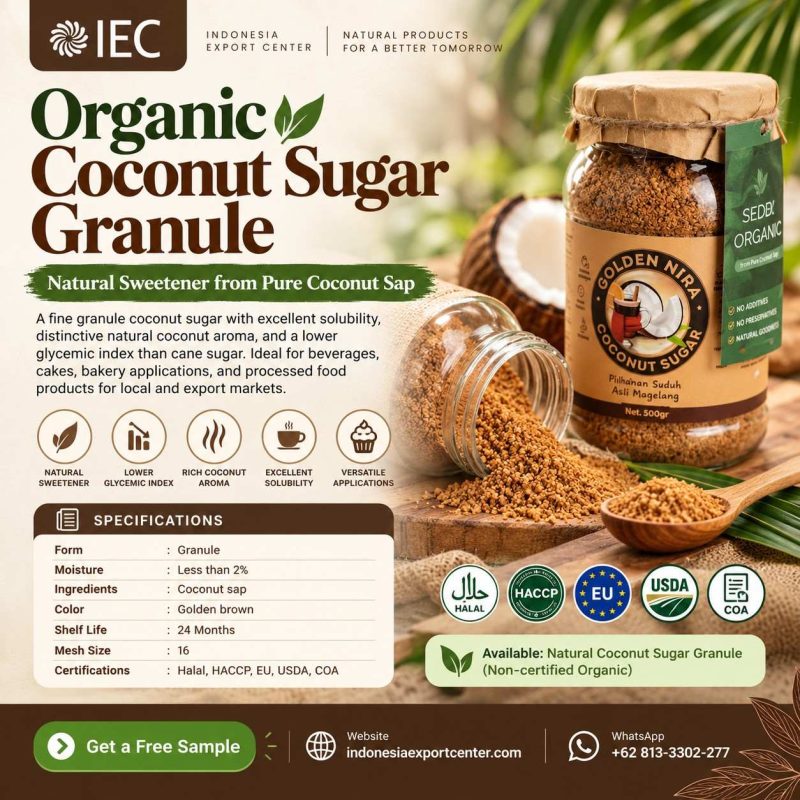
The IEC flyer describes organic coconut sugar granules made from coconut sap and also identifies a natural, non-certified-organic variant.
All offered specifications and supplier qualifications must be verified before commercial approval.
Why Food Ingredient Importers Consider Coconut Sugar
Coconut sugar may be evaluated for distribution to:
- Beverage manufacturers.
- Bakery ingredient buyers.
- Confectionery businesses.
- Specialty food producers.
- Retail ingredient brands.
- Food service suppliers.
- Private-label companies.
Ingredient distributors should assess whether the product meets their customers’ intended applications.
Product Overview
The IEC promotional material describes:
- Coconut sap as the raw material.
- Granulated form.
- Golden-brown colour.
- Distinctive coconut aroma.
- Good solubility.
- Organic and natural variants.
The exact technical specification should be obtained for the selected variant.
Reported Product Data
| Parameter | IEC Flyer Reference |
|---|---|
| Form | Granule |
| Moisture | Less than 2% |
| Ingredient | Coconut Sap |
| Colour | Golden Brown |
| Shelf Life | 24 Months |
| Mesh Size | 16 |
The values are promotional references, not verified batch results.
Ingredient Quality Specifications
A professional importer may establish acceptance criteria covering:
- Product identity.
- Ingredient composition.
- Moisture.
- Granulation.
- Colour.
- Aroma.
- Microbiological limits.
- Relevant contaminants.
- Foreign matter.
- Packaging.
- Shelf life.
- Lot traceability.
Moisture and Storage Stability
The reported moisture level is below 2%.
Buyers should verify the test method and actual lot result.
Moisture control can be relevant to caking, handling, and storage performance.
The supplier should provide appropriate packaging and storage guidance.
Particle-Size Distribution
Mesh 16 is listed in the flyer.
Importers may require additional information about:
- Sieve standard.
- Particle-size distribution.
- Fines.
- Oversized particles.
- Granule consistency.
- Bulk density.
This is especially relevant when selling to manufacturers with automated ingredient handling systems.
Batch-to-Batch Consistency
Importers should consider:
- Approved reference samples.
- Written specifications.
- Batch COAs.
- Lot identification.
- Change notification.
- Supplier corrective action procedures.
- Receiving inspection.
Consistency should be demonstrated rather than assumed.
Food Safety Documentation
Potential documents include:
- Product specification.
- COA.
- Microbiological reports.
- Relevant contaminant reports.
- Allergen declaration where applicable.
- Ingredient statement.
- Shelf-life information.
- Food safety system evidence.
- Traceability documentation.
Organic Certification
Importers supplying certified organic customers should verify:
- Current organic certification.
- Product scope.
- Processing site.
- Applicable destination standard.
- Transaction documentation.
- Chain of custody.
The natural variant must not be sold as certified organic without appropriate evidence.
Halal and HACCP
The IEC flyer references Halal and HACCP.
Importers should obtain the relevant documentation and verify the covered facility, product, and applicable scope.
Packaging for Ingredient Distribution
Potential requirements include:
- Food-grade contact materials.
- Moisture-resistant liners.
- Bulk packaging.
- Lot labels.
- Product identification.
- Palletization.
- Storage instructions.
Packaging options require supplier confirmation.
Import Compliance
The importer should check:
- Correct customs classification.
- Importer registration.
- Food import permits or notifications where applicable.
- Food safety standards.
- Labelling requirements.
- Organic import rules where relevant.
- Required certificates.
- Border inspection procedures.
Shipment Sample Evaluation
Where legally permitted, buyers may request samples for:
- Laboratory testing.
- Customer qualification.
- Sensory assessment.
- Dissolution testing.
- Manufacturing trials.
- Packaging evaluation.
Samples should be traceable to the supplier and identified product variant.
Ingredient Importer Approval Checklist
| Requirement | Buyer Action |
|---|---|
| Supplier Identity | Verify |
| Product Variant | Confirm |
| Specification | Approve |
| COA | Review |
| Microbiological Testing | Assess |
| Contaminants | Assess |
| Organic Documentation | Verify if required |
| Packaging | Approve |
| Shelf Life | Confirm |
| Samples | Evaluate |
| Import Eligibility | Verify |
| Commercial Terms | Agree |
Ingredient Importer RFQ Template
Subject: Indonesian Coconut Sugar Ingredient Supply Inquiry
Company: [Name]
Destination Country: [Country]
Customer Application: [Details]
Product Variant: [Organic / Natural]
Required Quantity: [KG or MT]
Monthly Demand: [Quantity]
Required Moisture: [Specification]
Required Granulation: [Specification]
Required Food Safety Tests: [Details]
Required Certifications: [Details]
Packaging: [Details]
Destination Port: [Port]
Preferred Incoterm: [Term]
Please provide current specifications, COA, supplier qualifications, sample feasibility, MOQ, and export quotation.
Frequently Asked Questions
Can coconut sugar be imported as a food ingredient?
Import eligibility depends on the destination and applicable regulations.
Is the reported moisture specification guaranteed?
No.
Can importers request batch-specific COAs?
Yes, subject to supplier arrangements.
Is the natural variant certified organic?
No organic certification is established for that variant.
Can samples be used for customer qualification?
Yes, subject to availability and legal shipment feasibility.
Does IEC guarantee food safety certification?
No.
Can buyers request recurring commercial supply?
Yes, subject to supplier capacity and agreement.
Request Indonesian Coconut Sugar for Ingredient Distribution
Looking for coconut sugar granules for food ingredient importing and wholesale distribution?
Contact IEC with your quality specifications, certification requirements, order quantity, and destination.
REQUEST INGREDIENT SAMPLE & EXPORT RFQ
INDONESIA EXPORT CENTER (IEC)
Website: https://indonesiaexportcenter.com/
WhatsApp: +62 813-3302-277
Related Resources
Coconut Sugar Supplier Indonesia
Organic Coconut Sugar Supplier Indonesia
Coconut Sugar for Food Manufacturers
