

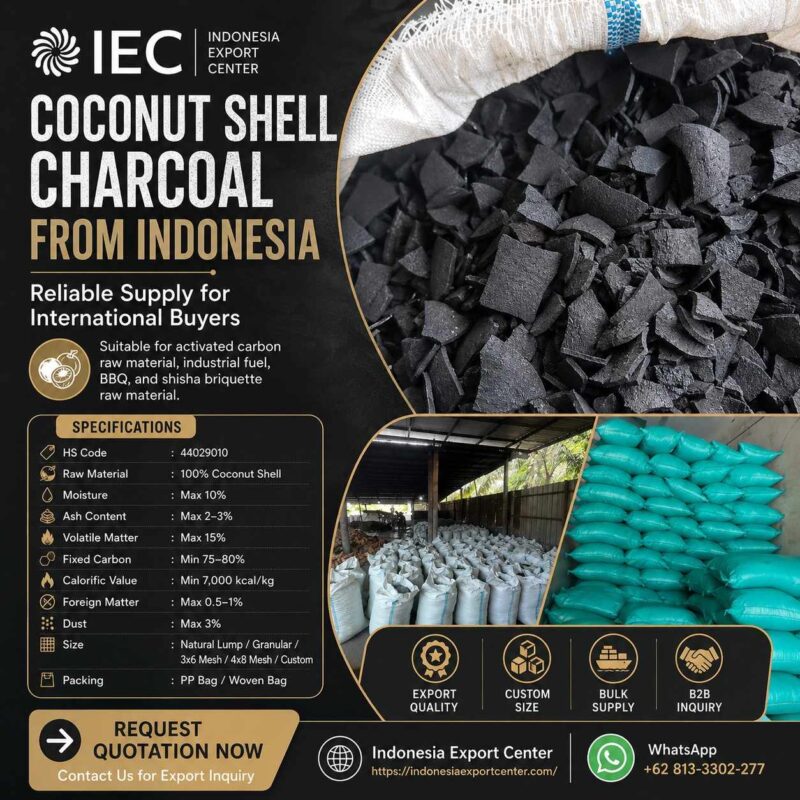
IEC | INDONESIA EXPORT CENTER
COCONUT SHELL CHARCOAL FROM INDONESIA
Reliable Supply for International Buyers
Looking for information about coconut shell charcoal quality control before purchasing raw charcoal from Indonesia?
Indonesia Export Center (IEC) facilitates international B2B sourcing inquiries for Indonesian coconut shell charcoal, helping industrial buyers, factory auditors, and procurement teams communicate technical specifications, quality assurance expectations, sampling requirements, and inspection arrangements to potential supply partners.
For industrial charcoal purchasing, product quality cannot be established through appearance or a single laboratory report alone.
An effective quality control system should address raw material identification, production traceability, representative sampling, laboratory methods, batch consistency, packaging, storage, and shipment verification.
Buyers should also establish how nonconforming material will be handled and how laboratory results will be linked to the actual goods being purchased.
This guide explains the principal elements of a coconut shell charcoal factory quality control program, including supplier audits, lot identification, third-party testing, and pre-shipment inspection.
Export Quality • Custom Size • Bulk Supply • B2B Inquiry
Request Coconut Shell Charcoal Quality-Control Information:
https://wa.me/628133302277
What Is Coconut Shell Charcoal Quality Control?
Coconut shell charcoal quality control refers to the procedures used to evaluate whether charcoal meets defined technical and commercial requirements.
A quality control program may include:
- Raw material inspection
- Production process monitoring
- Product grading
- Laboratory analysis
- Sampling
- Lot identification
- Packaging inspection
- Storage monitoring
- Pre-shipment verification
- Documentation review
The exact program depends on the product, intended application, factory capability, and contractual requirements.
Why Factory Quality Control Matters
International buyers often purchase charcoal for processes that require consistent feedstock.
Variation between batches may affect:
- Industrial processing
- Activated carbon manufacturing
- Briquette production
- Material handling
- Screening efficiency
- Storage
- Shipment acceptance
Buyer Recommendation
Evaluate both the quality of individual samples and the supplier’s ability to maintain consistent quality across commercial lots.
Quality Assurance vs. Quality Control
Although related, quality assurance and quality control serve different purposes.
Quality Assurance (QA)
Focuses on establishing processes intended to prevent quality problems.
Examples include documented procedures, staff training, equipment maintenance, and traceability systems.
Quality Control (QC)
Focuses on checking whether materials and products meet requirements.
Examples include laboratory testing, sieve analysis, moisture checks, and lot inspection.
Buyer Recommendation
Assess the supplier’s quality system as well as the final test results.
Raw Coconut Shell Charcoal vs. Finished Products
Quality requirements depend on the product being purchased.
Raw Coconut Shell Charcoal
Carbonized coconut shell material supplied as natural lump, granular, or specified mesh sizes.
Finished Activated Carbon
A processed material with additional application-specific properties.
Finished BBQ and Shisha Briquettes
Manufactured products with separate composition, shape, strength, and burning-performance requirements.
Important: IEC’s supplied technical specifications refer to raw coconut shell charcoal, not finished activated carbon or finished briquettes.
IEC Raw Coconut Shell Charcoal Specifications
| Parameter | Specification |
|---|---|
| HS Code | 44029010 |
| Raw Material | 100% Coconut Shell |
| Moisture | Max 10% |
| Ash Content | Max 2–3% |
| Volatile Matter | Max 15% |
| Fixed Carbon | Min 75–80% |
| Calorific Value | Min 7,000 kcal/kg |
| Foreign Matter | Max 0.5–1% |
| Dust | Max 3% |
| Size | Natural Lump / Granular / 3×6 Mesh / 4×8 Mesh / Custom |
| Packing | PP Bag / Woven Bag |
Specification note: Ash, fixed carbon, and foreign matter limits are grade-dependent ranges.
The exact contractual grade and acceptance limits must be agreed before purchase.
The supplied HS code is a reference requiring verification for the actual product and customs jurisdiction.
Establishing a Quality Control Plan
A quality control plan defines what will be checked, when testing will occur, and how results will be evaluated.
Recommended Elements
- Product identification
- Technical specification
- Inspection points
- Sampling method
- Laboratory methods
- Acceptance criteria
- Testing frequency
- Lot traceability
- Nonconformance procedures
- Release authorization
Buyer Recommendation
Request a written quality control plan where product consistency is commercially important.
Factory Quality Control Workflow
A practical QC workflow may include:
- Raw material receiving
- Raw material inspection
- Production or carbonization monitoring
- Cooling and handling verification
- Product sorting and grading
- Lot identification
- Representative sampling
- Laboratory testing
- Packaging inspection
- Finished-lot release
- Storage monitoring
- Pre-shipment inspection
The exact sequence varies by facility and production method.
Raw Material Verification
The supplied IEC reference specifies:
100% Coconut Shell
Important Checks
- Material identity
- Visible contamination
- Foreign material
- Source records
- Incoming material segregation
Buyer Recommendation
Request evidence of the raw material identification procedure.
Raw Material Traceability
Traceability helps connect incoming coconut shells to later production or finished charcoal lots.
Potential Records
- Receiving date
- Source or supplier reference
- Incoming quantity
- Material identification
- Storage location
- Production batch reference
Important Clarification
The existence and completeness of any supplier’s traceability system must be independently verified.
Carbonization Process Monitoring
Carbonization conditions influence charcoal characteristics.
Potential Monitoring Areas
- Feedstock preparation
- Process conditions
- Carbonization completion
- Cooling procedures
- Handling
- Material segregation
Buyer Recommendation
Ask the facility to explain how process consistency is monitored and recorded.
Cooling and Handling Controls
Charcoal handling after carbonization is important for both quality and safety.
Important Considerations
- Cooling procedures
- Material condition
- Storage
- Contamination prevention
- Safe handling
- Transport preparation
Important Clarification
Charcoal may present self-heating and fire hazards.
Appropriate safety controls and applicable transport requirements must be verified.
Factory Lot Identification
A lot is a defined quantity of material identified for production, quality control, or shipment purposes.
Potential Lot Information
- Lot number
- Production period
- Material source
- Processing reference
- Grade
- Quantity
- Storage location
Buyer Recommendation
Agree on the lot definition before establishing sampling and acceptance procedures.
Why Lot Traceability Matters
Lot traceability can help buyers determine which material was tested and shipped.
Potential Benefits
- Connect laboratory results to goods
- Identify affected material
- Support investigation of complaints
- Control stock segregation
- Document shipment history
- Support corrective action
Buyer Recommendation
Require lot identification on relevant quality and shipment records.
Lot Numbering and Recordkeeping
A lot number should be unique within the supplier’s relevant recordkeeping system.
Illustrative Lot Reference
[Facility Code]-[Production Date]-[Batch Number]
This is an example of a possible format, not an existing IEC lot-numbering system.
Buyer Recommendation
Use a traceability format that can be checked against actual production, warehouse, and shipment records.
Production Lot vs. Shipment Lot
These may be different.
Production Lot
Material associated with a defined production or processing event.
Shipment Lot
Material assembled for a particular commercial shipment.
Buyer Recommendation
Document how shipment lots relate to their underlying production lots, especially when multiple batches are combined.
Lot Segregation and Mixing Controls
Mixing different lots may affect traceability and quality consistency.
Important Questions
- Are grades stored separately?
- Can lots be identified physically?
- Are mixing procedures documented?
- Are mixed lots sampled appropriately?
- Are test results linked to the final shipment composition?
Buyer Recommendation
Require approval of any lot mixing that may affect contractual specifications.
Representative Sampling
Representative sampling is central to reliable quality control.
A small sample may not accurately represent a large shipment if the sampling procedure is inadequate.
Important Factors
- Lot size
- Sampling locations
- Number of increments
- Material heterogeneity
- Sample preparation
- Contamination prevention
Buyer Recommendation
Agree on a documented sampling method appropriate to the product and lot.
Sampling Plan for Coconut Shell Charcoal
A sampling plan should specify how samples will be collected.
Recommended Information
- Lot definition
- Sampling point
- Number of sampling increments
- Increment size
- Composite sample preparation
- Sample reduction method
- Sample identification
- Retention procedure
Important Clarification
IEC has not supplied a verified standard sampling frequency or sample size.
These should be determined by the agreed method and inspection requirements.
Sampling During Production
In-process sampling may help identify changes before a lot is completed.
Potential Uses
- Monitoring moisture
- Checking ash
- Evaluating grading
- Identifying contamination
- Tracking process variation
Buyer Recommendation
Review whether the supplier uses in-process testing and how results are recorded.
Sampling Before Shipment
Pre-shipment sampling can help verify the actual material intended for export.
Suggested Procedure
- Identify the shipment lot.
- Confirm lot quantity.
- Establish the sampling plan.
- Collect representative increments.
- Prepare laboratory samples.
- Label and secure samples.
- Perform agreed tests.
- Compare results with specifications.
- Document the outcome.
Buyer Recommendation
Specify whether sampling occurs before or after final grading and packaging.
Composite Samples vs. Individual Samples
Composite Sample
Combines material from multiple increments according to a defined procedure.
Individual Sample
Represents a particular sampling point or unit.
Buyer Recommendation
Select the approach based on the objective of testing and the agreed sampling method.
Sample Preparation and Reduction
Sample preparation can influence laboratory results.
Important Considerations
- Crushing or grinding
- Mixing
- Sample division
- Moisture preservation
- Contamination prevention
- Particle-size changes
Buyer Recommendation
Request the laboratory’s sample preparation procedure.
Sample Identification and Chain of Custody
Chain-of-custody records help establish the identity and handling history of a sample.
Recommended Information
- Sample ID
- Lot number
- Sampling date
- Sampling location
- Sampler identity
- Seal reference
- Laboratory receipt date
- Test request
Buyer Recommendation
Use documented custody procedures for independent testing or contractual disputes.
Retained Reference Samples
Retained samples may help resolve later quality questions.
Important Considerations
- Sample identity
- Sealing
- Storage conditions
- Retention period
- Access
- Retesting procedure
Buyer Recommendation
Agree on sample retention arrangements before shipment.
Moisture Quality Control
IEC’s raw charcoal moisture reference is:
Maximum 10%
Important QC Questions
- Which test method is used?
- Is the result reported on an as-received basis?
- When is the sample collected?
- How is the sample stored before testing?
- What is the exact acceptance limit?
Buyer Recommendation
Use a defined test method and reporting basis.
Ash Content Quality Control
IEC’s raw charcoal ash reference is:
Maximum 2–3%, depending on grade
Important QC Questions
- What is the exact maximum?
- Which method is used?
- How is the sample prepared?
- Is the result dry basis or as received?
- How frequently is testing performed?
Buyer Recommendation
Do not accept an undefined ash range as the final contractual criterion.
Fixed Carbon Quality Control
IEC’s raw charcoal fixed carbon reference is:
Minimum 75–80%, depending on grade
Fixed carbon is commonly determined through proximate analysis.
Important QC Questions
- What is the analytical basis?
- Which test method is used?
- How are moisture, ash, and volatile matter determined?
- How is the result calculated or reported?
Buyer Recommendation
Compare fixed carbon results only when analytical methods and reporting bases are compatible.
Volatile Matter Quality Control
IEC’s raw charcoal volatile matter reference is:
Maximum 15%
Important QC Questions
- What method is used?
- What is the reporting basis?
- Is sample preparation consistent?
- How is repeatability monitored?
Buyer Recommendation
Include volatile matter testing where required by the intended application.
Calorific Value Quality Control
IEC’s raw charcoal calorific value reference is:
Minimum 7,000 kcal/kg
Important QC Questions
- Which calorific value is reported?
- What method is used?
- What is the moisture basis?
- How is the sample prepared?
Buyer Recommendation
Agree on the reporting basis before evaluating results.
Foreign Matter Quality Control
IEC’s raw charcoal foreign matter reference is:
Maximum 0.5–1%, depending on grade
Potential Contaminants
- Stones
- Soil
- Metal
- Other non-charcoal material
Buyer Recommendation
Define the measurement method and exact acceptance limit.
Dust Quality Control
IEC’s raw charcoal dust reference is:
Maximum 3%
Important Considerations
- Dust definition
- Particle-size threshold
- Sieve method
- Sampling
- Handling losses
Buyer Recommendation
Specify how dust percentage is measured.
Particle Size and Mesh Quality Control
IEC’s supplied size reference includes:
- Natural lump
- Granular
- 3×6 mesh
- 4×8 mesh
- Custom size
Important QC Parameters
- Sieve standard
- Particle-size distribution
- Oversize fraction
- Undersize fraction
- Dust
- Screening consistency
Buyer Recommendation
Include a defined sieve analysis procedure and acceptance criteria.
Natural Lump Charcoal Inspection
Natural lump charcoal may vary in shape and dimensions.
Potential Checks
- Size range
- Oversize material
- Undersize material
- Dust
- Foreign matter
- Visible condition
Buyer Recommendation
Use measurable criteria rather than subjective descriptions.
Granular Charcoal Inspection
Granular charcoal quality control may emphasize particle-size distribution.
Potential Checks
- Sieve analysis
- Fines
- Oversize particles
- Foreign matter
- Moisture
- Packaging containment
Buyer Recommendation
Agree on the required grading tolerance.
Laboratory Test Methods
Laboratory testing should use methods appropriate to the product and required parameter.
Important Considerations
- Test method identification
- Sample preparation
- Reporting basis
- Equipment calibration
- Measurement uncertainty, where relevant
- Quality control procedures
Buyer Recommendation
Require the laboratory to identify the method used for each reported result.
Internal Factory Laboratory vs. Third-Party Laboratory
Internal Laboratory
Operated by or associated with the supplier.
Third-Party Laboratory
Operated independently of the supplier, subject to the actual ownership and contractual relationship.
Buyer Recommendation
Use independent testing where the transaction risk or contractual requirements justify it.
Third-Party Laboratory Verification
Buyers should assess the laboratory’s competence.
Potential Checks
- Laboratory identity
- Relevant testing capability
- Accreditation status
- Accreditation scope
- Test methods
- Reporting procedures
Important Clarification
Accreditation should be verified for the specific tests and methods, not assumed from a general statement.
ISO/IEC 17025 and Laboratory Competence
ISO/IEC 17025 is an international standard addressing the competence, impartiality, and consistent operation of testing and calibration laboratories.
Buyer Recommendation
Where appropriate, request reports from a laboratory accredited for the relevant test methods.
Important Clarification
IEC has not supplied confirmed ISO/IEC 17025 accreditation details for any particular laboratory.
Certificate of Analysis Review
A Certificate of Analysis may summarize results for an identified sample or lot.
Recommended COA Fields
- Supplier or customer reference
- Product description
- Lot number
- Sample ID
- Test date
- Laboratory
- Test methods
- Results
- Units
- Reporting basis
- Authorized report information
Buyer Recommendation
Verify that the COA relates to the actual goods being purchased.
Historical COA vs. Shipment-Specific COA
Historical COA
Shows results from a previous sample or lot.
Shipment-Specific COA
Relates to an identified shipment lot.
Buyer Recommendation
Do not treat historical test results as a guarantee of current shipment quality.
Comparing Test Results on the Same Basis
Laboratory results may be reported on different analytical bases.
Common Bases
- As-received
- Dry
Why This Matters
Moisture affects how some reported percentages are interpreted.
Buyer Recommendation
Confirm the basis before comparing laboratories or suppliers.
Testing Frequency and Lot Release
Testing frequency should reflect product risk, process variation, lot size, and contractual requirements.
Possible Approaches
- Per production lot
- Per shipment lot
- At defined intervals
- Based on risk or process changes
Important Clarification
IEC has not supplied a fixed testing frequency.
Quality Control Records
Useful records may include:
- Raw material receiving records
- Production logs
- Lot identification records
- Sampling records
- Laboratory reports
- Equipment calibration records
- Inspection reports
- Nonconformance reports
- Release approvals
- Shipment records
Buyer Recommendation
Ask the supplier to demonstrate how records are linked to specific lots.
Equipment Calibration and Maintenance
Reliable measurements depend on suitable equipment.
Potential Equipment
- Weighing scales
- Moisture testing equipment
- Laboratory furnaces
- Sieves
- Temperature measurement equipment
- Other analytical instruments
Buyer Recommendation
Review calibration and maintenance records relevant to the required tests.
Nonconforming Material Control
Nonconforming material is material that does not meet an agreed requirement.
Potential Actions
- Identification
- Segregation
- Investigation
- Retesting
- Reprocessing
- Regrading
- Rejection
- Authorized disposition
Buyer Recommendation
Require written approval for any proposed deviation from contractual specifications.
Corrective and Preventive Action
When a quality issue occurs, the supplier should investigate its cause.
Potential Process
- Record the issue.
- Identify affected lots.
- Contain the material.
- Investigate the cause.
- Implement corrective action.
- Verify effectiveness.
- Update procedures if needed.
Buyer Recommendation
Request evidence of corrective action for recurring problems.
Quality Control for Packaging
IEC’s supplied raw charcoal packaging reference includes:
- PP bags
- Woven bags
Potential Checks
- Bag material
- Bag dimensions
- Net weight
- Closure
- Strength
- Labeling
- Lot identification
Important Clarification
No fixed bag weight or packaging configuration has been confirmed.
Packaging Lot Traceability
Packaging should support identification of the contained charcoal.
Potential Markings
- Product name
- Grade
- Lot number
- Net weight
- Package count
- Destination
- Shipping marks
Buyer Recommendation
Align packaging identification with the packing list and inspection records.
Storage Quality Control
Storage conditions may influence charcoal condition.
Important Considerations
- Moisture exposure
- Contamination
- Lot segregation
- Handling
- Fire safety
- Storage duration
Buyer Recommendation
Review storage practices during supplier audits.
Warehouse Inspection
A warehouse inspection may evaluate:
- Product identification
- Lot segregation
- Storage conditions
- Packaging
- Stock records
- Handling procedures
- Safety controls
Buyer Recommendation
Verify that inspected material can be linked to the proposed shipment.
Factory Audit Checklist
| Audit Area | Questions to Verify |
|---|---|
| Legal identity | Is the operating entity verified? |
| Raw material | Is coconut shell identity controlled? |
| Production | Are relevant process records maintained? |
| Lot identification | Can batches be traced? |
| Sampling | Is a documented method used? |
| Laboratory testing | Are methods appropriate? |
| Third-party testing | Is independent testing available? |
| Equipment | Are calibration records maintained? |
| Nonconformance | Are failed lots controlled? |
| Packaging | Are specifications and labels checked? |
| Storage | Are lots segregated and protected? |
| Shipment release | Is approval documented? |
Third-Party Factory Audits
Buyers may request an independent facility audit.
Potential Audit Scope
- Company identity
- Facility operations
- Quality management
- Production records
- Traceability
- Laboratory arrangements
- Storage
- Packaging
- Shipment preparation
Important Clarification
Factory audit access and independent inspection arrangements require agreement with the relevant supplier.
Pre-Shipment Quality Inspection
Pre-shipment inspection may help verify the material intended for export.
Potential Checks
- Lot identity
- Product grade
- Quantity
- Packaging
- Sampling
- Laboratory results
- Container condition
- Loading arrangements
Buyer Recommendation
Define inspection scope and acceptance criteria before the purchase order is confirmed.
Container Loading Quality Checks
Loading inspection may document:
- Container number
- Seal number
- Product identity
- Bag count
- Net weight
- Gross weight
- Packaging condition
- Loading photographs
- Lot references
Buyer Recommendation
Cross-check loading records with the packing list and other shipping documents.
Charcoal Transport Safety and Quality Control
Charcoal may present self-heating and fire hazards.
Important Considerations
- Product characteristics
- Cooling and storage
- Transport classification
- Applicable testing
- Packaging
- Container suitability
- Carrier acceptance
Important Clarification
The current IMDG Code and carrier requirements must be checked for the actual cargo.
A satisfactory product quality test does not automatically establish transport safety compliance.
Quality Control vs. Transport Classification
These are separate requirements.
Product Quality Testing
Evaluates whether charcoal meets commercial specifications.
Transport Classification
Determines applicable transport requirements under the relevant rules.
Buyer Recommendation
Verify both before shipment.
Quality Acceptance at Origin vs. Destination
Contracts should identify where quality acceptance occurs.
Potential Inspection Points
- Factory
- Warehouse
- Loading port
- Destination
- Other agreed location
Buyer Recommendation
Define the acceptance point and claims procedure before shipment.
Managing Laboratory Result Disputes
Two laboratories may report different results because of sampling, preparation, methods, or reporting bases.
Recommended Contract Provisions
- Agreed sampling procedure
- Agreed test methods
- Reference laboratory
- Retained samples
- Retesting conditions
- Acceptance criteria
- Dispute resolution
Buyer Recommendation
Agree on these provisions before ordering.
Quality Control Documentation Checklist
| Document | Purpose |
|---|---|
| Product specification | Defines acceptance requirements |
| Lot identification record | Links material to production or shipment |
| Sampling record | Documents sample collection |
| Chain-of-custody record | Tracks sample handling |
| Laboratory report | Records test results |
| Certificate of Analysis | Summarizes identified sample or lot results |
| Inspection report | Records inspection findings |
| Nonconformance report | Documents failed requirements |
| Corrective action report | Records response to problems |
| Packaging inspection record | Confirms packaging checks |
| Shipment release record | Documents authorization |
| Loading report | Connects cargo to shipment details |
How to Compare Supplier Quality Control Systems
| Evaluation Item | Supplier A | Supplier B |
|---|---|---|
| Lot traceability | To verify | To verify |
| Raw material control | To verify | To verify |
| Documented sampling | To verify | To verify |
| Laboratory capability | To verify | To verify |
| Third-party testing | To verify | To verify |
| COA traceability | To verify | To verify |
| Calibration records | To verify | To verify |
| Nonconformance controls | To verify | To verify |
| Packaging inspection | To verify | To verify |
| Pre-shipment inspection | To verify | To verify |
Buyer Recommendation
Use evidence-based supplier assessment rather than marketing descriptions.
Common Charcoal Quality Control Problems
Potential issues include:
- Inconsistent lot identification.
- Unrepresentative samples.
- Laboratory reports unrelated to the shipment.
- Unspecified test methods.
- Mixed reporting bases.
- Vague ash or fixed carbon requirements.
- Inconsistent particle-size grading.
- Poor segregation of different grades.
- Incomplete inspection records.
- Missing nonconformance procedures.
Buyer Recommendation
Address these issues through documented procedures and contractual controls.
IEC’s Role in Quality Control Coordination
Indonesia Export Center operates as a sourcing and export facilitation intermediary.
IEC can receive international buyer inquiries and facilitate discussions about potential Indonesian coconut shell charcoal sourcing and quality verification arrangements.
IEC is not represented as a confirmed manufacturer, contractual seller, or exporter of record.
Factory audit access, lot traceability systems, laboratory arrangements, inspection availability, and quality documentation require verification with the relevant supplier and testing parties.
How to Request Factory Quality Control Information
Step 1 – Identify the Product
Specify raw coconut shell charcoal and the intended application.
Step 2 – Define the Grade
Provide the required technical specifications.
Step 3 – State Traceability Requirements
Specify lot identification and production record expectations.
Step 4 – Define Sampling Requirements
Identify the preferred sampling method and inspection point.
Step 5 – Specify Laboratory Testing
List the required tests, methods, and reporting bases.
Step 6 – Request Independent Verification
State whether a third-party laboratory or factory audit is required.
Step 7 – Define Commercial Requirements
Provide the quantity, packaging, destination, and shipment terms.
Step 8 – Submit the Inquiry
Send the requirements to IEC.
Coconut Shell Charcoal Quality Control RFQ Template
Subject: RFQ – Raw Coconut Shell Charcoal Quality Control and Third-Party Testing
Dear Indonesia Export Center Team,
We are interested in sourcing raw coconut shell charcoal from Indonesia and require information about supplier quality control, lot traceability, and independent testing.
Please advise whether suitable supply arrangements are available for the following requirements.
Company Name: [Company Name]
Country: [Country]
Business Activity: [Manufacturer / Importer / Trader / Distributor]
Contact Person: [Name]
Product: Raw Coconut Shell Charcoal
Intended Application: [Activated Carbon / Industrial Fuel / Briquette Feedstock / Other]
Required Grade: [Grade]
Maximum Moisture: [Percentage]
Maximum Ash: [Percentage]
Maximum Volatile Matter: [Percentage]
Minimum Fixed Carbon: [Percentage]
Minimum Calorific Value: [kcal/kg]
Maximum Foreign Matter: [Percentage]
Maximum Dust: [Percentage]
Required Size: [Natural Lump / Granular / 3×6 Mesh / 4×8 Mesh / Custom]
Mesh Standard / Tolerance: [Details]
Required Test Methods: [Details]
Reporting Basis: [As Received / Dry / Other]
Sampling Method: [Details]
Lot Traceability Requirements: [Details]
Testing Frequency: [Details]
Third-Party Laboratory Required: [Yes / No]
Factory Audit Required: [Yes / No]
Pre-Shipment Inspection Required: [Yes / No]
Retained Sample Requirement: [Details]
Packaging: [PP Bag / Woven Bag]
Net Weight per Bag: [kg]
Order Quantity: [Metric Tons]
Destination Country: [Country]
Destination Port: [Port]
Preferred Incoterm: [FOB / FCA / CFR / CIF / Other]
Target Shipment Date: [Date]
Please provide:
- Available charcoal grades
- Technical specifications
- Supplier identity and operating details
- Raw material control information
- Production lot identification procedures
- Lot traceability arrangements
- Sampling procedures
- Laboratory testing capabilities
- Available Certificate of Analysis information
- Third-party laboratory options
- Factory audit arrangements
- Testing frequency
- Nonconforming material procedures
- Packaging inspection arrangements
- Pre-shipment inspection options
- Loading inspection options
- Transport safety documentation requirements
- MOQ
- Commercial quotation
- Estimated shipment lead time and payment terms
We look forward to receiving your quotation and quality control information.
Best regards,
[Your Name]
[Company Name]
[Contact Information]
Send Your Quality Control Inquiry via WhatsApp:
https://wa.me/628133302277
Frequently Asked Questions About Coconut Shell Charcoal Quality Control
What is coconut shell charcoal quality control?
It is the process of checking whether charcoal meets defined technical, packaging, and commercial requirements.
Why is factory quality control important?
It helps buyers evaluate product consistency and reduce the risk of receiving nonconforming material.
What is lot traceability?
Lot traceability connects identified material to relevant production, testing, storage, and shipment records.
Does IEC guarantee a factory traceability system?
No. The actual supplier’s traceability arrangements require verification.
What is representative sampling?
It is a sampling approach intended to obtain material that appropriately represents the defined lot.
Can buyers request third-party laboratory testing?
Yes. Buyers may include independent testing requirements in their sourcing inquiries.
Does IEC operate a laboratory?
IEC is presented as a sourcing and export facilitation intermediary, not a confirmed laboratory operator.
What is a Certificate of Analysis?
A COA reports or summarizes laboratory results for an identified sample or lot.
Does a historical COA guarantee future shipment quality?
No. Shipment-specific verification may still be necessary.
What is IEC’s raw charcoal moisture reference?
Maximum 10%.
What is IEC’s raw charcoal ash reference?
Maximum 2–3%, depending on grade.
What is IEC’s raw charcoal fixed carbon reference?
Minimum 75–80%, depending on grade.
Can buyers specify exact test methods?
Yes. Buyers should identify appropriate methods and reporting bases in the purchase specification.
Can buyers request factory audits?
Factory audit requests may be submitted, subject to supplier agreement and inspector availability.
Is ISO/IEC 17025 accreditation mandatory for every charcoal test?
Not universally. Requirements depend on the contract, applicable rules, and intended use.
Can buyers request lot-based COAs?
Yes. Buyers may request reports linked to identified shipment lots, subject to laboratory and supplier arrangements.
How should failed laboratory results be handled?
The contract should define retesting, rejection, corrective action, and other agreed remedies.
Does passing quality testing mean charcoal is safe to ship?
Not automatically. Transport classification and applicable safety requirements must be checked separately.
Can buyers request pre-shipment inspection?
Yes. Buyers may specify inspection scope and acceptance criteria.
What is the difference between QA and QC?
QA focuses on processes intended to prevent defects, while QC focuses on checking conformity.
How can buyers request quality control information?
Contact IEC through WhatsApp at +62 813-3302-277 with the required grade, quantity, testing, traceability, and inspection requirements.
Request Coconut Shell Charcoal Quality Control and Bulk Supply Information
Need raw coconut shell charcoal with clearly defined quality requirements and independent verification options?
Indonesia Export Center (IEC) welcomes B2B inquiries from factory auditors, industrial quality control teams, activated carbon manufacturers, commodity traders, and international procurement managers.
Product: Raw Coconut Shell Charcoal
Origin: Indonesia
Applications: Activated Carbon Feedstock • Industrial Fuel • Briquette Raw Material
Technical Reference: Moisture • Ash • Fixed Carbon • Volatile Matter • Calorific Value • Foreign Matter • Dust
Size Options to Inquire About: Natural Lump • Granular • 3×6 Mesh • 4×8 Mesh • Custom
Packaging Reference: PP Bag • Woven Bag
Quality Control Topics: Lot Traceability • Sampling • Laboratory Testing • COA • Factory Audit • Third-Party Inspection
Shipment Verification: Packaging Inspection • Pre-Shipment Inspection • Loading Inspection • Export Documents • Cargo Safety
Target Market: International B2B Buyers
Contact IEC to discuss potential supplier availability, technical specifications, quality control documentation, lot traceability, independent testing, factory audit arrangements, MOQ, pricing, and shipment terms.
Indonesia Export Center (IEC)
Website: https://indonesiaexportcenter.com/
WhatsApp: +62 813-3302-277
Request Quotation via WhatsApp:
https://wa.me/628133302277
Please include your company name, country, required charcoal grade, technical specifications, quantity, sampling method, laboratory testing requirements, third-party inspection preferences, packaging, destination port, and expected shipment date.
