

IEC | INDONESIA EXPORT CENTER
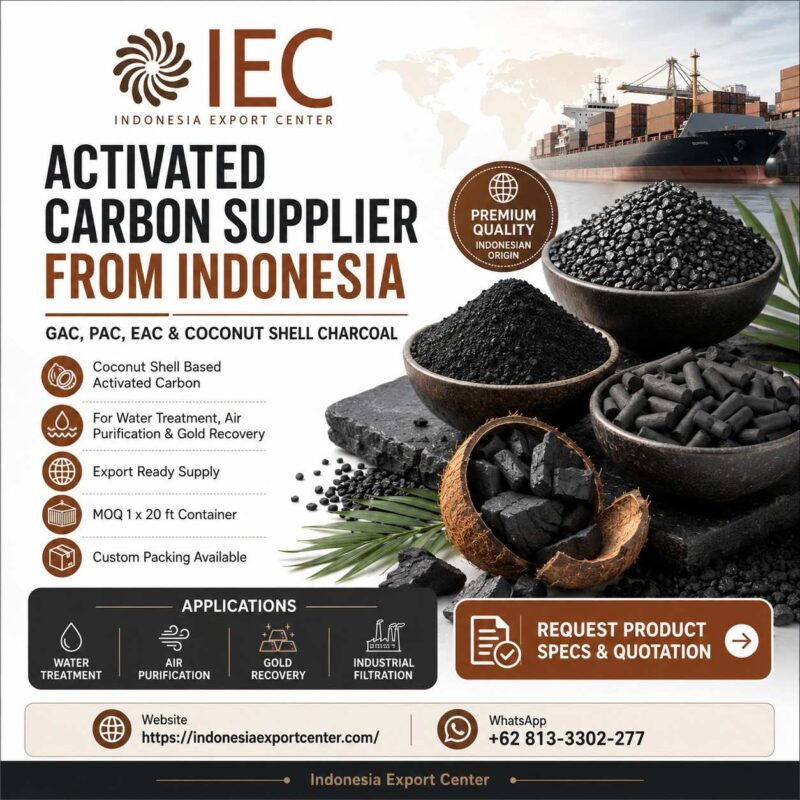
INDONESIAN COCONUT SHELL ACTIVATED CARBON FOR SOUTH KOREA
Industrial Filter Media | OEM Manufacturing | Batch Quality Control | International Wholesale Supply
Indonesian Activated Carbon Sourcing for South Korean Importers
South Korean industrial filtration companies, water-treatment equipment manufacturers, and activated carbon distributors may evaluate Indonesian coconut shell activated carbon as part of their procurement strategies.
For industrial buyers, activated carbon purchasing requires more than confirming a product’s country of origin. The supplied material must meet the required technical specifications, demonstrate acceptable batch consistency, and be compatible with the intended filtration or adsorption system.
Indonesia Export Center (IEC) facilitates sourcing inquiries between South Korean buyers and potential Indonesian activated carbon suppliers.
IEC helps communicate technical requirements, request supplier documentation, arrange preliminary sample inquiries, and coordinate commercial discussions.
Actual production capability, grade availability, and shipment terms require confirmation from the supplier.
Potential Applications in South Korea
Industrial Water Treatment
Industrial water-treatment companies may require granular activated carbon for defined adsorption processes.
Filter Equipment Manufacturing
OEM manufacturers may evaluate activated carbon for filter housings, cartridges, and industrial treatment systems.
Industrial Process Filtration
Manufacturing facilities may use qualified activated carbon to address specific process contaminants.
Activated Carbon Distribution
Importers and wholesalers may seek consistent grades for repeat supply to downstream customers.
Air Purification
Selected carbon grades may be evaluated for gas-phase adsorption, subject to appropriate testing.
Product Grades for Korean Buyers
Potential inquiries may involve:
- Granular activated carbon (GAC).
- Mesh-specific coconut shell GAC.
- Powdered activated carbon (PAC), if manufactured.
- High-iodine grades supported by test results.
- Low-ash grades supported by test results.
- Specialized grades subject to supplier capability.
No grade should be described as currently available without supplier confirmation.
Technical Specification Checklist
| Parameter | Buyer Requirement |
|---|---|
| Raw Material | Coconut shell |
| Product Form | GAC / PAC |
| Product Grade | Defined code |
| Mesh Size | Specified distribution |
| Iodine Number | Required mg/g |
| Moisture | Maximum % |
| Ash | Maximum % |
| Hardness | Method and minimum |
| Apparent Density | Required range |
| pH | If applicable |
| Application Performance | Relevant test |
| Batch COA | Required |
| TDS | Required |
| Packaging | Buyer-defined |
Why Batch Consistency Matters
Industrial OEMs may use activated carbon as a recurring manufacturing input.
Variation in particle size, moisture, adsorption characteristics, or fines content can affect product performance and production processes.
Buyers should establish written specifications and agreed acceptance tolerances.
A supplier’s sample should be linked to an identifiable product grade, and future deliveries should be evaluated against the approved requirements.
Quality Assurance and Supplier Verification
South Korean buyers may request:
- Manufacturer identification.
- Manufacturing facility information.
- Product-specific TDS.
- Batch COA.
- Sieve analysis.
- Relevant adsorption test results.
- Quality-control procedures.
- Product labeling details.
- Sample availability.
- Commercial supply information.
The buyer should verify any certification claims against the actual certificate and its scope.
Sample Approval Workflow
Step 1: Define the intended application and technical requirements.
Step 2: Request documentation for candidate grades.
Step 3: Compare product specifications.
Step 4: Obtain representative samples.
Step 5: Conduct laboratory and application testing.
Step 6: Evaluate manufacturing consistency.
Step 7: Approve an initial commercial lot.
Step 8: Establish repeat-order quality controls.
South Korean Import Compliance
Importers should confirm current Korean customs and product requirements.
Depending on the product’s classification, composition, intended use, and importer’s role, chemical substance obligations under Korean frameworks such as K-REACH may need to be assessed.
Industrial activated carbon, drinking-water materials, and other specialized applications may have different requirements.
IEC does not claim blanket compliance with Korean regulations.
Documentation and Customs Classification
Activated carbon is generally associated with international HS subheading 3802.10.
The applicable Korean tariff classification and import treatment should be confirmed by the importer or customs broker.
Common transaction documents may include:
- Commercial invoice.
- Packing list.
- Bill of lading.
- Origin information.
- Technical documents.
- Other applicable import documents.
Shipping to South Korea
Possible destination ports include Busan and Incheon, depending on the buyer’s distribution arrangements.
Shipment routing, freight cost, and transit time require confirmation.
Packaging and Lot Identification
OEM buyers may require clear product identification on each package.
Relevant information may include product code, batch number, net weight, and handling instructions.
Custom packaging is subject to supplier capability.
Repeat-Order and Replenishment Planning
For ongoing distribution or manufacturing, buyers should communicate:
- Expected monthly volume.
- Order frequency.
- Forecast horizon.
- Required safety stock.
- Lot acceptance procedures.
- Shipment scheduling.
- Packaging requirements.
Long-term supply commitments must be negotiated with the actual seller.
IEC Supplier Coordination
IEC acts as a sourcing facilitator, helping South Korean buyers communicate with potential Indonesian suppliers.
IEC does not independently guarantee production capacity, product performance, or regulatory approval.
South Korea Activated Carbon RFQ
Subject: Indonesian Coconut Shell Activated Carbon for South Korea
Dear Indonesia Export Center Team,
We are a South Korean company evaluating Indonesian coconut shell activated carbon suppliers.
Company: [Company Name] Location: [City, South Korea] Application: [Industrial Filtration / OEM / Other] Product Form: [GAC / PAC] Mesh Size: [Specification] Iodine Number: [mg/g] Moisture: [%] Ash: [%] Hardness: [Requirement] Additional Testing: [Details] Required Documentation: [TDS / COA / Other] Sample Quantity: [Amount] Trial Order: [MT] Monthly Requirement: [MT] Packaging: [Requirement] Destination Port: [Busan / Incheon / Other] Preferred Incoterm: [FOB / CFR / CIF]
Please advise on potential suppliers, product specifications, quality documentation, samples, MOQ, and commercial quotations.
Best regards,
[Name]
[Company]
Frequently Asked Questions
Can South Korean importers source activated carbon from Indonesia?
Yes, subject to supplier availability and applicable import requirements.
Is batch consistency important for OEM filtration?
Yes. Manufacturers should establish measurable quality requirements.
Is Korean chemical compliance automatically satisfied?
No. Applicable obligations must be evaluated for the specific product and importer.
Can IEC request a batch COA?
IEC can facilitate documentation requests.
Are long-term supply agreements possible?
They depend on supplier capability and commercial agreement.
Can buyers request a trial order?
Yes, subject to supplier confirmation.
Request Activated Carbon for South Korea
REQUEST ACTIVATED CARBON FOR SOUTH KOREA
INDONESIA EXPORT CENTER
Connecting Indonesian Products to Global Markets
Website: https://indonesiaexportcenter.com/
WhatsApp: +62 813-3302-277
Related Resources
OEM Activated Carbon Filter Media from Indonesia
Coconut Shell Activated Carbon Distributor Supply
Coconut Shell Activated Carbon TDS and COA Requirements
