

IEC | INDONESIA EXPORT CENTER
COCONUT SHELL ACTIVATED CARBON 6×12 MESH
Mining Carbon Sourcing | Granular Activated Carbon | Sieve Analysis | Industrial Procurement
Source 6×12 Mesh Coconut Shell Activated Carbon from Indonesia
Industrial filtration operators, mining companies, and activated carbon distributors often require granular activated carbon with a specific particle-size distribution.
6×12 mesh coconut shell activated carbon is a nominal granular size classification that may be evaluated for selected mining and industrial applications.
For gold-processing plants, choosing the appropriate carbon size is especially important because particle size affects screening, carbon retention, adsorption kinetics, and mechanical handling.
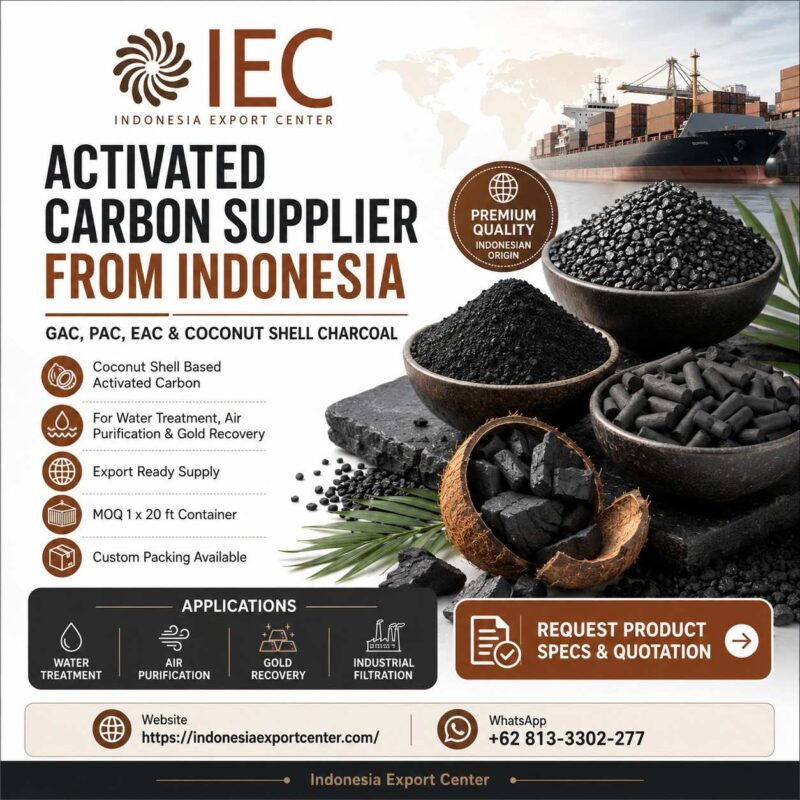
Indonesia Export Center (IEC) facilitates sourcing inquiries for international buyers seeking potential Indonesian suppliers of 6×12 mesh coconut shell activated carbon.
Our sourcing coordination may include technical specification review, supplier introductions, documentation requests, sample inquiries, and commercial discussions.
Actual product availability, mesh distribution, mining-grade suitability, and export terms must be confirmed with the supplier.
What Is 6×12 Mesh Activated Carbon?
The term 6×12 mesh refers to a nominal granular particle-size classification based on specified sieve openings.
Under commonly used U.S. standard sieve designations:
- No. 6 sieve opening: approximately 3.35 mm.
- No. 12 sieve opening: approximately 1.70 mm.
A nominal 6×12 mesh grade is generally associated with particles within this approximate size range.
However, commercial products may contain permitted oversize and undersize fractions.
The actual distribution must be verified through sieve analysis using an agreed test method.
Why Particle Size Matters in Mining
Activated carbon used in gold-processing circuits must be compatible with the plant’s equipment and metallurgical requirements.
Particle size can influence:
- Carbon retention on interstage screens.
- Carbon movement through the circuit.
- Adsorption kinetics.
- Mechanical handling.
- Fines generation.
- Carbon losses.
- Process stability.
The appropriate size must be selected by the plant’s metallurgical team.
Potential Applications
Gold Recovery CIP
Carbon-in-pulp systems use activated carbon in an engineered gold-recovery process.
A 6×12 mesh grade may be evaluated where compatible with the plant’s equipment and operating requirements.
Gold Recovery CIL
Carbon-in-leach systems combine leaching and carbon adsorption within the process circuit.
Carbon selection must account for the specific plant design.
Mining Reagent Distribution
Mining-supply distributors may procure mesh-specific activated carbon for customers with defined specifications.
Industrial Process Filtration
Certain industrial applications may evaluate coarse granular carbon where its physical and adsorption characteristics are appropriate.
6×12 Mesh Technical Specification Checklist
| Parameter | Buyer Requirement |
|---|---|
| Product | Coconut Shell Activated Carbon |
| Nominal Mesh | 6×12 |
| Sieve Standard | Agreed standard |
| Oversize Fraction | Maximum % |
| Undersize Fraction | Maximum % |
| Fines | Maximum % |
| Gold Adsorption Activity | If applicable |
| Adsorption Rate | Required test |
| Hardness | Method and minimum |
| Abrasion Resistance | Required method |
| Moisture | Maximum % |
| Ash | Maximum % |
| Apparent Density | Required range |
| Iodine Number | If relevant |
| Packaging | Buyer-defined |
| Batch COA | Required |
Sieve Analysis and Particle Distribution
A supplier should provide an appropriate sieve analysis demonstrating the actual particle-size distribution.
The test report should identify:
- Sieve standard.
- Test procedure.
- Individual sieve fractions.
- Oversize material.
- Undersize material.
- Fines content.
A product name alone is not sufficient proof of mesh conformity.
Gold Adsorption Performance
Gold recovery applications require evaluation of adsorption behavior under representative process conditions.
The buyer may request relevant gold adsorption activity and rate tests.
An iodine number does not independently establish gold-recovery performance.
Hardness and Abrasion Resistance
Mining carbon may be exposed to repeated mechanical stresses.
Poor durability can increase particle breakage and carbon losses.
Buyers should request relevant hardness or abrasion results and confirm the testing method.
CIP and CIL Compatibility
Carbon selection should reflect the actual plant process.
A carbon grade approved for one circuit should not automatically be approved for another.
The metallurgical team should evaluate the proposed grade before commercial use.
Fines and Carbon Losses
Fines may be generated during manufacturing, transport, handling, or operation.
Excessive fines can create operational challenges and contribute to carbon losses.
Buyers should define acceptable fines limits and inspection requirements.
Sample Qualification Process
Step 1: Submit the plant’s technical specification.
Step 2: Request supplier TDS and COA.
Step 3: Verify mesh distribution.
Step 4: Review hardness and abrasion data.
Step 5: Request relevant gold adsorption testing.
Step 6: Evaluate representative samples.
Step 7: Conduct plant trials where appropriate.
Step 8: Approve the grade before commercial procurement.
Packaging and Export Considerations
Buyers should specify packaging weight, bag construction, labeling, lot identification, palletization, and destination requirements.
Packaging availability must be confirmed by the supplier.
IEC Supplier Coordination
IEC acts as a sourcing facilitator and helps communicate technical and commercial requirements.
The actual manufacturer or seller remains responsible for product claims, supply commitments, export documentation, and binding quotations.
6×12 Mesh Activated Carbon RFQ
Subject: Indonesian Coconut Shell Activated Carbon 6×12 Mesh
Dear Indonesia Export Center Team,
We are seeking potential Indonesian suppliers of 6×12 mesh coconut shell activated carbon.
Company: [Company Name]
Country: [Country]
Application: [CIP / CIL / Industrial]
Required Mesh: 6×12
Sieve Standard: [Standard]
Maximum Oversize: [%]
Maximum Undersize: [%]
Maximum Fines: [%]
Gold Adsorption Activity: [Requirement]
Hardness / Abrasion: [Requirement]
Moisture: [%]
Ash: [%]
Sample Quantity: [Amount]
Commercial Quantity: [MT]
Monthly Requirement: [MT]
Packaging: [Requirement]
Destination Port: [Port]
Preferred Incoterm: [FOB / CFR / CIF]
Please advise whether suitable suppliers can provide product specifications, sieve analysis, COA, samples, MOQ, and a commercial quotation.
Best regards,
[Name]
Frequently Asked Questions
What does 6×12 mesh mean?
It is a nominal granular size classification defined using specified sieve openings.
Is 6×12 mesh suitable for gold recovery?
It may be suitable for selected circuits after metallurgical evaluation.
Is 6×12 mesh automatically mining grade?
No.
Is iodine number sufficient for mining carbon selection?
No. Gold adsorption performance and mechanical durability must also be considered.
Can IEC provide samples?
IEC can facilitate sample inquiries, subject to supplier availability.
Is 6×12 mesh currently available?
Availability must be confirmed with potential suppliers.
Request 6×12 Mesh Activated Carbon
REQUEST 6×12 MESH ACTIVATED CARBON
INDONESIA EXPORT CENTER
Connecting Indonesian Products to Global Markets
Website: https://indonesiaexportcenter.com/
WhatsApp: +62 813-3302-277
Related Resources
Coconut Shell Activated Carbon 4×8 Mesh Supply
Coconut Shell Activated Carbon for Gold Recovery CIP
Coconut Shell Activated Carbon for Gold Recovery CIL
