

IEC | INDONESIA EXPORT CENTER
COCONUT SHELL ACTIVATED CARBON FOR GOLD RECOVERY CIP
Carbon-in-Pulp Applications | Mining-Grade Carbon | Adsorption Performance | Attrition Resistance
Mining-Grade Activated Carbon for Carbon-in-Pulp Gold Recovery
Gold-processing operations using carbon-in-pulp (CIP) technology require activated carbon selected for adsorption performance, mechanical durability, particle-size characteristics, and compatibility with the processing circuit.
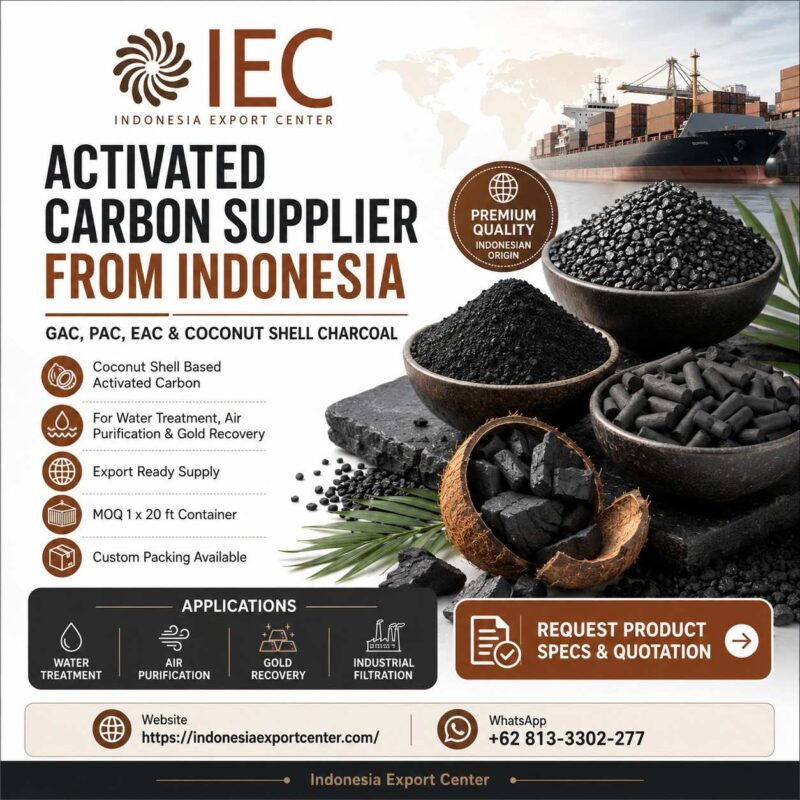
Coconut-shell-derived activated carbon is one material category evaluated for gold adsorption in appropriate mining applications.
Indonesia Export Center (IEC) facilitates sourcing inquiries for mining companies, mineral-processing contractors, engineering firms, and mining-reagent distributors seeking potential Indonesian suppliers of mining-grade activated carbon.
Not every coconut shell activated carbon grade is suitable for gold recovery. Mining-grade performance must be supported by relevant technical testing and supplier documentation.
What Is Carbon-in-Pulp?
Carbon-in-pulp is a gold-recovery process in which dissolved gold is adsorbed onto activated carbon after the ore has undergone an appropriate leaching stage.
The carbon is subsequently separated and processed through the mine’s established gold-recovery circuit.
The effectiveness of the process depends on ore characteristics, solution chemistry, carbon properties, equipment design, and operating conditions.
The Role of Activated Carbon in CIP
Activated carbon provides adsorption sites for dissolved gold species under suitable process conditions.
The carbon must perform reliably while being exposed to slurry movement, screening, pumping, and other operational stresses.
Important properties include:
- Gold adsorption activity.
- Adsorption kinetics.
- Mechanical strength.
- Abrasion resistance.
- Particle-size distribution.
- Fines generation.
- Density.
- Product consistency.
Why Carbon Hardness Matters
Carbon particles may experience repeated mechanical stress in a CIP circuit.
Excessive attrition can create fines and increase the risk of carbon losses.
Hardness and abrasion resistance are therefore important qualification parameters.
Particle Size and Screening
Carbon particle size should be compatible with the mine’s carbon-retention and recovery equipment.
The buyer should specify the required size distribution, applicable sieve standard, and acceptable fines content.
Nominal mesh descriptions alone may be insufficient.
Gold Adsorption Activity
A general iodine number does not establish gold-recovery performance.
Mining buyers should request relevant gold adsorption activity testing using methods appropriate to the intended application.
Laboratory results should be interpreted alongside actual process conditions.
Mining-Grade Technical Specification Checklist
| Parameter | Buyer Requirement |
|---|---|
| Product | Mining-Grade Activated Carbon |
| Raw Material | Coconut shell |
| Application | CIP gold recovery |
| Particle Size | Required distribution |
| Gold Adsorption Activity | Relevant test |
| Adsorption Rate | Required test |
| Hardness / Abrasion | Test method and limit |
| Fines Content | Maximum |
| Apparent Density | Required range |
| Moisture | Maximum % |
| Ash | Maximum % |
| Iodine Number | If required |
| Packaging | Mining-site requirement |
| Batch COA | Required |
Carbon Losses and Operational Economics
Carbon losses may affect both material consumption and precious-metal recovery.
Mining operators should consider carbon breakage, screening efficiency, handling losses, and process controls.
The total operating cost of activated carbon is not determined by purchase price alone.
Carbon Fouling and Performance
Activated carbon performance may be affected by fouling or contamination during use.
The mine’s metallurgical team should evaluate relevant process conditions and regeneration requirements.
Sample Qualification
Before commercial procurement, buyers may request:
- Representative samples.
- Mining-grade TDS.
- COA.
- Particle-size testing.
- Hardness or abrasion testing.
- Gold adsorption activity testing.
- Relevant laboratory or plant trial results.
Plant Trial Considerations
A mine may conduct controlled trials to evaluate adsorption performance, carbon durability, screening behavior, and operational compatibility.
The trial should be designed and assessed by qualified metallurgical personnel.
Safety and Process Responsibility
Gold recovery may involve hazardous processing chemicals and specialized plant systems.
IEC does not provide chemical handling instructions or operational process guarantees.
The mining operator remains responsible for plant engineering, safety, environmental compliance, and process control.
Supplier Qualification
Potential suppliers should be evaluated for actual mining-grade production capability, relevant testing, product consistency, export eligibility, and commercial authority.
A general water-treatment GAC COA should not be used as proof of mining-grade suitability.
CIP Activated Carbon RFQ
Subject: Mining-Grade Coconut Shell Activated Carbon for CIP
Dear IEC Team,
We are evaluating Indonesian mining-grade activated carbon for a carbon-in-pulp gold-recovery application.
Company: [Name]
Mine / Project Country: [Country]
Application: CIP
Required Particle Size: [Distribution]
Gold Adsorption Test: [Requirement]
Hardness / Abrasion: [Requirement]
Maximum Fines: [%]
Apparent Density: [Requirement]
Other Parameters: [Details]
Sample Quantity: [Amount]
Initial Commercial Quantity: [MT]
Recurring Requirement: [MT/month]
Packaging: [Requirement]
Destination Port: [Port]
Preferred Incoterm: [Term]
Please advise whether potential suppliers can provide verified mining-grade technical documentation, samples, and commercial information.
Best regards,
[Name]
Frequently Asked Questions
Is ordinary GAC suitable for CIP gold recovery?
Not necessarily. Mining-grade performance requires separate qualification.
Is iodine number enough to select CIP carbon?
No.
Why is abrasion resistance important?
It helps assess resistance to particle breakdown during handling and operation.
Can IEC guarantee gold adsorption performance?
No.
Can buyers request mining-grade samples?
Yes, subject to supplier availability.
Is a plant trial recommended?
It may be appropriate before commercial approval.
Request CIP Mining-Grade Activated Carbon
REQUEST GOLD RECOVERY CIP ACTIVATED CARBON
INDONESIA EXPORT CENTER
Connecting Indonesian Products to Global Markets
Website: https://indonesiaexportcenter.com/
WhatsApp: +62 813-3302-277
Related Resources
Coconut Shell Activated Carbon for Gold Recovery CIL
Coconut Shell Activated Carbon Custom Specifications
Coconut Shell Activated Carbon Samples and COA
