

INDONESIA EXPORT CENTER (IEC)
B2B Coconut Blossom Nectar Sourcing for Oat Drinks, Soy Beverages, Almond Drinks and Plant-Based Beverage Manufacturers
Coconut Nectar for Plant-Based Beverage Development
Plant-based beverage manufacturers must balance sweetness, flavour, appearance, texture, ingredient compatibility, and shelf stability. A sweetener that performs well in one beverage may behave differently in another because plant proteins, fats, stabilizers, minerals, and processing conditions affect the finished formulation.
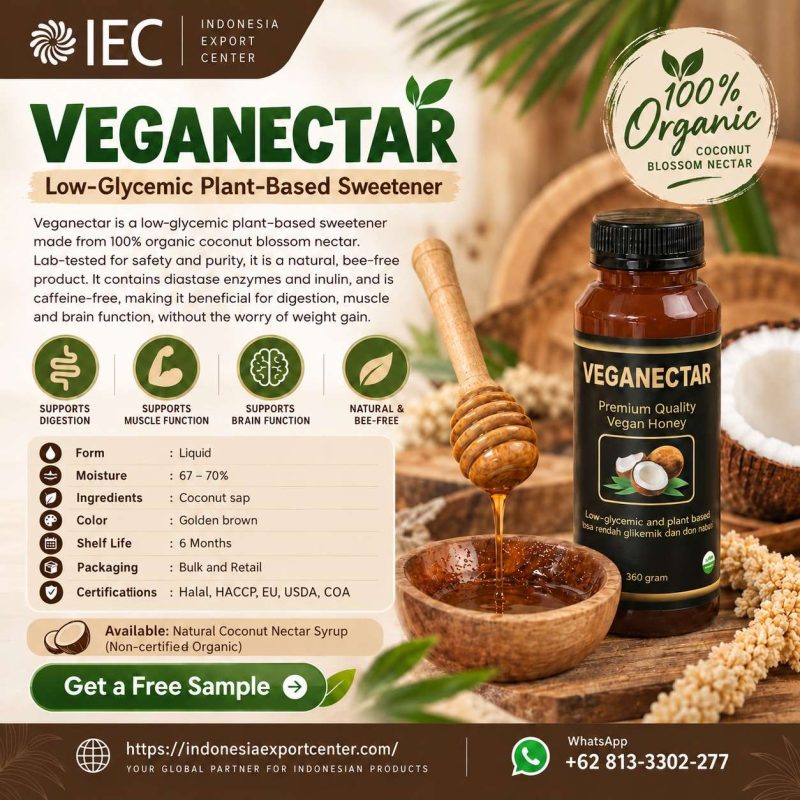
For businesses researching coconut nectar for plant-based beverages, Indonesia Export Center (IEC) facilitates sourcing inquiries for Indonesian coconut blossom nectar syrup, including the VEGANECTAR product described in IEC promotional material.
VEGANECTAR is presented as a plant-derived, bee-free liquid sweetener made from coconut sap. Its golden-brown appearance and liquid form may be relevant to selected plant-based beverage concepts.
However, its suitability for dairy alternatives, ready-to-drink products, or beverage concentrates must be established through formulation trials.
Understanding Coconut Blossom Nectar
Coconut blossom nectar is a liquid sweetening ingredient derived from coconut palm sap.
It differs from granulated coconut sugar in its physical form and water contribution. It also differs from conventional liquid sweeteners in composition and sensory characteristics.
Manufacturers should evaluate it against their existing ingredients using measured specifications.
VEGANECTAR Reference Product Information
| Parameter | Promotional Information |
|---|---|
| Product | VEGANECTAR |
| Source | Coconut Sap |
| Ingredient Claim | 100% Organic Coconut Blossom Nectar |
| Physical Form | Liquid |
| Colour | Golden Brown |
| Moisture | 67–70% |
| Shelf Life | 6 Months |
| Packaging | Bulk and Retail |
| Certification References | Halal, HACCP, EU, USDA |
| Alternative | Natural Coconut Nectar Syrup |
These are promotional references, not independently verified batch specifications.
Potential Plant-Based Beverage Applications
Oat-Based Beverages
Oat drink manufacturers may investigate coconut nectar for sweetness and flavour. Trials should evaluate interaction with the oat base, processing conditions, and storage stability.
Soy-Based Beverages
Soy beverages can have distinctive protein and flavour characteristics. Coconut nectar should be tested for sensory compatibility and physical stability.
Almond and Other Nut Beverages
Nut beverage producers may evaluate coconut nectar in selected sweetened formulations. Colour and flavour should be considered alongside emulsion stability.
Coconut-Based Drinks
Coconut nectar may be investigated in coconut-derived beverages. The finished drink’s sweetness and flavour must be balanced experimentally.
Plant-Based Coffee Drinks
Manufacturers may evaluate coconut nectar in ready-to-drink coffee beverages containing plant-based milk alternatives.
Plant-Based Cocoa Drinks
Coconut nectar may be tested alongside cocoa and plant-derived beverage bases.
Ingredient Compatibility
The success of a sweetener in a plant-based beverage depends on its interaction with the complete formulation.
Relevant considerations include:
- Plant protein stability.
- Fat dispersion.
- pH.
- Minerals.
- Stabilizers.
- Homogenization.
- Heat processing.
- Sedimentation.
- Storage temperature.
No specific compatibility results are provided in the VEGANECTAR flyer.
Sweetness and Flavour Evaluation
Manufacturers should establish the desired sweetness using controlled dosage trials.
Sensory testing may assess sweetness intensity, aftertaste, coconut nectar flavour contribution, and compatibility with the beverage base.
A successful formula should satisfy both sensory and technical requirements.
Colour Considerations
VEGANECTAR is described as golden brown.
This may influence the appearance of light-coloured oat, almond, or other plant-based beverages.
Manufacturers should evaluate colour immediately after processing and during storage.
Moisture and Soluble Solids
The promotional moisture range of 67–70% is relevant to beverage formulation.
Buyers may also request Brix, total soluble solids, sugar composition, and water activity data.
These measurements help manufacturers understand the ingredient’s contribution to the finished product.
Processing and Stability Trials
Plant-based beverage manufacturers may use pasteurization, UHT processing, homogenization, or other technologies.
Coconut nectar’s performance under any particular process is not established by the flyer.
Testing may include:
- Ingredient dispersion.
- Heat treatment compatibility.
- pH changes.
- Sedimentation.
- Emulsion stability.
- Colour stability.
- Flavour retention.
- Microbiological quality.
- Packaging compatibility.
- Shelf-life performance.
Sample Evaluation Checklist
| Evaluation Area | Recommended Assessment |
|---|---|
| Ingredient Identity | Verify specification and composition |
| Sweetness | Establish dosage |
| Flavour | Evaluate compatibility with plant base |
| Colour | Compare against product target |
| Mixing | Assess uniformity |
| pH | Monitor formulation response |
| Heat Treatment | Validate under intended process |
| Sedimentation | Observe during storage |
| Microbiology | Assess relevant food safety criteria |
| Shelf Life | Validate finished beverage stability |
Organic and Vegan Positioning
The flyer describes VEGANECTAR as organic and bee-free.
Buyers should request current organic certification and relevant ingredient declarations before making claims.
The natural non-certified organic variant should be treated separately.
The product should not be promoted as sugar-free or medically beneficial without appropriate evidence.
Industrial Procurement Requirements
Beverage manufacturers may request:
- Current specification.
- Ingredient declaration.
- COA.
- Microbiological test results.
- Organic and halal documentation where relevant.
- Packaging options.
- Samples.
- MOQ.
- Lead time.
- Export quotation.
Supply feasibility must be confirmed.
Plant-Based Beverage RFQ Template
Subject: Coconut Nectar for Plant-Based Beverage Manufacturing
Company: [Name]
Country: [Country]
Beverage Base: [Oat / Soy / Almond / Coconut / Other]
Product: VEGANECTAR Coconut Blossom Nectar
Variant: [Organic / Natural]
Initial Quantity: [KG or MT]
Monthly Forecast: [Quantity]
Required Technical Parameters: [Details]
Processing Method: [Details]
Packaging: [Details]
Destination Port: [Port]
Please provide current specifications, COA, ingredient declaration, sample feasibility, packaging, MOQ, lead time, and export quotation.
Frequently Asked Questions
Can coconut nectar be used in oat beverages?
It may be evaluated through formulation trials.
Can coconut nectar be used in soy drinks?
Potentially, subject to ingredient compatibility and stability testing.
Does coconut nectar remain stable during UHT processing?
No such performance guarantee is provided. Testing is necessary.
Will coconut nectar change beverage colour?
It may influence appearance; the result should be tested.
Is VEGANECTAR suitable for vegan beverage brands?
Its plant-derived positioning may be relevant, but claims require documentation.
Is VEGANECTAR organic-certified?
The flyer references organic status; current certification must be verified.
Can manufacturers request samples?
Sample availability requires supplier confirmation.
Can IEC facilitate bulk purchasing inquiries?
Yes, subject to supplier feasibility.
Discuss Coconut Nectar for Plant-Based Beverages
Contact Indonesia Export Center to explore coconut nectar sourcing for your plant-based beverage development program.
REQUEST PLANT-BASED BEVERAGE APPLICATION SAMPLE
INDONESIA EXPORT CENTER (IEC)
Website: https://indonesiaexportcenter.com/
WhatsApp: +62 813-3302-277
Product suitability, certifications, samples, specifications, packaging, MOQ, pricing, and shipment arrangements require confirmation.
Related Resources
Coconut Nectar for Beverage Manufacturers
Coconut Nectar for Vegan Food Brands
Liquid Coconut Sap Sweetener from Indonesia
