

INDONESIA EXPORT CENTER (IEC)
Wholesale Coconut Blossom Nectar Sourcing for Coffee Shops, Tea Brands, Beverage Distributors and Commercial Drink Manufacturers
Coconut Nectar for Coffee and Tea Applications
Coffee and tea businesses continuously explore sweetening ingredients that can complement their beverages, support new menu concepts, and meet customer preferences for plant-derived ingredients.
For companies searching for coconut nectar for coffee and tea, Indonesian coconut blossom nectar syrup may be worth evaluating.
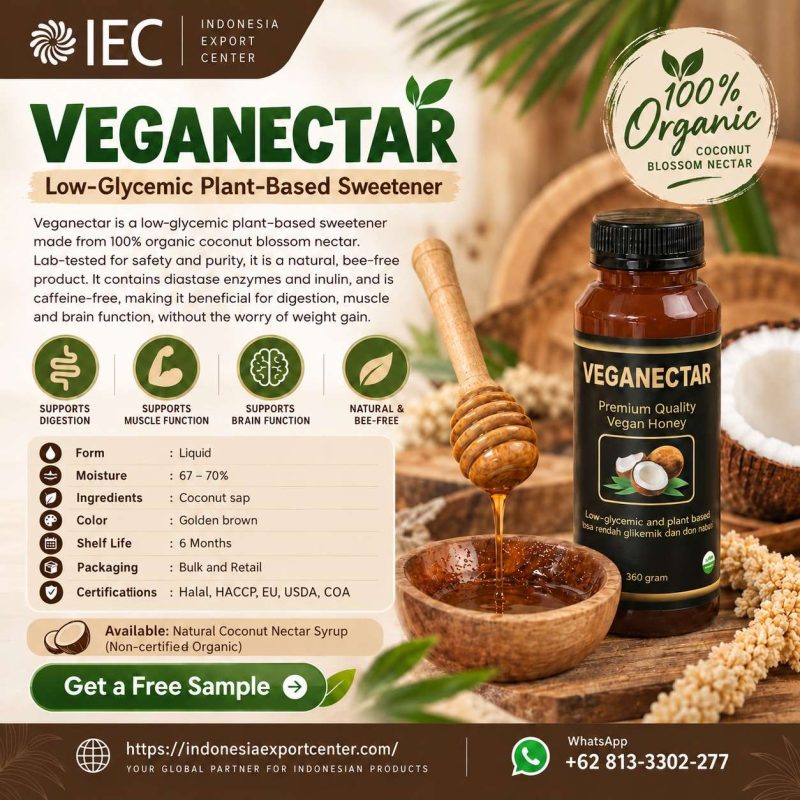
Indonesia Export Center (IEC) facilitates sourcing inquiries for Indonesian coconut nectar syrup, including VEGANECTAR, a product presented in promotional material as a liquid sweetener derived from coconut sap.
VEGANECTAR is described as golden brown, plant-based, and bee-free, with bulk and retail packaging referenced in the promotional material.
Coffee roasters, tea brands, café operators, beverage distributors, and drink manufacturers may evaluate the ingredient for selected beverage applications.
However, actual sweetness, flavour compatibility, dissolution, and stability must be tested before commercial adoption.
What Is Coconut Blossom Nectar Syrup?
Coconut blossom nectar syrup is a liquid sweetening ingredient derived from coconut palm sap.
Its liquid form differs from granulated coconut sugar and may be relevant to beverage recipes where liquid ingredients are preferred.
The ingredient can be assessed for sweetness, flavour, colour, and blending behaviour.
It should not automatically be treated as an equivalent replacement for cane syrup, honey, agave syrup, or another beverage sweetener.
VEGANECTAR Reference Product Specifications
| Parameter | Information from Promotional Material |
|---|---|
| Product | VEGANECTAR |
| Category | Coconut Blossom Nectar Syrup |
| Ingredient Claim | 100% Organic Coconut Blossom Nectar |
| Source | Coconut Sap |
| Form | Liquid |
| Colour | Golden Brown |
| Moisture | 67–70% |
| Shelf Life | 6 Months |
| Packaging | Bulk and Retail |
| Certification References | Halal, HACCP, EU, USDA |
| Alternative Variant | Natural Coconut Nectar Syrup |
The information requires verification against current supplier specifications and documentation.
Why Coffee Businesses May Evaluate Coconut Nectar
Specialty Coffee Menu Development
Coffee businesses may evaluate coconut nectar as a sweetening option for selected signature drinks.
Plant-Based Ingredient Positioning
The coconut sap origin may be relevant to cafés developing plant-based beverage menus.
Distinctive Sensory Characteristics
The ingredient’s colour and potential flavour contribution may influence beverage development.
Wholesale Ingredient Opportunities
Coffee ingredient distributors may assess coconut nectar for resale to cafés and specialty beverage customers.
Coconut Nectar in Hot Coffee
Cafés may investigate coconut nectar in espresso-based beverages, brewed coffee, or selected coffee preparations.
A trial should assess:
- Sweetness intensity.
- Flavour interaction.
- Mixing time.
- Appearance.
- Aftertaste.
- Customer acceptance.
The required dosage must be established through testing.
Coconut Nectar in Iced Coffee
Cold beverages may present different blending challenges.
Manufacturers and cafés should evaluate:
- Mixing at low temperature.
- Uniformity.
- Sediment formation.
- Flavour balance.
- Colour.
- Storage stability where applicable.
No guaranteed cold-dissolution performance is provided in the VEGANECTAR flyer.
Coconut Nectar in Tea
Tea businesses may test coconut nectar in selected black tea, green tea, herbal tea, or specialty tea formulations.
The ingredient may influence the perceived flavour and appearance of the beverage.
Different tea varieties may respond differently to the sweetener.
Coconut Nectar in Milk Tea
Milk tea manufacturers may evaluate coconut nectar for sweetness and flavour.
Compatibility with dairy or plant-based ingredients should be tested.
Potential considerations include:
- Ingredient mixing.
- Flavour balance.
- Sedimentation.
- Colour.
- Microbiological quality.
- Finished-product stability.
Coconut Nectar in Ready-to-Drink Coffee and Tea
Industrial beverage manufacturers require more extensive validation than café operators preparing drinks for immediate consumption.
Relevant tests may include:
- pH.
- Brix.
- Microbiological quality.
- Colour stability.
- Flavour stability.
- Sedimentation.
- Packaging compatibility.
- Shelf-life performance.
The six-month promotional shelf life of VEGANECTAR does not establish the shelf life of a finished ready-to-drink beverage.
Flavour Pairing Evaluation
Coconut nectar may be evaluated alongside different beverage ingredients.
Potential combinations to investigate include:
- Coffee and coconut nectar.
- Black tea and coconut nectar.
- Cocoa and coconut nectar.
- Cinnamon-flavoured beverages.
- Vanilla-flavoured beverages.
- Selected plant-based milk drinks.
These are formulation ideas rather than verified product-performance claims.
Sweetness Comparison
Coffee and tea businesses should not assume that coconut nectar has the same sweetness intensity as conventional syrup.
A practical sensory test can compare several controlled dosage levels.
The preferred formulation should be based on taste, ingredient cost, and beverage quality.
Café Serving Formats
Potential foodservice requirements include:
- Convenient pouring containers.
- Portion-control packaging.
- Food-contact-safe closures.
- Easy handling.
- Clear date coding.
- Suitable storage instructions.
The flyer references bulk and retail packaging but does not confirm specific bottle or dispenser formats.
Sample Evaluation Checklist
| Evaluation | Question |
|---|---|
| Appearance | Is the colour acceptable? |
| Aroma | Does it complement the drink? |
| Sweetness | What dosage is required? |
| Hot Mixing | Does it disperse adequately? |
| Cold Mixing | Does it remain uniform? |
| Flavour | Is the taste acceptable? |
| Sedimentation | Does sediment develop? |
| Storage | What conditions are required? |
| Documentation | Are specifications available? |
| Cost | Is the recipe commercially feasible? |
Food Safety and Quality Documentation
Buyers may request:
- Current product specification.
- Ingredient declaration.
- Certificate of Analysis.
- Microbiological information.
- Shelf-life evidence.
- Organic certification where claimed.
- Halal documentation where relevant.
- Packaging specifications.
- Storage instructions.
Organic and Natural Coconut Nectar
The flyer references organic VEGANECTAR and a natural non-certified organic variant.
Buyers should verify the relevant certification before using organic claims.
The natural variant should not be represented as certified organic without valid documentation.
Wholesale Sourcing Considerations
Commercial buyers should confirm:
- Available packaging.
- Minimum order quantity.
- Sample feasibility.
- Production capacity.
- Lead time.
- Storage requirements.
- Export documentation.
- Freight arrangements.
- Current price.
- Repeat-order feasibility.
Coffee and Tea Ingredient RFQ Template
Subject: Coconut Nectar Syrup for Coffee and Tea – B2B Inquiry
Company: [Company Name]
Country: [Country]
Business Type: [Café / Coffee Brand / Tea Brand / Distributor]
Application: [Hot Coffee / Iced Coffee / Tea / RTD Beverage]
Product: VEGANECTAR Coconut Blossom Nectar
Variant: [Organic / Natural]
Initial Quantity: [KG or Units]
Monthly Demand: [Quantity]
Preferred Packaging: [Details]
Required Certifications: [Details]
Destination: [Port]
Please provide current product specifications, sample feasibility, available packaging, storage instructions, MOQ, lead time, and wholesale quotation.
Frequently Asked Questions
Can coconut nectar be used in coffee?
It may be evaluated in selected coffee formulations.
Can coconut nectar be used in tea?
Yes, as a potential ingredient for formulation trials.
Does coconut nectar dissolve in cold beverages?
Actual mixing performance should be tested.
Is coconut nectar identical to honey?
No. It is a different ingredient.
Is VEGANECTAR organic-certified?
The flyer references organic certification, but current evidence must be verified.
What is the reported shelf life?
Six months, according to the promotional material.
Can cafés request smaller packaging?
They may inquire about available retail formats.
Can beverage manufacturers request bulk supply?
Bulk packaging is referenced, subject to supplier confirmation.
Request Coconut Nectar Samples for Coffee and Tea
Looking for coconut blossom nectar syrup for cafés, tea businesses, or beverage manufacturing?
Contact Indonesia Export Center with your intended application, packaging requirements, and purchasing volume.
REQUEST COFFEE AND TEA APPLICATION SAMPLE
INDONESIA EXPORT CENTER (IEC)
Website: https://indonesiaexportcenter.com/
WhatsApp: +62 813-3302-277
Product specifications, certifications, samples, packaging, MOQ, prices, and supply arrangements require supplier verification.
Related Resources
Coconut Nectar for Beverage Manufacturers
VEGANECTAR Coconut Nectar Syrup Wholesale
Coconut Nectar for HoReCa Supply
