

Indonesia Export Center (IEC) | Organic Coconut Blossom Nectar Procurement
How to Verify Organic Coconut Nectar Before Importing
Organic certification is an important purchasing requirement for many international food ingredient importers, organic food brands and specialty distributors.
However, a product described as natural, plant-based or made from coconut sap is not automatically certified organic.
Likewise, an organic logo in promotional material is not sufficient proof that a specific supplier, manufacturing facility, product or shipment is covered by a valid certification.
Indonesia Export Center (IEC) facilitates sourcing inquiries for Indonesian coconut blossom nectar syrup, including VEGANECTAR.
This guide explains how buyers can verify organic claims, evaluate certification documents and distinguish certified-organic coconut nectar from non-certified natural alternatives.
VEGANECTAR Organic Product Reference
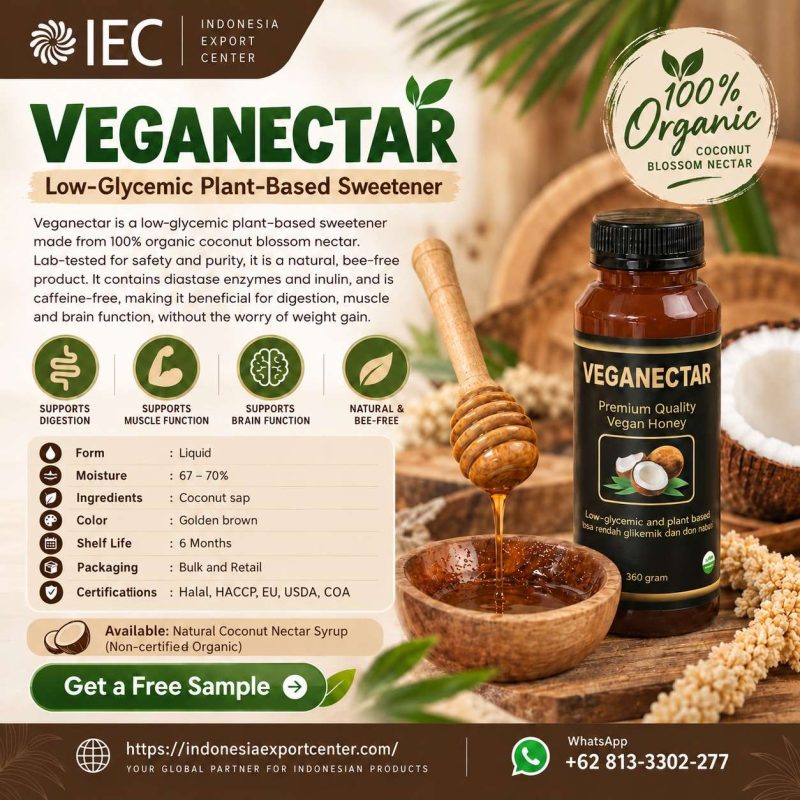
VEGANECTAR is presented in promotional material as a liquid sweetener made from 100% organic coconut blossom nectar.
The flyer references EU and USDA organic-related certifications, alongside Halal, HACCP and COA.
It also mentions a Natural Coconut Nectar Syrup alternative that is not certified organic.
No independently verified certificate, certificate number, certified operation or current validity record has been provided in the supplied material.
Therefore, buyers should treat organic certification as a claim requiring documentary confirmation.
Organic vs Natural Coconut Nectar
| Topic | Certified Organic Coconut Nectar | Natural Non-Certified Coconut Nectar |
|---|---|---|
| Coconut sap origin | Must satisfy applicable organic requirements | Coconut sap origin does not establish organic status |
| Certification | Requires valid applicable certification | No certified-organic status established |
| Organic labelling | Subject to applicable rules | Must not claim certified organic without evidence |
| Supply-chain records | Organic traceability requirements apply | General traceability requirements still apply |
| Import documentation | Market-specific organic requirements may apply | General food import requirements apply |
| Price | Supplier quotation required | Supplier quotation required |
The exact product specifications of the two variants must be verified separately.
Step 1: Request the Current Organic Certificate
Buyers should request a readable copy of the current certificate from the prospective supplier.
The document should identify the certified operation and the relevant certification scope.
Do not rely solely on screenshots of certification logos.
Step 2: Verify the Certificate Holder
The certificate holder should be identified and compared with the actual supplier, manufacturer or processor.
The company selling the product may not be the same entity that manufactures it.
Buyers should understand the role of each party in the supply chain.
Step 3: Check the Product Scope
A certificate covering one product does not automatically cover every product made by the same company.
The buyer should verify whether the relevant coconut blossom nectar syrup is included within the applicable certified scope.
The exact product description may differ between certificates and commercial labels.
Step 4: Check the Certification Body
The buyer should identify the issuing certification body and determine whether it is recognized under the applicable organic system.
Where an official database is available, certificate details should be checked against that source.
Step 5: Verify Current Validity
Organic certification is not established simply because a certificate existed in the past.
Buyers should check the current status, relevant validity information, and any suspension or withdrawal notices.
Step 6: Review the Supply Chain
Depending on the market and transaction, relevant organic requirements may extend to processing, handling, trading, storage, repacking and import activities.
Buyers should determine which operations must be certified and how the product’s identity is maintained.
USDA Organic Verification
For buyers targeting the United States, the USDA National Organic Program is a key reference.
Importers should verify the certified operation, applicable product scope, import requirements and relevant documentation.
Where required, USDA organic imports must be accompanied by the applicable NOP Import Certificate.
Official reference: https://www.ams.usda.gov/rules-regulations/organic
The presence of a USDA logo in a flyer does not prove that the product is eligible for organic sale in the United States.
EU Organic Verification
For buyers targeting the European Union, the applicable EU organic framework and import controls must be considered.
Importers should review:
- Certified operation.
- Recognized control body.
- Product scope.
- Applicable import arrangements.
- Supply-chain documentation.
- TRACES procedures.
- Certificate of Inspection requirements.
- Organic labelling eligibility.
Official reference: https://agriculture.ec.europa.eu/farming/organic-farming_en
The applicable requirements should be verified for the actual transaction.
Other Destination Markets
Organic requirements differ between countries.
Buyers in Japan, Canada, the United Kingdom, Australia, Saudi Arabia, the UAE and other markets should verify the local rules and recognition arrangements.
Certification under one system does not automatically establish compliance with every other system.
Transaction Documents and Traceability
Depending on the organic programme and destination market, buyers may need documentation linking the certified operation to the commercial shipment.
Relevant information can include:
- Supplier identity.
- Product identity.
- Lot numbers.
- Quantity.
- Purchase records.
- Shipment documents.
- Organic import certificates where required.
- Other applicable traceability records.
The precise documents vary by regulatory framework.
Organic Segregation and Handling
Buyers should ask how certified-organic material is identified and protected during processing, storage, filling and shipment.
Questions may include:
- Are organic and non-certified products handled separately?
- How are batches identified?
- What records support traceability?
- Are cleaning procedures documented?
- Are packaging operations covered where required?
- Can the shipment be traced to the certified source?
- What happens if certification status changes?
The supplier should provide evidence for its actual operating practices.
Organic Certification vs Food Safety Certification
Organic certification and food safety management address different requirements.
A product may have organic certification without that certificate alone proving every food safety parameter.
Similarly, a supplier may operate a food safety management system without being certified organic.
Buyers should assess each requirement independently.
Organic Certification Verification Checklist
| Verification Item | Buyer Action |
|---|---|
| Certificate holder | Match to actual operation |
| Issuing body | Verify recognition |
| Certificate status | Check current validity |
| Product scope | Confirm coconut nectar coverage |
| Facility | Confirm relevant site |
| Supply chain | Review certified operations |
| Import requirements | Check destination rules |
| Transaction records | Verify shipment traceability |
| Organic label | Confirm authorization |
| Natural variant | Keep non-certified status separate |
Organic Documentation Request Template
Subject: Organic Coconut Blossom Nectar Certification Verification
Company: [Company Name]
Destination market: [Country]
Product: VEGANECTAR Coconut Blossom Nectar
Required organic standard: [USDA / EU / Other]
Initial quantity: [Quantity]
Packaging: [Details]
Please provide the current organic certificate, certification body details, certified operation information, product scope, relevant supply-chain records and applicable organic import documentation.
Please also confirm whether the requested product and shipment can be supplied under the required organic certification arrangement.
Frequently Asked Questions
Is VEGANECTAR certified organic?
The promotional material claims organic status, but the current certificate has not been independently verified.
Does a USDA logo prove organic certification?
No. Buyers should verify current certification and scope.
Is EU organic certification the same as USDA organic certification?
No. They are distinct regulatory systems with their own requirements.
Can a natural coconut nectar product be labelled organic?
Not without valid certification and compliance with applicable rules.
Does a COA prove organic status?
No. A COA reports analytical results.
Can organic certification apply to the manufacturer but not the trader?
Certification obligations depend on the applicable system and supply-chain activities.
Can IEC facilitate certification document requests?
Yes, subject to supplier cooperation and document availability.
Check Coconut Nectar Organic Certification Status
Contact Indonesia Export Center with your destination market, required organic standard and purchasing volume.
Indonesia Export Center (IEC)
Website: https://indonesiaexportcenter.com/
WhatsApp: +62 813-3302-277
No product-specific organic certification is independently verified by this page. Buyers must review current evidence and applicable market requirements before making organic claims.
Related Resources
Organic Coconut Nectar Sourcing
VEGANECTAR Coconut Nectar Syrup Wholesale
Coconut Nectar Certificate of Analysis Guide
