

INDONESIA EXPORT CENTER (IEC)
Organic Coconut Blossom Nectar Procurement, Supplier Qualification and International Documentation Review
Organic Coconut Nectar Sourcing from Indonesia
Organic food manufacturers and importers require ingredients supported by appropriate certification, traceability, and documentation.
For buyers evaluating organic coconut nectar sourcing, Indonesia Export Center (IEC) facilitates inquiries involving Indonesian coconut blossom nectar syrup, including the VEGANECTAR product described in its promotional material.
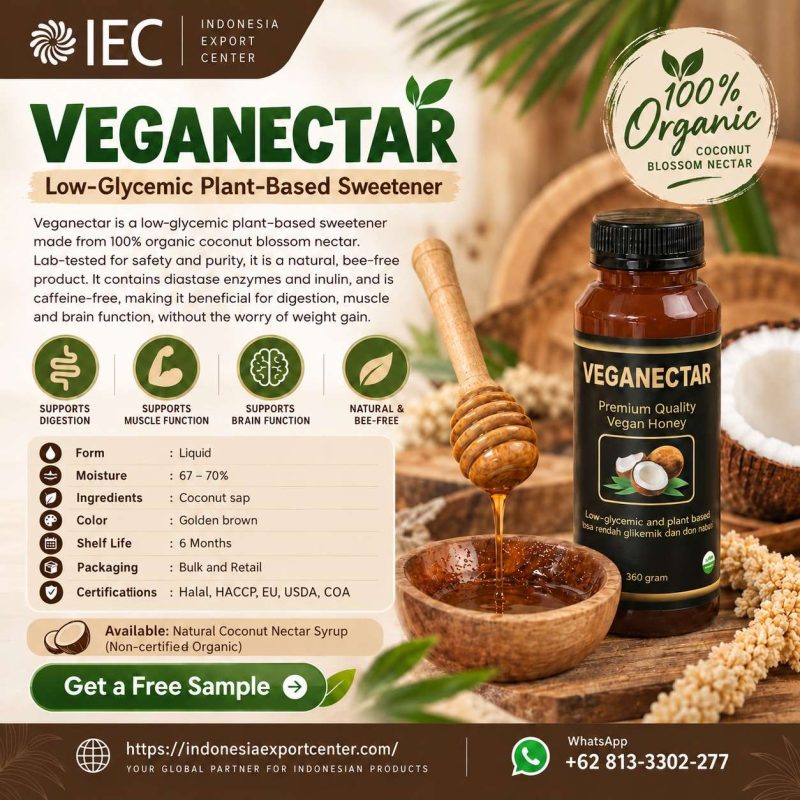
The flyer identifies VEGANECTAR as a liquid sweetener made from 100% organic coconut blossom nectar and references EU and USDA organic-related markings.
These statements are promotional and must be verified before a buyer relies on them for organic product manufacturing, importation, or labelling.
An organic sourcing program should evaluate the product, the certified operator, the supply chain, and the destination market’s rules.
What Is Organic Coconut Blossom Nectar?
Coconut blossom nectar is derived from coconut palm sap.
For the product to be marketed as certified organic, the relevant production and handling activities must meet applicable organic requirements.
Organic status should not be inferred from the product’s plant origin, appearance, or natural ingredient description.
VEGANECTAR Reference Product Profile
| Parameter | Promotional Information |
|---|---|
| Product | VEGANECTAR |
| Source | Coconut Sap |
| Ingredient Claim | 100% Organic Coconut Blossom Nectar |
| Form | Liquid |
| Moisture | 67–70% |
| Colour | Golden Brown |
| Shelf Life | 6 Months |
| Packaging | Bulk and Retail |
| Organic References | EU and USDA |
| Other References | Halal, HACCP, COA |
The product information requires verification against current supplier records.
Organic Certification Is More Than a Logo
An organic logo or statement on promotional material does not establish the current certification status of a specific product.
Buyers should request the underlying documents.
Important verification points include:
- Certified operator’s legal name.
- Certification body.
- Certificate number.
- Validity period.
- Certified product scope.
- Relevant manufacturing or handling facilities.
- Supply-chain participants.
- Transaction documentation.
- Destination-market acceptance.
- Product labelling permissions.
USDA Organic Considerations
For buyers targeting the United States, organic claims should be evaluated against applicable USDA National Organic Program requirements.
The importer should determine whether the relevant certified operations and import documentation satisfy current requirements.
An organic certificate alone may not be sufficient for a particular import transaction.
The buyer should coordinate with its certifier and import compliance professionals.
EU Organic Considerations
For European Union markets, organic importers should verify the applicable EU organic framework and import procedures.
This may involve reviewing the recognized control body, certified operator, supply-chain documentation, and transaction-specific import requirements.
The importer should confirm the current procedure before shipment.
Organic Chain of Custody
Organic integrity depends on maintaining appropriate controls throughout the supply chain.
Potential points of review include:
- Raw material sourcing.
- Processing.
- Storage.
- Packaging.
- Transport.
- Trading.
- Export handling.
- Import handling.
- Distribution.
The relevant certification scope should cover activities required under the destination market’s rules.
Organic vs Natural Coconut Nectar
The IEC flyer also references a natural non-certified organic alternative.
| Attribute | Organic VEGANECTAR | Natural Variant |
|---|---|---|
| Marketing Position | Organic | Natural |
| Organic Certification | Claimed; Requires Verification | Not Described as Certified Organic |
| Product Form | Liquid | Requires Confirmation |
| Moisture | 67–70% Reported for VEGANECTAR | Not Separately Confirmed |
| Shelf Life | 6 Months Reported for VEGANECTAR | Not Separately Confirmed |
| Organic Labelling | Subject to Valid Compliance | Not Appropriate Without Certification |
Buyers should maintain clear separation between the two variants.
Product Quality Beyond Organic Certification
Organic certification does not replace food safety or product quality testing.
Buyers should separately evaluate:
- Ingredient composition.
- Moisture.
- Brix.
- pH.
- Water activity.
- Microbiological quality.
- Relevant contaminants.
- Shelf life.
- Packaging.
- Traceability.
Certificate of Analysis Review
A COA should identify the product and relevant analytical results.
Buyers should review lot numbers, methods, dates, and specification limits.
The availability of a COA does not independently prove organic certification.
Organic Product Applications
Organic coconut nectar may be evaluated for:
- Organic specialty beverages.
- Organic bakery products.
- Organic dessert sauces.
- Organic plant-based foods.
- Organic retail sweeteners.
- Organic foodservice products.
The finished product’s organic labelling eligibility depends on the complete formulation and applicable regulations.
Packaging and Labelling
Organic buyers should clarify:
- Available bulk and retail formats.
- Product identity.
- Organic certification marks.
- Certified operator details.
- Lot coding.
- Country of origin.
- Importer information.
- Destination-market label rules.
Artwork and label claims should be approved before printing.
Organic Supplier Approval Process
A practical approval sequence may involve:
- Obtain manufacturer identity.
- Request current organic certification.
- Verify the certificate with the relevant body or database.
- Confirm product scope.
- Review the supply chain.
- Confirm destination-market import requirements.
- Request product specification.
- Evaluate COA and food safety records.
- Assess samples.
- Agree commercial and documentary requirements.
Organic Coconut Nectar RFQ Template
Subject: Certified Organic Coconut Nectar Sourcing Inquiry
Company: [Name]
Destination Market: [Country]
Product: VEGANECTAR Organic Coconut Blossom Nectar
Application: [Details]
Initial Quantity: [KG or MT]
Monthly Demand: [Quantity]
Required Organic Standard: [US / EU / Other]
Required Documents: [Details]
Packaging: [Details]
Destination Port: [Port]
Please provide the current organic certificate, certificate holder information, product scope, relevant import documentation, specification, COA, sample feasibility, MOQ, lead time, and quotation.
Frequently Asked Questions
Is VEGANECTAR promoted as organic?
Yes, in the supplied promotional material.
Does the flyer prove USDA organic certification?
No. Current certification must be verified.
Does an EU logo prove import eligibility?
No. Applicable documentation and compliance must be checked.
Is natural coconut nectar automatically organic?
No.
Does organic certification replace food safety testing?
No.
Can buyers request certification documents?
Yes, subject to supplier availability.
Can IEC confirm organic import compliance automatically?
No. Destination-specific review is necessary.
Can buyers request bulk quotations?
Yes, subject to supplier feasibility.
Discuss Organic Coconut Nectar Supply Options
Contact IEC to request current organic documentation and explore sourcing feasibility.
DISCUSS ORGANIC COCONUT NECTAR SOURCING
INDONESIA EXPORT CENTER (IEC)
Website: https://indonesiaexportcenter.com/
WhatsApp: +62 813-3302-277
Organic certification, chain of custody, product specifications, import eligibility, packaging, MOQ, and prices require verification.
Related Resources
Coconut Blossom Nectar Supplier Indonesia
VEGANECTAR Coconut Nectar Syrup Wholesale
Natural Coconut Nectar Syrup Wholesale
