

INDONESIA EXPORT CENTER (IEC)
VEGANECTAR Coconut Nectar Syrup, CFIA-Related Import Review, Bilingual Retail Labelling and B2B Sourcing
Indonesian Coconut Blossom Nectar for Canadian Buyers
Canadian ingredient importers, food manufacturers, specialty retailers, and distributors may evaluate coconut blossom nectar syrup as a plant-derived sweetening ingredient.
For businesses researching a coconut nectar supplier for Canada, Indonesia Export Center (IEC) facilitates sourcing inquiries for Indonesian coconut blossom nectar syrup, including VEGANECTAR.
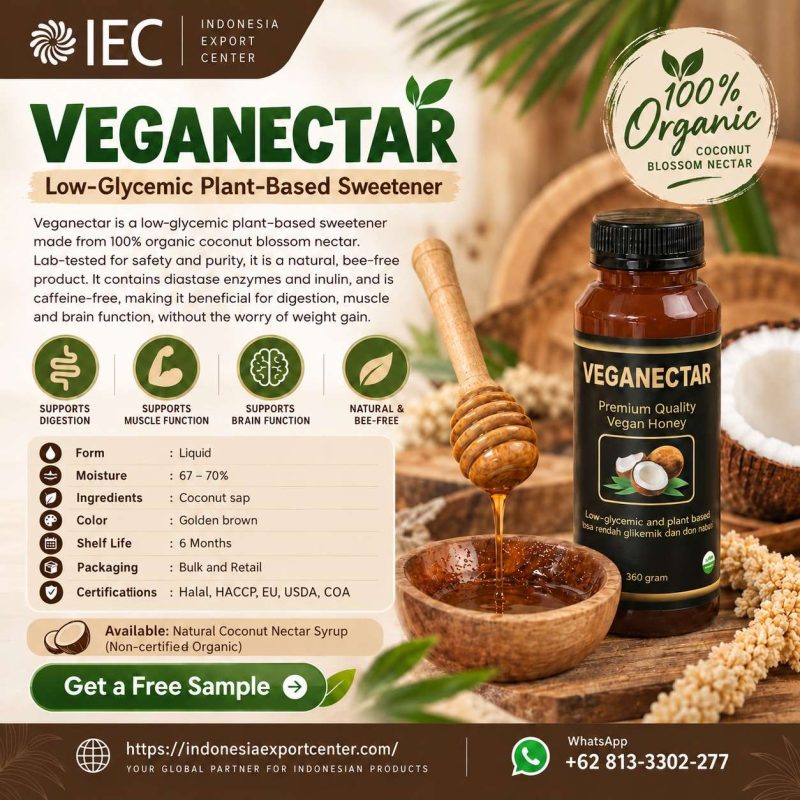
The promotional material describes VEGANECTAR as a golden-brown liquid sweetener made from coconut sap, with bulk and retail packaging referenced.
Canadian buyers may investigate the ingredient for selected food and beverage applications, subject to technical evaluation and compliance with applicable Canadian requirements.
VEGANECTAR Reference Product Information
| Parameter | Promotional Information |
|---|---|
| Product | VEGANECTAR |
| Ingredient Claim | 100% Organic Coconut Blossom Nectar |
| Source | Coconut Sap |
| Form | Liquid |
| Colour | Golden Brown |
| Moisture | 67–70% |
| Shelf Life | 6 Months |
| Packaging | Bulk and Retail |
| Certification References | Halal, HACCP, EU, USDA |
| Alternative | Natural Coconut Nectar Syrup |
All information requires supplier verification.
Potential Canadian Buyer Segments
Food Ingredient Importers
Importers may evaluate coconut nectar for industrial distribution.
Beverage Manufacturers
Manufacturers may investigate its use in selected beverage formulations.
Plant-Based Food Brands
Brands may assess coconut nectar as a sweetening ingredient.
Specialty Food Distributors
Distributors may explore retail and wholesale product formats.
Private Label Businesses
Private label buyers may submit packaging inquiries, although manufacturing capability is not confirmed.
Canadian Food Import Compliance
Canadian food imports must meet applicable federal requirements.
Depending on the product and importer, relevant topics may include:
- Safe Food for Canadians Regulations.
- Import licensing requirements.
- Preventive controls.
- Traceability.
- Product composition.
- Food safety.
- Packaging.
- Labelling.
- Customs declarations.
- Import inspections.
The responsible importer should determine which obligations apply to the specific product and transaction.
Official resources:
Canadian Food Inspection Agency
Importer Licensing and Preventive Controls
Some Canadian food import activities require a Safe Food for Canadians licence.
The importer should determine whether licensing and preventive control requirements apply.
Supplier documentation may support the importer’s food safety review, but a promotional HACCP reference is not sufficient evidence of compliance with all Canadian requirements.
Canadian Bilingual Labelling
Canadian retail food labels commonly require mandatory information in English and French, subject to applicable rules and exemptions.
Depending on the product, the label review may include:
- Common name.
- Ingredient list.
- Net quantity.
- Nutrition Facts.
- Responsible business information.
- Date marking where applicable.
- Storage instructions.
- Allergen and other declarations where applicable.
- Country-of-origin information where required.
- Organic claims.
- Bilingual presentation.
Buyers should obtain regulatory review of the final artwork before printing.
Organic Coconut Nectar for Canada
VEGANECTAR is marketed as organic in the flyer.
Canadian buyers should verify the actual certificate and whether the product meets applicable Canadian organic import and labelling requirements.
Recognition of a foreign organic certification should not be assumed without checking the relevant arrangements.
The natural non-certified organic variant should not be marketed as certified organic.
Product Quality and Safety Documentation
Canadian importers may request:
- Product specification.
- Ingredient declaration.
- COA.
- Moisture and Brix.
- Sugar composition where available.
- Microbiological testing.
- Relevant contaminant testing.
- Shelf-life evidence.
- Manufacturing facility information.
- Organic certification where claimed.
- Packaging specifications.
- Traceability records.
Formulation Evaluation
Canadian food manufacturers may investigate coconut nectar in beverages, bakery products, plant-based foods, sauces, desserts, and snack products.
The ingredient’s sweetness, flavour, colour, water contribution, and processing behaviour must be evaluated experimentally.
It should not be assumed to provide equivalent performance to conventional syrups.
Packaging for Canadian Distribution
The flyer references bulk and retail packaging but does not confirm specific container formats.
Canadian importers should request:
- Packaging dimensions.
- Net contents.
- Material specifications.
- Food-contact documentation.
- Case packs.
- Palletization.
- Storage instructions.
- Shelf-life evidence.
Shipping from Indonesia to Canada
Potential destinations for quotation inquiries include Vancouver, Montreal, Halifax, or other suitable locations.
The appropriate route depends on the destination warehouse, freight services, customs arrangements, and inland delivery requirements.
No transit time or freight rate is guaranteed.
Landed Cost Evaluation
Canadian importers should assess:
- Product price.
- Ocean freight.
- Insurance.
- Customs brokerage.
- Applicable duties.
- Applicable taxes.
- Inspection or testing costs.
- Port handling.
- Inland transportation.
- Warehousing.
Tariff classification and charges should be verified with the relevant customs authorities or broker.
Canada Import RFQ Template
Subject: Coconut Blossom Nectar Supplier – Canada Import Inquiry
Company: [Company Name]
Province: [Province]
Business Type: [Importer / Distributor / Manufacturer]
Product: VEGANECTAR Coconut Blossom Nectar
Variant: [Organic / Natural]
Initial Quantity: [KG or MT]
Annual Demand: [Quantity]
Packaging: [Details]
CFIA Documentation Requirements: [Details]
Organic Requirements: [Details]
Destination Port: [Port]
Preferred Incoterm: [Term]
Please provide current specifications, COA, ingredient declaration, relevant certificates, packaging options, sample feasibility, MOQ, lead time, and export quotation.
Frequently Asked Questions
Can coconut nectar be imported into Canada?
Potentially, subject to applicable Canadian requirements.
Does every importer require the same licence?
No. Requirements depend on the business activity and product.
Are bilingual labels required?
Mandatory information often requires English and French presentation, subject to applicable rules.
Is VEGANECTAR certified organic for Canada?
Current certification and Canadian eligibility must be verified.
Can Canadian manufacturers request samples?
Sample feasibility requires supplier confirmation.
Can buyers request bulk packaging?
Yes, subject to available supplier formats.
Can IEC quote shipping to Vancouver?
Buyers may request a quotation, subject to logistics feasibility.
Does IEC guarantee Canadian customs clearance?
No. Clearance depends on the shipment and applicable requirements.
Request a Canada Coconut Nectar Import Quotation
Contact IEC to discuss Indonesian coconut blossom nectar syrup for Canadian ingredient sourcing, food manufacturing, and retail distribution.
INDONESIA EXPORT CENTER (IEC)
Website: https://indonesiaexportcenter.com/
WhatsApp: +62 813-3302-277
Canadian import, labelling, licensing, and organic requirements must be checked against current official guidance. Product specifications, certifications, packaging, samples, and supply arrangements require confirmation.
Related Resources
Coconut Nectar for Food Ingredient Importers
Coconut Nectar for Private Label Brands
Coconut Blossom Nectar Supplier Indonesia
