

INDONESIA EXPORT CENTER (IEC)
VEGANECTAR Coconut Nectar Syrup, Australian Biosecurity Review, Food Standards and B2B Export Quotations
Import Coconut Blossom Nectar from Indonesia to Australia
Australian food importers, natural food brands, ingredient distributors, and beverage manufacturers may investigate Indonesian coconut blossom nectar syrup for their commercial requirements.
For companies searching for a coconut nectar supplier for Australia, Indonesia Export Center (IEC) facilitates sourcing inquiries for Indonesian coconut blossom nectar syrup, including VEGANECTAR.
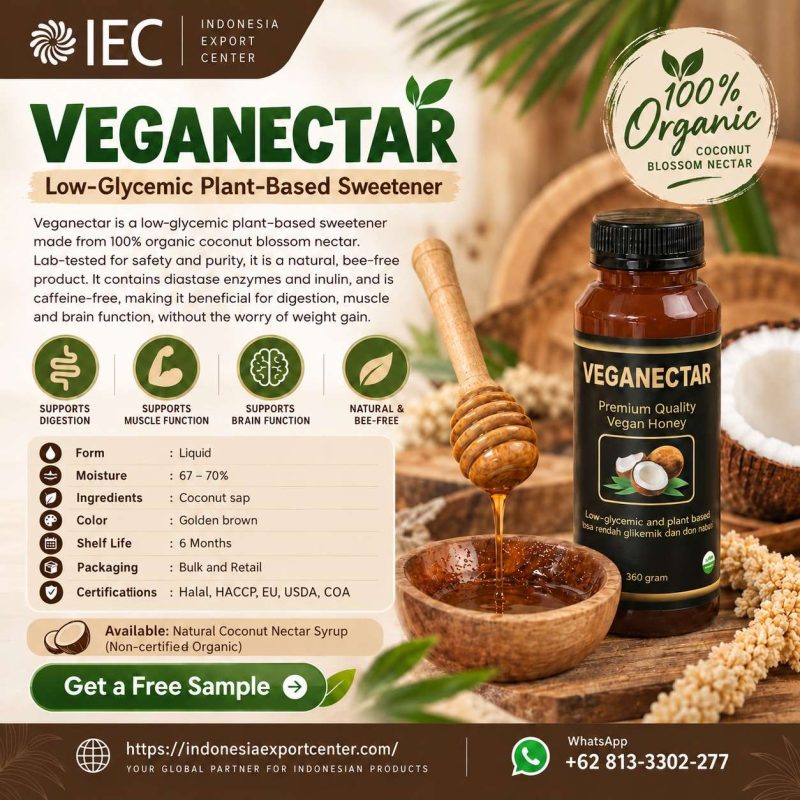
The product is described in promotional material as a plant-based liquid sweetener made from coconut sap.
It has a reported golden-brown appearance and is referenced in bulk and retail packaging formats.
However, commercial importation requires verification of the supplier, product specifications, packaging, food safety requirements, and Australian import eligibility.
VEGANECTAR Product Information
| Parameter | Promotional Information |
|---|---|
| Product | VEGANECTAR |
| Source | Coconut Sap |
| Ingredient Claim | 100% Organic Coconut Blossom Nectar |
| Form | Liquid |
| Colour | Golden Brown |
| Moisture | 67–70% |
| Shelf Life | 6 Months |
| Packaging | Bulk and Retail |
| Certification References | Halal, HACCP, EU, USDA |
| Alternative | Natural Coconut Nectar Syrup |
The information requires verification through current supplier documents.
Potential Australian Buyer Segments
Natural Food Importers
Importers may evaluate coconut nectar for specialty ingredient distribution.
Plant-Based Food Brands
Brands may investigate coconut nectar in selected plant-derived food products.
Beverage Manufacturers
Manufacturers may test the ingredient in beverage formulations.
Specialty Retailers
Retailers may explore consumer-ready packaging where market compliance is established.
Foodservice Distributors
Distributors may assess suitable packaging for cafés, restaurants, and commercial kitchens.
Australian Biosecurity Requirements
Australia maintains biosecurity controls that may affect imported food and agricultural-origin products.
Importers should verify the conditions applying to the actual coconut-derived syrup.
The product’s processing method, ingredients, packaging, country of origin, and intended use may be relevant to import eligibility.
Buyers should consult the Australian Government’s Biosecurity Import Conditions system (BICON) and relevant authorities.
Official resource: Australian Department of Agriculture, Fisheries and Forestry.
Import permission should never be assumed solely because a product is commercially available in Indonesia.
Imported Food Safety Requirements
Australian food imports may be subject to the Imported Food Control Act and related requirements, depending on the product and circumstances.
Importers should assess:
- Food safety.
- Product composition.
- Applicable food standards.
- Ingredient identity.
- Contaminants.
- Microbiological requirements.
- Import inspection.
- Food-contact packaging.
- Traceability.
- Retail labelling.
Official resource: Food Standards Australia New Zealand.
Australian Food Labelling
Retail products should be reviewed against applicable Australia New Zealand Food Standards Code requirements.
Depending on the product, relevant information may include:
- Product name.
- Ingredient declaration.
- Nutrition information.
- Net quantity.
- Supplier details.
- Date marking.
- Storage instructions.
- Lot identification.
- Country-of-origin information.
- Applicable claims.
The importer should review the complete label before shipment.
Organic Claims in Australia
The VEGANECTAR flyer references organic status.
Australian buyers should verify the actual certification and the rules applicable to any organic claims.
An EU or USDA organic logo alone does not establish that all Australian marketing requirements have been met.
The natural non-certified organic variant should not be described as certified organic.
Product Quality Documentation
Australian buyers may request:
- Current product specification.
- Ingredient declaration.
- COA.
- Moisture and Brix.
- Microbiological results.
- Relevant contaminant testing.
- Shelf-life evidence.
- Manufacturing information.
- Organic certification where claimed.
- Packaging specifications.
- Traceability records.
- Export documentation.
Food Manufacturing Applications
Potential applications for evaluation include:
- Beverages.
- Bakery products.
- Plant-based foods.
- Dessert toppings.
- Sauces.
- Snack products.
The ingredient’s performance must be validated in the intended formulation.
Packaging for Australian Importers
The flyer references bulk and retail packaging.
Specific drums, jerrycans, bottles, and pack sizes are not confirmed.
Buyers should specify their preferred format and request food-contact documentation.
Shipping to Australia
Buyers may request quotations to Melbourne, Sydney, Brisbane, Fremantle, or another suitable destination.
The appropriate route depends on the buyer’s location, shipping service, freight cost, and import arrangements.
No particular transit time or freight rate is guaranteed.
Landed Cost Considerations
Australian importers should consider:
- Product price.
- Freight.
- Insurance.
- Customs duties where applicable.
- GST where applicable.
- Biosecurity or inspection charges.
- Customs brokerage.
- Inland delivery.
- Warehousing.
- Testing costs.
A qualified customs broker should confirm the applicable classification and import charges.
Australia Import RFQ Template
Subject: Coconut Blossom Nectar Supplier – Australia Import Inquiry
Company: [Company Name]
Australian State: [State]
Business Type: [Importer / Distributor / Manufacturer]
Product: VEGANECTAR Coconut Blossom Nectar
Variant: [Organic / Natural]
Initial Quantity: [KG or MT]
Monthly Forecast: [Quantity]
Packaging: [Details]
Biosecurity Documentation Requirements: [Details]
Food Safety Requirements: [Details]
Destination Port: [Port]
Preferred Incoterm: [Term]
Please provide current specifications, COA, ingredient declaration, relevant certification documents, packaging options, samples, MOQ, lead time, and export quotation.
Frequently Asked Questions
Can coconut nectar be imported from Indonesia into Australia?
Potentially, subject to the applicable biosecurity and food import requirements.
Is coconut nectar automatically permitted because it is a processed syrup?
No. Product-specific import conditions should be checked.
Is VEGANECTAR organic-certified for Australia?
The certification and applicable claims must be verified.
Can Australian manufacturers request samples?
Sample feasibility requires supplier confirmation.
Are bulk packaging formats available?
Bulk packaging is referenced, but formats must be confirmed.
Can IEC quote delivery to Melbourne or Sydney?
Buyers may request quotations, subject to freight feasibility.
Is the product guaranteed to pass import inspection?
No.
Does the reported shelf life apply during ocean freight?
Storage conditions and shipment suitability must be verified.
Request an Australia Coconut Nectar Import Quotation
Looking for Indonesian coconut blossom nectar syrup for the Australian food market?
Contact IEC with your purchasing volume, packaging requirements, destination port, and required technical documentation.
REQUEST AUSTRALIA IMPORT QUOTE
INDONESIA EXPORT CENTER (IEC)
Website: https://indonesiaexportcenter.com/
WhatsApp: +62 813-3302-277
Australian biosecurity, food import, and labelling requirements must be checked against current official guidance. Supplier certifications, packaging, samples, and commercial terms require verification.
Related Resources
Coconut Nectar for Food Ingredient Importers
Coconut Nectar for Plant-Based Beverages
Coconut Blossom Nectar Supplier Indonesia
