

IEC | INDONESIA EXPORT CENTER
CONNECTING INDONESIAN PRODUCTS TO THE WORLD
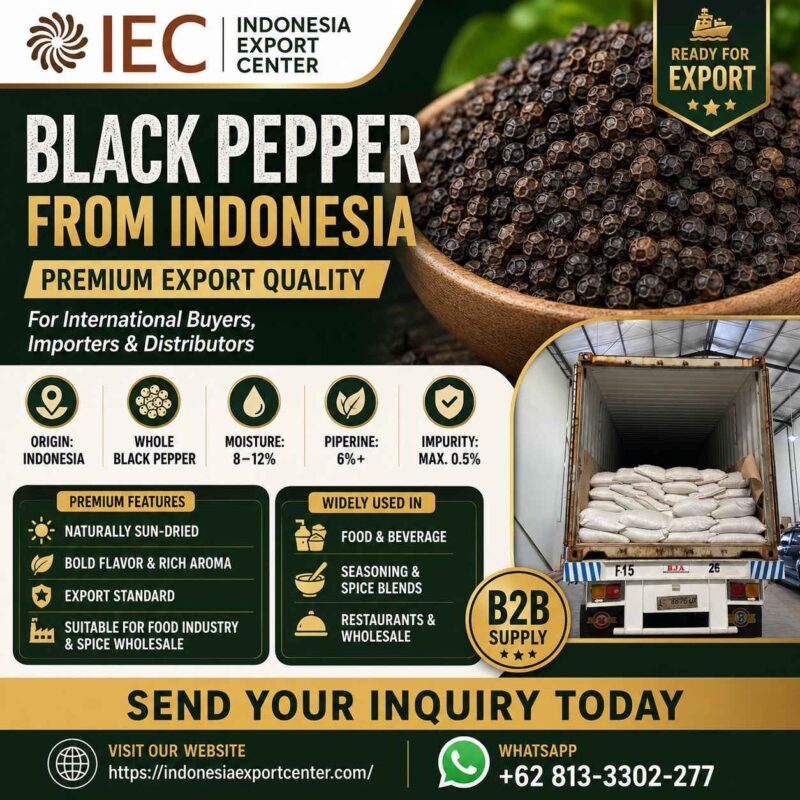
BLACK PEPPER FROM INDONESIA
PREMIUM EXPORT QUALITY
WHOLE BLACK PEPPER | AUSTRALIAN BIOSECURITY | FOOD SAFETY STANDARDS | BULK EXPORT SOURCING
FOR AUSTRALIAN SPICE IMPORTERS, FOOD MANUFACTURERS & WHOLESALE DISTRIBUTORS
Source Indonesian Black Pepper for the Australian Market
Looking for a black pepper supplier Australia importers can contact for Indonesian whole black pepper sourcing?
Indonesia is an established origin for black pepper, supplying an agricultural spice ingredient used in seasoning production, food manufacturing, wholesale distribution, and commercial kitchens.
For Australian importers, purchasing black pepper from overseas involves more than selecting a product grade or negotiating a competitive price.
Imported food must meet applicable Australian food safety requirements, while plant-based products may also be subject to biosecurity import conditions.
Importers should evaluate the product’s processing status, country of origin, intended use, packaging, food safety documentation, and relevant Australian border requirements before confirming a shipment.
IEC | Indonesia Export Center facilitates sourcing and export enquiries for Indonesian agricultural products, including whole black pepper intended for Australian businesses.
IEC can receive purchasing requirements and seek confirmation of suitable Indonesian suppliers, available grades, quality documentation, packaging options, samples, and export quotations.
Our sourcing approach emphasizes clear buyer specifications and early consideration of Australian import requirements.
Product availability, supplier qualifications, laboratory results, Australian biosecurity eligibility, food safety compliance, pricing, and shipping arrangements must be verified for each proposed transaction.
Request an Indonesian Black Pepper Quote for Australia
Send your required quantity, product grade, packaging requirements, Australian destination, and applicable import conditions.
REQUEST A BLACK PEPPER QUOTE VIA WHATSAPP
WhatsApp: +62 813-3302-277
Website: https://indonesiaexportcenter.com/
Indonesian Black Pepper – Product Specifications for Australia
| Product Information | Details |
|---|---|
| Product | Whole Black Pepper |
| Botanical Name | Piper nigrum L. |
| Country of Origin | Indonesia |
| Destination Market | Australia |
| Product Form | Whole Dried Peppercorns |
| Reference Moisture | 8–12% |
| Reference Piperine | 6%+ |
| Reference Impurity | Maximum 0.5% |
| Bulk Density | Buyer-Specified |
| Foreign Matter | Buyer-Specified |
| Defect Tolerance | Buyer-Specified |
| Drying Method | Subject to Lot Verification |
| Processing or Treatment Status | To Be Verified |
| Biosecurity Import Conditions | Check Applicable BICON Entry |
| Food Safety Requirements | Applicable Australian Requirements |
| Pesticide Residues | Applicable Australian Requirements |
| Microbiological Requirements | Applicable Australian and Buyer Requirements |
| Traceability | To Be Verified |
| Lot-Specific COA | To Be Requested |
| Packaging | To Be Confirmed |
| Minimum Order Quantity | To Be Confirmed |
| Export Price | Request Quotation |
| Destination | Australian Port or Agreed Delivery Point |
Specification note: Moisture 8–12%, piperine 6%+, and impurity maximum 0.5% are supplied reference specifications. They are not independently verified laboratory results for an available commercial lot.
Indonesian Black Pepper for Australian Food and Spice Businesses
Whole black pepper is a versatile ingredient used across food manufacturing and wholesale spice supply.
Potential Applications
Food Manufacturing
Black pepper may be incorporated into processed food products and savoury formulations.
Seasoning and Spice Blends
Peppercorns can be ground and blended with other herbs and spices.
Spice Packing
Whole peppercorns may be packed for wholesale or retail distribution by appropriately equipped businesses.
Restaurants and Foodservice
Black pepper is widely used in commercial food preparation.
Ingredient Distribution
Importers may supply whole black pepper to processors, wholesalers, and food businesses.
Buyer Considerations
Australian businesses should establish specifications appropriate to their intended application, including physical quality, microbiological safety, contaminants, packaging, and traceability.
Australian Biosecurity Requirements for Imported Black Pepper
Biosecurity is a central consideration when importing plant-based products into Australia.
Australia applies biosecurity measures intended to manage risks associated with pests, diseases, and other biological hazards.
Whole dried black pepper may be subject to specific import conditions depending on the commodity description, processing status, origin, and intended use.
Check Australia’s Biosecurity Import Conditions System (BICON)
The Australian Government’s Biosecurity Import Conditions system (BICON) is an important reference for determining applicable import conditions.
Before ordering Indonesian black pepper, the importer should identify the correct BICON commodity entry and review the conditions applicable to the proposed shipment.
Information Needed for a Biosecurity Check
- Product name
- Botanical name
- Country of origin
- Whole or ground form
- Dried or otherwise processed condition
- Intended use
- Packaging details
- Treatment history, if any
- Relevant supporting documents
Potential Biosecurity Requirements
Depending on the applicable BICON conditions, import requirements may involve:
- Import permits
- Phytosanitary certification
- Approved treatments
- Supporting declarations
- Documentary checks
- Physical inspection
- Other biosecurity measures
These requirements are conditional and must not be assumed to apply universally to every black pepper shipment.
Important
A product being dried, cleaned, or intended for food use does not automatically establish that it meets Australia’s biosecurity import conditions.
Biosecurity Import Checklist for Australian Spice Importers
| Import Check | Required Action |
|---|---|
| Commodity Identification | Confirm Whole Black Pepper |
| Botanical Name | Piper nigrum L. |
| Origin | Indonesia |
| Processing Status | Verify |
| Intended Use | Confirm |
| BICON Commodity Entry | Identify Correct Entry |
| Import Permit | Determine Whether Required |
| Phytosanitary Certificate | Determine Whether Required |
| Treatment Requirements | Verify Applicable Conditions |
| Packaging Requirements | Verify |
| Inspection Requirements | Verify |
| Supporting Documents | Confirm |
| Importer Responsibilities | Confirm |
Why Early Verification Matters
Checking biosecurity requirements before placing an order may help buyers avoid purchasing a product that cannot satisfy the applicable import conditions.
Importers should resolve questions about treatment, certification, and shipment eligibility before cargo is dispatched.
Food Standards Australia New Zealand Requirements
In addition to biosecurity rules, imported black pepper intended for food must comply with applicable Australian food laws.
The Australia New Zealand Food Standards Code establishes standards relevant to food safety, composition, contaminants, and other matters.
Food Standards Australia New Zealand (FSANZ) develops and maintains the Code, while Australian authorities administer and enforce relevant import and food requirements.
Potential Food Safety Considerations
- Food safety and suitability
- Pesticide residues
- Chemical contaminants
- Microbiological hazards
- Food additives, if applicable
- Food labeling, where applicable
- Traceability
- Food-contact packaging requirements
Important
Meeting biosecurity conditions does not automatically establish compliance with Australian food standards.
Both areas must be assessed separately.
Imported Food Inspection in Australia
Food imported into Australia may be subject to requirements under the Imported Food Control Act 1992 and associated arrangements.
The Australian Department of Agriculture, Fisheries and Forestry (DAFF) administers relevant imported food inspection activities.
Potential Inspection Considerations
Depending on the applicable classification and requirements, shipments may be subject to:
- Documentary assessment
- Physical inspection
- Sampling
- Laboratory testing
- Compliance assessment
- Other border controls
Risk-Based Controls
Inspection arrangements may vary according to the product, applicable regulatory classification, compliance history, and current government requirements.
Important
No particular black pepper shipment is claimed to be exempt from inspection or guaranteed to receive Australian border clearance.
Pesticide Residue Requirements for Australian Black Pepper Imports
Pesticide residues are an important consideration for spice importers and food manufacturers.
Australian requirements should be assessed against the relevant food commodity and chemical substances.
Buyer Verification Steps
- Identify the applicable food commodity classification.
- Determine relevant Australian pesticide residue limits.
- Review the required pesticide testing panel.
- Agree on sampling procedures.
- Request laboratory results.
- Review analytical methods and reporting limits.
- Compare results with applicable requirements.
- Confirm the results relate to the proposed commercial lot.
Important
Pesticide residue requirements are substance-specific and commodity-specific.
Compliance with EU, Japanese, or US requirements does not automatically establish Australian compliance.
Microbiological Safety for Australia-Bound Black Pepper
Dried spices may present microbiological hazards.
Low moisture does not automatically eliminate pathogenic microorganisms.
Potential Microbiological Parameters
| Parameter | Buyer Consideration |
|---|---|
| Salmonella spp. | Relevant Food Safety Hazard |
| Total Aerobic Count | Buyer-Specified |
| Yeasts and Moulds | Buyer-Specified |
| E. coli | Buyer-Specified |
| Other Relevant Microorganisms | Risk-Based |
Salmonella
Salmonella is an important hazard to consider in black pepper sourcing.
Australian importers should establish appropriate acceptance criteria, analytical methods, and sampling procedures based on applicable requirements and intended use.
Cleaning vs. Microbial Treatment
Physical cleaning and sorting may reduce foreign matter but do not establish that the product has received an effective microbial reduction treatment.
Important
No particular black pepper lot is claimed to be sterilized, Salmonella-free, or microbiologically compliant without appropriate verification.
Mycotoxins and Other Chemical Contaminants
Australian food ingredient buyers may also evaluate relevant chemical contaminants.
Potential Testing Areas
- Aflatoxins
- Ochratoxin A, where relevant
- Heavy metals
- Other substances identified through risk assessment
Recommended Verification
- Identify applicable Australian requirements.
- Determine the required analytical panel.
- Agree on representative sampling.
- Request laboratory reports.
- Review the relevant analytical methods.
- Confirm lot identification.
- Compare results with applicable acceptance criteria.
No specific black pepper lot is claimed to meet every applicable contaminant requirement without supporting evidence.
Black Pepper Quality Grades for Australian Importers
Different Australian food manufacturers and spice wholesalers may require different product grades.
Common Grade Evaluation Parameters
- Bulk density
- Moisture
- Piperine
- Impurity
- Foreign matter
- Broken peppercorns
- Defective peppercorns
- Appearance
- Aroma
- Microbiological quality
Buyer-Specified Bulk Density
Some buyers may request targets such as:
- 500 g/L
- 550 g/L
- 600 g/L
These are examples of buyer-defined bulk density targets, not confirmed IEC inventory or universally standardized commercial grades.
Grade Verification
Buyers should agree on:
- The required density.
- Whether the value is a minimum, nominal target, or acceptable range.
- The test method.
- The sampling procedure.
- The acceptance criteria.
Actual grade availability and density results must be verified for the proposed commercial lot.
Quality Control Specifications for Australian Buyers
Australian importers should establish a written product specification before approving a purchase.
| Quality Parameter | Reference or Requirement |
|---|---|
| Product | Whole Black Pepper |
| Origin | Indonesia |
| Moisture | 8–12% Reference; Agree Contractual Maximum |
| Piperine | 6%+ Reference; Verify by Testing |
| Impurity | Maximum 0.5% Reference |
| Bulk Density | Buyer-Specified |
| Foreign Matter | Buyer-Specified |
| Broken Peppercorns | Buyer-Specified |
| Defective Peppercorns | Buyer-Specified |
| Salmonella | Applicable Acceptance Criterion |
| Other Microbiological Parameters | Risk-Based |
| Pesticide Residues | Applicable Australian Requirements |
| Mycotoxins | Applicable Australian Requirements |
| Heavy Metals | Applicable Australian Requirements |
| Biosecurity Conditions | Verify BICON |
| Packaging | Buyer-Specified |
| Lot Identification | Required |
| COA | To Be Requested |
Contractual Specifications
Some Australian buyers may require specifications stricter than applicable legal minimums.
The final acceptance criteria should be agreed before shipment.
Certificate of Analysis for Australia-Bound Black Pepper
A lot-specific Certificate of Analysis can help Australian buyers evaluate product quality.
Recommended COA Information
| COA Field | Requested Information |
|---|---|
| Product | Whole Black Pepper |
| Origin | Indonesia |
| Supplier | Identified Supplier |
| Lot Number | Required |
| Sample Identification | Required |
| Moisture | Actual Result |
| Piperine | Actual Result |
| Impurity | Actual Result |
| Bulk Density | If Required |
| Foreign Matter | If Required |
| Salmonella | If Required |
| Other Microbiological Results | If Required |
| Pesticide Residues | If Required |
| Mycotoxins | If Required |
| Heavy Metals | If Required |
| Laboratory | Identified |
| Analytical Methods | Documented |
| Test Date | Recorded |
Important
A COA does not independently establish Australian food safety compliance or biosecurity eligibility.
These must be assessed against the applicable requirements for the actual shipment.
Supplier Qualification for Australian Spice Importers
Australian buyers may require a structured supplier qualification process.
Recommended Supplier Evaluation
- Legal supplier identity
- Processing or packing facility information
- Product specifications
- Food safety procedures
- Cleaning and sorting controls
- Microbiological controls
- Contaminant testing
- Traceability
- Packaging procedures
- Treatment history, where applicable
- Available certifications
- Audit reports, where available
- Corrective action procedures
- Recall procedures
Food Safety Certifications
Some buyers may request information regarding:
- HACCP-based food safety controls
- GMP
- ISO 22000
- FSSC 22000
- Other relevant food safety schemes
Actual certification status, scope, and validity must be verified.
Traceability for Indonesian Black Pepper Exported to Australia
Traceability helps connect the imported product to the relevant supplier, processing activities, and commercial shipment.
Potential Supply Chain
Indonesian Producer → Collection → Drying → Cleaning → Packing → Export → Australian Importer → Food Processor or Distributor
Recommended Traceability Records
- Supplier identification
- Country of origin
- Product description
- Lot number
- Relevant processing records
- Treatment records, where applicable
- Packing records
- Laboratory reports
- Commercial documents
- Shipping documents
Important
Traceability records should be sufficiently clear to link the product, samples, testing, and shipment documents.
Packaging for Indonesian Black Pepper Export to Australia
Packaging should protect whole black pepper during international transportation and storage.
Potential Packaging Options
- Food-compatible woven bags with suitable liners
- Multiwall paper bags with suitable liners
- Other supplier-approved bulk packaging
Actual packaging materials and bag weights must be confirmed.
Packaging Checklist
| Packaging Requirement | Buyer Specification |
|---|---|
| Packaging Material | [Specify] |
| Net Weight per Bag | [Specify] |
| Inner Liner | [Required / Not Required] |
| Palletization | [Required / Not Required] |
| Lot Marking | Required |
| Product Identification | Required |
| Country of Origin Information | As Applicable |
| Moisture Protection | [Specify] |
| Australian Labeling Requirements | As Applicable |
| Biosecurity Packaging Conditions | Verify |
Wooden Pallets and Packaging
Wooden pallets and other timber packaging may be subject to separate Australian biosecurity requirements.
Importers should verify applicable conditions before selecting a packaging configuration.
Shipping Black Pepper from Indonesia to Australia
International shipments may be arranged through appropriate freight providers.
Potential Shipping Methods
Full Container Load (FCL)
May be suitable for larger wholesale shipments.
Less Than Container Load (LCL)
May be considered for smaller commercial quantities.
Air Freight
May be considered for suitable smaller consignments or samples.
Australian Destination Options
Buyers may request quotations for destinations such as:
- Melbourne
- Sydney
- Brisbane
- Fremantle
- Adelaide
- Other Australian ports or inland delivery points
Actual freight availability, routing, transit times, and costs must be confirmed.
Australian Destination Checks Before Shipment
Before cargo leaves Indonesia, Australian importers should confirm the requirements applicable to the intended destination and entry arrangements.
Recommended Pre-Shipment Checklist
| Destination Check | Verification |
|---|---|
| Australian Importer | Identified |
| Destination Port | Confirmed |
| Customs Broker | Appointed if Required |
| BICON Conditions | Checked |
| Import Permit | Confirm Whether Required |
| Treatment Requirements | Checked |
| Phytosanitary Certificate | Confirm Whether Required |
| Imported Food Requirements | Checked |
| Product Specifications | Agreed |
| Laboratory Testing | Reviewed |
| Packaging | Approved |
| Timber Packaging | Checked if Applicable |
| Shipment Documents | Prepared |
| Inspection Arrangements | Confirmed |
Why Destination Checks Matter
Requirements may vary according to the product, processing status, intended use, and relevant import conditions.
The destination port alone does not determine all regulatory requirements.
Export and Import Documentation for Australia
Commercial black pepper imports require appropriate customs and transport documentation.
Potential Documents
| Document | Purpose |
|---|---|
| Commercial Invoice | Describes the transaction |
| Packing List | Details packaging and quantity |
| Bill of Lading | Ocean freight transport document |
| Air Waybill | Air freight transport document |
| Certificate of Origin | Supports origin information where applicable |
| Phytosanitary Certificate | If required under applicable conditions |
| Treatment Certificate | If required |
| Import Permit | If required |
| Product Specification | Defines agreed quality requirements |
| Certificate of Analysis | Supports quality verification |
| Laboratory Reports | Supports food safety assessment |
| Insurance Certificate | If required under the agreed terms |
Australian Import Coordination
Importers should also confirm:
- Importer identification
- Customs declaration
- Product tariff classification
- Applicable customs duties
- GST treatment
- Biosecurity requirements
- Imported food inspection requirements
- Packaging requirements
- Customs broker arrangements
- Applicable permits and certificates
Actual requirements must be verified for the shipment and destination.
Australian Border Inspection and Clearance
Imported black pepper may be subject to biosecurity and food-related border controls.
Potential Clearance Process
- Confirm the applicable BICON conditions.
- Prepare required import documents.
- Complete relevant declarations.
- Present cargo for inspection, if directed.
- Complete any required testing.
- Resolve compliance issues, if identified.
- Obtain relevant release or clearance.
- Arrange onward delivery.
Important
Border authorities may require additional action if goods do not satisfy applicable conditions.
No particular shipment is guaranteed clearance.
Indonesian Black Pepper Wholesale Pricing for Australia
Export pricing depends on product specifications and commercial arrangements.
Main Price Drivers
- Product grade
- Moisture
- Piperine
- Impurity limit
- Bulk density
- Cleaning and sorting
- Biosecurity-related requirements
- Treatment requirements, where applicable
- Microbiological testing
- Pesticide residue testing
- Packaging
- Order quantity
- Supplier availability
- Inspection arrangements
- Freight
- Incoterm
- Payment terms
Potential Quotation Terms
Australian buyers may request quotations under suitable Incoterms, including:
- FCA
- FOB
- CFR
- CIF
- CIP
The appropriate term depends on the actual transport arrangement.
No current price, MOQ, supplier capacity, or available shipment quantity has been independently verified.
How Australian Buyers Can Source Black Pepper from Indonesia
Step 1: Define Your Product Requirements
Specify the required grade, quantity, intended use, and packaging.
Step 2: Check BICON
Identify the correct Australian biosecurity import conditions for the product.
Step 3: Review Australian Food Standards
Confirm applicable food safety and imported food requirements.
Step 4: Submit Your RFQ
Provide quantity, destination, packaging, and commercial requirements.
Step 5: Request Supplier Information
Ask for supplier identity, processing details, and treatment history, where relevant.
Step 6: Confirm Product Availability
Request confirmation of the proposed grade, quantity, and lead time.
Step 7: Review Quality Documentation
Evaluate available laboratory reports and supplier controls.
Step 8: Request Samples
Where available, assess representative samples.
Step 9: Agree on Inspection
Define sampling, testing, and acceptance criteria.
Step 10: Review Export Pricing
Compare price, Incoterm, freight, and payment terms.
Step 11: Coordinate Australian Import
Confirm biosecurity, imported food controls, customs, and shipment documentation.
Step 12: Finalize the Purchase Agreement
Identify the contractual seller, exporter of record, importer, and other responsible parties.
Ready-to-Send RFQ – Indonesian Black Pepper for Australia
Subject: RFQ – Indonesian Whole Black Pepper for Australia Import
Dear IEC | Indonesia Export Center Team,
We are interested in importing whole black pepper from Indonesia into Australia for spice wholesale, food ingredient supply, or food manufacturing.
Our purchasing requirements include product quality, Australian biosecurity import conditions, food safety documentation, packaging, and commercial export terms.
Please advise whether suitable Indonesian supply options are available.
BUYER INFORMATION
Company Name: [Company Name]
Country: Australia
Business Type: [Spice Importer / Food Manufacturer / Ingredient Distributor / Wholesale Buyer]
Contact Person: [Name]
Email: [Email]
WhatsApp: [Number]
Destination Port: [Melbourne / Sydney / Brisbane / Fremantle / Adelaide / Other]
PRODUCT REQUIREMENTS
Product: Whole Black Pepper
Botanical Name: Piper nigrum L.
Origin: Indonesia
Required Quantity: [MT]
Order Frequency: [Trial / One-Time / Monthly / Quarterly]
Intended Application: [Specify]
TECHNICAL REQUIREMENTS
| Parameter | Requirement |
|---|---|
| Product | Whole Black Pepper |
| Origin | Indonesia |
| Moisture | 8–12% Reference; Confirm Contractual Maximum |
| Piperine | 6%+ Reference; Request Verification |
| Impurity | Maximum 0.5% Reference |
| Bulk Density | [Specify] |
| Foreign Matter | [Specify] |
| Broken Peppercorns | [Specify] |
| Defective Peppercorns | [Specify] |
| Salmonella | [Specify Acceptance Criterion and Method] |
| Other Microbiological Requirements | [Specify] |
| Pesticide Residues | Applicable Australian Requirements |
| Mycotoxins | Applicable Australian Requirements |
| Heavy Metals | Applicable Australian Requirements |
AUSTRALIAN BIOSECURITY INFORMATION
BICON Commodity Entry: [Specify]
Import Permit Required: [Yes / No / To Be Confirmed]
Phytosanitary Certificate Required: [Yes / No / To Be Confirmed]
Treatment Required: [Yes / No / To Be Confirmed]
Treatment Type: [Specify if Applicable]
Additional Declarations: [Specify if Applicable]
SUPPLIER AND QUALITY DOCUMENTATION REQUESTED
Please advise whether the following can be provided:
- Legal supplier identity.
- Manufacturer or processing facility information.
- Product technical specification.
- Lot-specific COA.
- Microbiological test report.
- Pesticide residue test report, if required.
- Mycotoxin test report, if required.
- Heavy metal test report, if required.
- Traceability information.
- Treatment documentation, where applicable.
- Available food safety certifications.
- Packaging specifications.
- Representative samples.
- Relevant export documentation.
COMMERCIAL REQUIREMENTS
Required Quantity: [MT]
Preferred Packaging: [Specify]
Destination Country: Australia
Destination Port: [Port]
Requested Incoterm: [FCA / FOB / CFR / CIF / CIP / Other]
Target Shipment Period: [Month / Year]
Please confirm:
- Product availability.
- Minimum order quantity.
- Available quantity.
- Sample availability.
- Price per metric ton.
- Available laboratory documentation.
- Biosecurity-related documentation capability.
- Inspection arrangements.
- Packaging options.
- Payment terms.
- Shipment lead time.
- Australian freight options.
- Relevant export documentation.
- Quotation validity.
We will review the supplier information, product specifications, Australian biosecurity requirements, food safety documentation, import responsibilities, and commercial terms before proceeding.
Thank you. We look forward to your response.
Kind regards,
[Your Name] [Company Name]Australia
SEND YOUR AUSTRALIA BLACK PEPPER RFQ VIA WHATSAPP
Frequently Asked Questions – Indonesian Black Pepper for Australia
1. Can Australian companies import black pepper from Indonesia?
Yes, subject to applicable Australian biosecurity, food safety, customs, and import requirements.
2. Can IEC help Australian buyers source Indonesian black pepper?
IEC can receive enquiries and seek confirmation of suitable Indonesian suppliers and export quotations.
3. What is BICON?
BICON is Australia’s Biosecurity Import Conditions system, used to identify applicable import conditions.
4. Does black pepper require an Australian import permit?
Permit requirements depend on the applicable BICON conditions for the specific product.
5. Is a phytosanitary certificate required?
A phytosanitary certificate may be required under applicable import conditions. The requirement must be verified.
6. Is biosecurity treatment required?
Treatment requirements depend on the applicable commodity entry and import conditions.
7. Does Australia inspect imported food?
Imported food may be subject to inspection and testing under applicable Australian arrangements.
8. What food standards apply?
Relevant requirements may arise under the Australia New Zealand Food Standards Code and other applicable Australian laws.
9. Is Salmonella testing important?
Yes. Salmonella is an important hazard to consider in dried spice procurement.
10. Can Australian buyers request a COA?
A lot-specific COA may be requested, subject to supplier and laboratory availability.
11. What is the supplied moisture specification?
8–12% as a reference range. The contractual maximum and actual lot result must be confirmed.
12. What is the supplied piperine specification?
6%+ as a reference value, subject to laboratory verification.
13. Can black pepper be shipped to Melbourne or Sydney?
Buyers may request quotations for these destinations. Actual freight availability and commercial terms must be confirmed.
14. Are wooden pallets subject to biosecurity rules?
Wooden packaging may be subject to separate biosecurity requirements.
15. Can buyers request third-party inspection?
Inspection may be arranged subject to agreement on provider, scope, timing, and cost.
16. What is the minimum order quantity?
No fixed MOQ has been independently verified.
17. Can IEC provide CIF quotations to Australia?
Buyers may request CIF quotations, subject to supplier and logistics confirmation.
18. Does IEC guarantee Australian biosecurity clearance?
No. Biosecurity eligibility and border clearance depend on the applicable conditions and competent authorities.
Request Indonesian Black Pepper Export Pricing for Australia
For businesses searching for a black pepper supplier Australia spice importers and food manufacturers can approach, successful procurement requires verified product quality, appropriate biosecurity planning, food safety assessment, supplier due diligence, and coordinated import documentation.
IEC | Indonesia Export Center welcomes enquiries from Australian spice importers, food ingredient buyers, food manufacturers, and wholesale distributors seeking Indonesian whole black pepper.
Australia Black Pepper Import Enquiry Summary
| Parameter | Details |
|---|---|
| Product | Whole Black Pepper |
| Origin | Indonesia |
| Destination | Australia |
| Reference Moisture | 8–12% |
| Reference Piperine | 6%+ |
| Reference Impurity | Maximum 0.5% |
| Bulk Density | Buyer-Specified |
| Biosecurity Conditions | Verify BICON |
| Import Permit | Determine Whether Required |
| Phytosanitary Certificate | Determine Whether Required |
| Food Safety Requirements | Applicable Australian Criteria |
| Traceability | To Be Verified |
| Lot-Specific COA | To Be Requested |
| Packaging | To Be Confirmed |
| MOQ | To Be Confirmed |
| Australian Destination | Buyer-Specified |
| Export Price | Request Quotation |
IEC | INDONESIA EXPORT CENTER
CONNECTING INDONESIAN PRODUCTS TO THE WORLD
INDONESIAN BLACK PEPPER SOURCING FOR AUSTRALIA
FOR AUSTRALIAN SPICE IMPORTERS, FOOD MANUFACTURERS & WHOLESALE DISTRIBUTORS
SEND YOUR AUSTRALIA BLACK PEPPER IMPORT ENQUIRY TODAY
WhatsApp: +62 813-3302-277
Website: https://indonesiaexportcenter.com/
Contact us for specifications, Australian biosecurity enquiries, food safety documentation, quotations, and export inquiries.
Regulatory and Commercial Disclaimer: This page provides general sourcing information, not legal or regulatory advice. Australian biosecurity import conditions, BICON requirements, permits, phytosanitary certification, treatment conditions, imported food inspection requirements, food standards, customs procedures, and importer obligations must be verified for the actual product and shipment under current rules. No specific supplier’s Australian biosecurity eligibility, food safety compliance, laboratory results, certification, product availability, or shipment clearance has been independently verified. Moisture, piperine, and impurity values are reference specifications, not tested results for an available lot. IEC facilitates sourcing and export enquiries; the contractual seller, exporter of record, and importer must be identified before shipment.
