

IEC | INDONESIA EXPORT CENTER
Natural Goodness from Indonesia to the World
Explore Indonesian Edible Bird’s Nest Ingredients for Specialty Beverage Development
Specialty beverage brands may investigate edible swiftlet bird’s nest as an ingredient in selected premium food and beverage concepts.
However, developing a beverage containing bird’s nest requires careful consideration of ingredient identity, physical form, preparation, food safety, processing compatibility, packaging, shelf life, and regulatory requirements.
Indonesia Export Center (IEC) facilitates inquiries involving potential Indonesian edible bird’s nest suppliers.
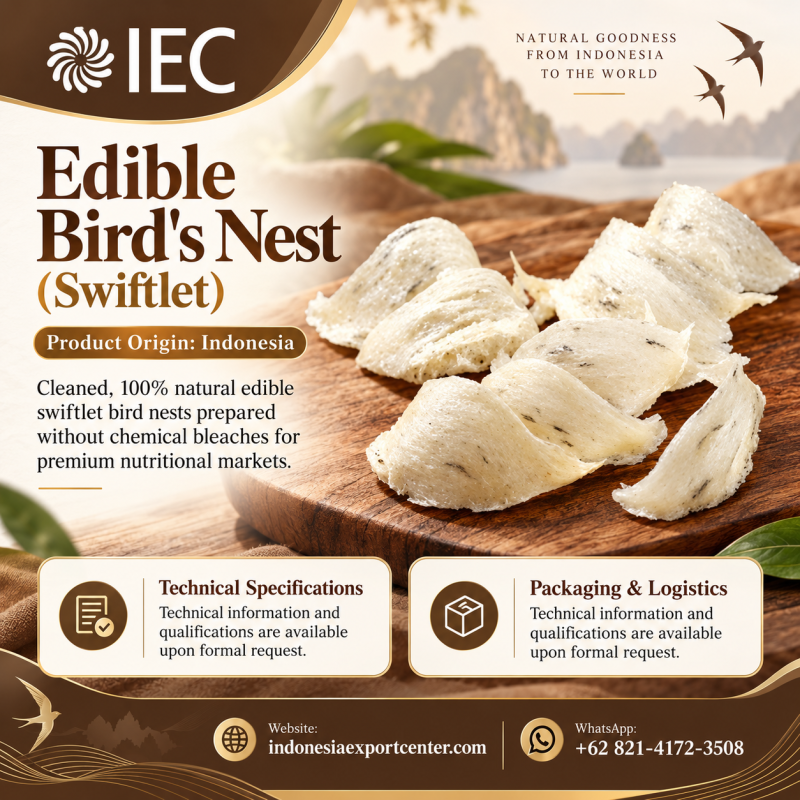
The IEC brochure describes cleaned, natural edible swiftlet bird’s nest originating from Indonesia and prepared without chemical bleaches.
IEC does not guarantee that a particular ingredient grade is suitable for beverage manufacturing, that ready-to-drink production is available, or that a finished beverage will meet specific performance or shelf-life targets.
Why Beverage Developers May Consider Edible Bird’s Nest
Edible bird’s nest has a traditional culinary association with certain prepared foods and beverages.
For modern product developers, it may be considered as a specialty ingredient in formulations where its identity, presentation, and consumer positioning are relevant.
Potential development objectives include:
- Creating a specialty beverage concept.
- Investigating ingredient texture.
- Evaluating visible ingredient presentation.
- Developing a premium culinary product.
- Comparing different ingredient forms.
- Exploring private-label or OEM feasibility.
These are possible product development objectives, not guaranteed ingredient benefits.
Beverage Product Concepts
Potential concepts for feasibility assessment may include:
Ready-to-Drink Beverages
A beverage manufacturer may investigate bird’s nest as part of a packaged drink formulation.
Such products require appropriate process design, food safety validation, and shelf-life studies.
Specialty Dessert Drinks
The ingredient may be evaluated for products combining beverage and dessert characteristics.
Premium Culinary Beverages
Brand owners may investigate ingredient presentation and sensory characteristics.
Custom Food and Beverage Formulations
A manufacturer may consider a buyer-specific product concept, subject to formulation and regulatory feasibility.
No finished beverage product or OEM service is confirmed as available.
Ingredient Form Selection
Different physical forms may affect handling and appearance.
| Ingredient Form | Development Consideration |
|---|---|
| Whole Nest | Preparation and portioning |
| Broken Nest | Processing suitability |
| Strips | Visual presentation |
| Fragments | Distribution and appearance |
| Prepared Ingredient | Separate processing and safety evaluation |
Availability must be confirmed with the supplier.
Step 1 – Define the Beverage Concept
Specify:
- Beverage category.
- Target market.
- Target consumer.
- Ingredient form.
- Desired appearance.
- Desired texture.
- Pack size.
- Processing method.
- Distribution conditions.
- Shelf-life objective.
Step 2 – Define Ingredient Specifications
The buyer should establish:
- Product identity.
- Origin.
- Cleaning status.
- Grade.
- Physical form.
- Moisture.
- Foreign matter.
- Microbiological requirements.
- Relevant chemical contaminant limits.
- Packaging.
- Storage conditions.
- Traceability.
Step 3 – Evaluate Ingredient Preparation
The development team should investigate:
- Hydration behavior.
- Handling.
- Portioning.
- Mixing.
- Appearance.
- Texture.
- Compatibility with other ingredients.
- Processing stability.
No particular hydration time, temperature, or formula is recommended without product-specific validation.
Step 4 – Assess Processing Compatibility
The appropriate process depends on the finished beverage.
Qualified food technologists should evaluate:
- Ingredient preparation.
- Microbial hazards.
- Processing conditions.
- Packaging method.
- Product stability.
- Process validation.
- Storage requirements.
A product should not be considered shelf-stable merely because it has been heated or sealed.
Step 5 – Review Beverage Safety
Food safety assessments may address:
- Raw ingredient microbiological quality.
- Processing hygiene.
- Contamination.
- Relevant chemical hazards.
- Packaging integrity.
- Finished-product microbiological stability.
- Storage and distribution.
The finished beverage may require controls beyond those used for the raw bird’s nest ingredient.
Step 6 – Evaluate Sensory Characteristics
Product development may examine:
- Appearance.
- Texture.
- Mouthfeel.
- Ingredient distribution.
- Flavour compatibility.
- Product consistency.
Consumer acceptance should be evaluated using appropriate methods.
Step 7 – Review Packaging
Potential packaging considerations include:
- Food-contact suitability.
- Closure integrity.
- Processing compatibility.
- Barrier properties.
- Label requirements.
- Product presentation.
- Storage and distribution conditions.
No specific bottle, can, pouch, or jar format is confirmed.
Step 8 – Validate Shelf Life
Shelf-life evaluation may include:
- Microbiological stability.
- Physical stability.
- Sensory changes.
- Packaging integrity.
- Relevant chemical changes.
- Storage-condition testing.
Shelf life must be established for the actual finished product.
Step 9 – Review Nutrition and Marketing Claims
Bird’s nest beverages may be marketed in premium food categories, but any nutritional or health claims must be substantiated and permitted in the target market.
Avoid unsupported claims involving:
- Disease prevention.
- Immune enhancement.
- Anti-aging.
- Medical treatment.
- Guaranteed nutritional effects.
- Unverified protein content.
- Unverified functional benefits.
Ingredient origin and traditional use do not establish clinical effectiveness.
Step 10 – Evaluate OEM or Contract Manufacturing
A beverage brand should determine whether a qualified manufacturer can provide:
- Product development.
- Pilot production.
- Validated processing.
- Food safety controls.
- Packaging.
- Testing.
- Traceability.
- Regulatory documentation.
- Commercial production.
No such capability is confirmed by IEC’s brochure.
Step 11 – Calculate Commercial Feasibility
Costs may include:
- Bird’s nest ingredient.
- Other ingredients.
- Processing.
- Packaging.
- Testing.
- Product development.
- Regulatory compliance.
- Freight.
- Storage.
- Distribution.
No fixed ingredient price, OEM cost, or minimum production volume is provided.
Beverage Ingredient Supplier Questionnaire
- What edible bird’s nest forms are available?
- What cleaning procedures are used?
- What origin information is available?
- What microbiological testing is performed?
- Are relevant contaminant tests available?
- What packaging is offered?
- Are samples available?
- Is lot traceability maintained?
- What quantities can be discussed?
- Are processing characteristics documented?
- What food safety certifications or approvals, if any, can be verified?
- Is the supplier eligible to export to the destination market?
Beverage Development Workflow
Product Concept → Ingredient Specification → Supplier Inquiry → Sample Evaluation → Formulation Trial → Processing Assessment → Food Safety Validation → Packaging Study → Shelf-Life Evaluation → Commercial Review
Each stage should be completed by appropriately qualified personnel.
Bird’s Nest Beverage Ingredient RFQ Template
Subject: Indonesian Edible Bird’s Nest Ingredient for Beverage Development
Company Name: [Name]
Country: [Country]
Brand: [Name]
Beverage Concept: [Details]
Target Market: [Country]
Ingredient: Edible Swiftlet Bird’s Nest
Preferred Ingredient Form: [Details]
Required Grade: [Details]
Cleaning Requirements: [Details]
Technical Specifications: [Details]
Food Safety Requirements: [Details]
Sample Quantity: [KG]
Trial Production Requirement: [KG]
Estimated Commercial Requirement: [KG]
Preferred Packaging: [Details]
Destination: [Port / Country]
Required Documents: [Details]
OEM Manufacturing Inquiry: [Yes / No]
Please provide available ingredient information, sample feasibility, quality documentation, and potential supplier quotation details.
Frequently Asked Questions
Can edible bird’s nest be used in beverages?
It may be evaluated as an ingredient, but formulation and food safety requirements must be addressed.
Is every bird’s nest grade suitable for beverage production?
No.
Can IEC supply ready-to-drink bird’s nest beverages?
No finished-product supply capability is confirmed.
Can a beverage manufacturer request samples?
Yes, subject to supplier availability and applicable import requirements.
Does IEC provide a beverage formula?
No formula development service is confirmed.
Can the beverage be stored at room temperature?
That depends on a validated product and packaging system. No universal storage claim is made.
Can bird’s nest beverages carry health claims?
Only claims supported by adequate evidence and permitted by applicable regulations should be used.
Can I request private-label or OEM services?
You may inquire about feasibility, but availability is not guaranteed.
Request Indonesian Bird’s Nest Ingredients for Beverage Development
Developing a specialty beverage that incorporates edible swiftlet bird’s nest?
Indonesia Export Center welcomes B2B inquiries from beverage brands, product developers, ingredient importers, and contract manufacturers.
Share your ingredient requirements, target product, quantity, destination, and technical documentation needs.
REQUEST BIRD’S NEST BEVERAGE INGREDIENT SPECIFICATIONS & QUOTATION
IEC | INDONESIA EXPORT CENTER
Natural Goodness from Indonesia to the World
Website: https://indonesiaexportcenter.com/
WhatsApp: +62 821-4172-3508
Related Resources
Edible Bird’s Nest Supplier Indonesia
Edible Bird’s Nest for Food Manufacturers
OEM Edible Bird’s Nest Product Development
Private Label Bird’s Nest Sourcing Indonesia
