

IEC | INDONESIA EXPORT CENTER
Natural Goodness from Indonesia to the World
Explore OEM Edible Bird’s Nest Product Development Opportunities
Food brands seeking to develop products containing edible swiftlet bird’s nest may need an OEM manufacturing partner, a suitable ingredient supplier, or both.
OEM development requires a structured assessment of formulation, processing, food safety, packaging, regulatory compliance, production capability, and commercial feasibility.
Indonesia Export Center (IEC) facilitates inquiries involving potential Indonesian edible bird’s nest suppliers.
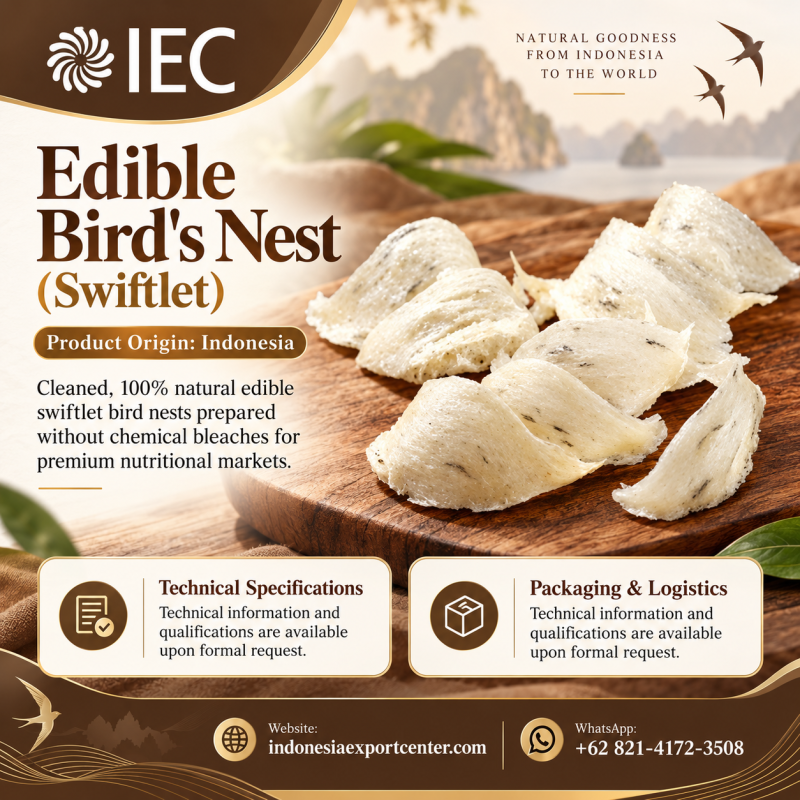
The IEC brochure describes cleaned, natural edible swiftlet bird’s nest prepared without chemical bleaches.
IEC does not claim to own an OEM factory or guarantee contract manufacturing, recipe development, processing capacity, or finished-product approvals.
What Is OEM Bird’s Nest Product Development?
OEM refers to manufacturing arrangements in which a business produces goods according to agreed requirements for another company.
For edible bird’s nest, potential product concepts may include:
- Packaged edible bird’s nest.
- Bird’s nest food preparations.
- Specialty beverages containing bird’s nest.
- Other food products incorporating the ingredient.
Each concept requires a separate feasibility assessment.
Step 1 – Define the Product Concept
The buyer should specify:
- Product category.
- Target market.
- Intended consumer.
- Ingredient form.
- Desired appearance.
- Serving size.
- Packaging.
- Shelf-life objective.
- Distribution conditions.
- Regulatory requirements.
Step 2 – Define Ingredient Requirements
Important questions include:
- What bird’s nest form is needed?
- What cleaning status is required?
- What grade is acceptable?
- What physical characteristics matter?
- What testing is required?
- What origin documentation is needed?
- What quantity is required?
- Can the ingredient be consistently supplied?
Step 3 – Verify Food Manufacturing Capability
A prospective OEM manufacturer should be evaluated for:
- Legal establishment status.
- Relevant food manufacturing permissions.
- Hygiene management.
- Hazard analysis and preventive controls.
- Production equipment.
- Quality assurance.
- Laboratory arrangements.
- Traceability.
- Packaging capability.
- Product-specific processing experience.
A supplier of raw bird’s nest is not automatically a qualified OEM manufacturer.
Step 4 – Develop the Ingredient Specification
| Parameter | Development Consideration |
|---|---|
| Product Identity | Confirm |
| Origin | Verify |
| Physical Form | Specify |
| Grade | Define |
| Moisture | Evaluate |
| Foreign Matter | Control |
| Microbiological Quality | Assess |
| Relevant Chemical Contaminants | Test |
| Particle or Portion Size | Define if relevant |
| Processing Compatibility | Evaluate |
| Storage | Establish |
| Traceability | Require |
Step 5 – Evaluate Other Ingredients
A finished food product may contain ingredients beyond edible bird’s nest.
The development team should assess:
- Ingredient identity.
- Supplier approval.
- Allergen status.
- Compatibility.
- Food safety.
- Regulatory permissions.
- Stability.
- Labelling requirements.
No specific formula is provided or guaranteed.
Step 6 – Assess Processing Feasibility
Manufacturing engineers should evaluate:
- Raw material preparation.
- Hydration behavior.
- Mixing.
- Heating or other processing, where applicable.
- Packaging compatibility.
- Contamination prevention.
- Cleaning and sanitation.
- Process validation.
- Finished-product testing.
A process must be designed and validated by qualified food professionals.
Step 7 – Establish Food Safety Controls
Depending on the product, relevant hazards may include:
- Microbiological contamination.
- Chemical contaminants.
- Foreign matter.
- Allergen cross-contact.
- Process failures.
- Packaging integrity.
- Storage conditions.
The manufacturer should implement an appropriate food safety system.
Step 8 – Evaluate Shelf Life
Shelf life must be supported by suitable evidence.
Potential evaluation areas include:
- Microbiological stability.
- Product appearance.
- Packaging integrity.
- Storage conditions.
- Relevant chemical changes.
- Sensory characteristics.
No shelf-life duration is claimed.
Step 9 – Develop Packaging
Possible requirements include:
- Food-contact compatibility.
- Barrier properties.
- Closure integrity.
- Portion size.
- Label area.
- Distribution protection.
- Storage conditions.
Packaging must be suitable for the finished product and processing method.
Step 10 – Review Regulatory Requirements
The target market may regulate:
- Food ingredients.
- Product categories.
- Manufacturing facilities.
- Import eligibility.
- Food safety.
- Labelling.
- Nutrition information.
- Health claims.
- Shelf life.
- Packaging.
The brand owner and manufacturer should clarify their respective legal responsibilities.
Step 11 – Conduct Pilot Production
Where OEM capability is confirmed, a pilot may be used to assess:
- Ingredient handling.
- Processing feasibility.
- Product consistency.
- Packaging.
- Quality.
- Production yield.
- Stability.
Pilot production is subject to manufacturer availability.
Step 12 – Evaluate Commercial Feasibility
Costs may include:
- Raw materials.
- Formulation development.
- Testing.
- Packaging.
- Production.
- Quality assurance.
- Documentation.
- Freight.
- Import compliance.
No OEM development price or MOQ is confirmed.
OEM Supplier Qualification Checklist
- Ingredient supplier identified.
- Manufacturing entity verified.
- Product concept defined.
- Target regulations reviewed.
- Ingredient specifications agreed.
- Processing feasibility assessed.
- Food safety controls reviewed.
- Packaging feasibility confirmed.
- Shelf-life validation planned.
- Pilot production discussed.
- MOQ and cost confirmed.
- Contract responsibilities defined.
OEM Development RFQ Template
Subject: OEM Edible Bird’s Nest Product Development Inquiry
Company: [Name]
Country: [Country]
Product Concept: [Details]
Target Market: [Country]
Product Category: [Food / Beverage / Other]
Bird’s Nest Ingredient Form: [Details]
Other Ingredients: [Details]
Required Packaging: [Details]
Target Pack Size: [Details]
Estimated Trial Quantity: [Units]
Estimated Commercial Quantity: [Units]
Required Shelf Life: [Target, Subject to Validation]
Required Tests: [Details]
Required Certifications or Approvals: [Details]
Target Launch Period: [Date]
Please advise whether appropriate ingredient sourcing and OEM manufacturing feasibility can be explored.
Frequently Asked Questions
Does IEC operate an edible bird’s nest OEM factory?
No such facility is confirmed.
Can I develop a ready-to-drink bird’s nest beverage?
The concept may be evaluated, but manufacturing capability and product safety must be established.
Are formulation services available?
Availability is unconfirmed.
Can an OEM manufacturer guarantee shelf life without testing?
No.
Is private-label packaging included?
It must be discussed separately.
Can IEC guarantee regulatory approval?
No.
Request OEM Bird’s Nest Development Information
Planning a food or beverage product containing Indonesian edible bird’s nest?
Contact IEC with your concept, ingredient requirements, production quantity, target market, and manufacturing questions.
REQUEST OEM BIRD’S NEST FEASIBILITY INFORMATION
IEC | INDONESIA EXPORT CENTER
Website: https://indonesiaexportcenter.com/
WhatsApp: +62 821-4172-3508
Related Resources
Private Label Bird’s Nest Sourcing Indonesia
Edible Bird’s Nest for Food Manufacturers
Bird’s Nest for Specialty Beverage Brands
