

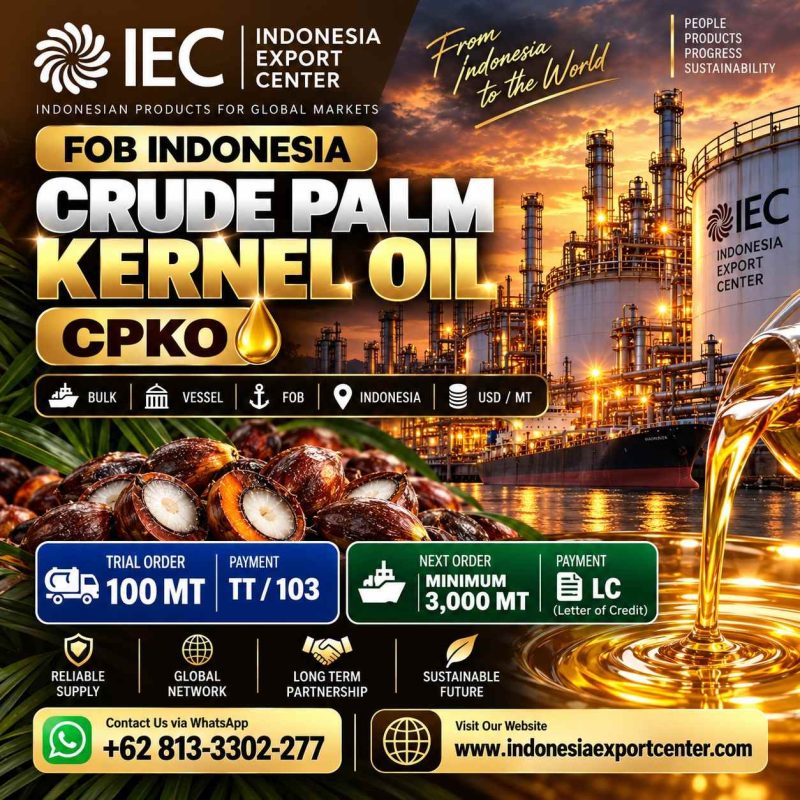
Source Indonesian CPKO for United States Industrial Manufacturing
Indonesia Export Center (IEC) facilitates Indonesian Crude Palm Kernel Oil sourcing inquiries for United States industrial buyers, specialty chemical manufacturers, vegetable oil importers, oleochemical processors, soap producers, and commodity trading companies.
Crude Palm Kernel Oil, commonly abbreviated as CPKO, is an unrefined lauric vegetable oil derived from oil palm kernels.
Its characteristic fatty acid composition makes it relevant to selected industrial manufacturing processes requiring palm kernel oil-based feedstock.
For US procurement teams evaluating international supply options, Indonesia may represent a potential sourcing origin for crude palm kernel oil and related palm-based industrial commodities.
IEC supports supplier matching, technical inquiries, commercial communication, and potential FOB export arrangements.
We welcome inquiries from American businesses seeking trial purchases, commercial bulk shipments, and recurring industrial procurement.
Indonesian CPKO Product Profile
| Product Parameter | Reference Information |
|---|---|
| Product | Crude Palm Kernel Oil |
| Abbreviation | CPKO |
| Origin | Indonesia |
| Target Market | United States |
| Raw Material | Oil Palm Kernels |
| Grade | Crude Industrial Feedstock |
| Oil Category | Lauric Vegetable Oil |
| Reference Trade Term | FOB Indonesia |
| Shipment Format | Bulk, Subject to Confirmation |
| Reference HS Code | 1513.21 |
| Minimum Order Quantity | To Be Confirmed |
| Loading Port | Subject to Supplier Confirmation |
| Pricing | Available Upon Request |
Final specifications and commercial terms must be established through supplier-specific verification.
Indicative CPKO Technical Specifications
| Parameter | Indicative Reference |
|---|---|
| FFA as Lauric Acid | Maximum 5.0% |
| Moisture and Impurities | Maximum 0.5% |
| Iodine Value | Approximately 16–19 |
| Lauric Acid | Approximately 45–52% of Total Fatty Acids |
| Processing Stage | Crude / Unrefined |
These reference values are intended for preliminary sourcing discussions.
They do not establish actual batch quality, regulatory compliance, food-grade suitability, or guaranteed contractual acceptance limits.
US buyers should provide their required technical specifications before commercial quotation.
Industrial Applications for United States Buyers
Oleochemical Manufacturing
CPKO may serve as a raw material for selected oleochemical manufacturing processes.
Its fatty acid composition may be relevant to the production of fatty acids, fatty alcohol intermediates, surfactant derivatives, and specialty chemical products.
Manufacturers should evaluate feedstock compatibility according to their processing technology.
Specialty Chemical Manufacturing
Palm kernel oil-derived materials may be used in selected specialty chemical supply chains.
Potential applications may include industrial additives, esters, emulsifiers, surfactants, and related processed derivatives.
Crude CPKO is an upstream feedstock rather than a finished specialty chemical ingredient.
Industrial Soap Production
US soap manufacturers may evaluate palm kernel oil-derived materials according to their formulation and manufacturing requirements.
Crude oil may require additional preparation, refining, or purification.
Oil Refining and Fractionation
Vegetable oil refineries may purchase CPKO for further processing into refined palm kernel oil or specialty fractions.
The appropriate crude oil specification depends on the refinery’s process capabilities and intended finished products.
Personal Care Ingredient Supply Chains
Appropriately processed palm kernel oil derivatives may be relevant to selected personal care manufacturing applications.
The reference crude industrial grade is not represented as suitable for direct cosmetic use.
CPKO Procurement for American Industrial Buyers
US manufacturers should evaluate both technical and commercial aspects when selecting a new international oil supplier.
Important procurement considerations include feedstock quality, consistency between batches, traceability, supplier documentation, commercial pricing, shipment reliability, and total landed cost.
A supplier offering a lower purchase price may not necessarily provide better overall manufacturing economics.
Additional preparation costs, processing recovery, storage requirements, and quality-related risks should be included in the evaluation.
Understanding US Import Classification
The reference international HS subheading for crude palm kernel oil is 1513.21.
US importers should confirm the applicable Harmonized Tariff Schedule of the United States classification for the actual commodity.
National tariff classifications may include additional digits beyond the international six-digit HS subheading.
The correct classification may affect import duties, reporting requirements, and other customs obligations.
Buyers should consult their customs broker or qualified trade compliance professional before confirming shipment.
No particular US duty rate or preferential tariff treatment is guaranteed.
US Customs and Regulatory Due Diligence
United States import requirements may vary according to the actual product, intended use, commercial arrangement, and applicable regulations.
Industrial buyers should evaluate:
- Importer of record responsibilities.
- Customs classification.
- Customs entry documentation.
- Customs bond requirements where applicable.
- Applicable duties, taxes, and fees.
- Product-specific regulatory obligations.
- Origin and supply chain documentation.
- Relevant transportation and cargo handling requirements.
The importer should confirm requirements with US Customs and Border Protection and other relevant agencies where applicable.
Industrial Versus Food-Related Import Requirements
The reference CPKO product is positioned as crude industrial feedstock.
US buyers intending to use palm kernel oil in food-related manufacturing should separately evaluate applicable food safety and regulatory requirements.
Depending on the actual product and intended use, requirements involving the US Food and Drug Administration may apply.
Potential considerations may include facility registration, prior notice, foreign supplier verification, food safety documentation, and applicable product standards.
These obligations should be assessed for the specific transaction.
IEC does not claim FDA approval, food-grade status, or verified compliance for the reference crude product.
Traceability and Responsible Procurement
US manufacturers may require supplier documentation relating to agricultural origin, supply chain transparency, labor practices, responsible sourcing, and environmental performance.
Buyers should establish their internal procurement policies before selecting suppliers.
Potential documentation may include supplier declarations, origin records, traceability information, certification evidence, and additional customer-specific records.
No specific RSPO, organic, halal, kosher, or other certification has been verified for the reference CPKO product.
FOB Indonesia Export Arrangements
IEC’s reference commercial arrangement is FOB Indonesia.
Under FOB Incoterms 2020, the seller delivers the goods on board the buyer-nominated vessel at the agreed port of shipment.
The buyer generally arranges main ocean freight and may arrange cargo insurance.
The actual loading port, cargo quantity, shipment format, and loading period must be confirmed.
Alternative trade terms may be considered where commercially feasible.
Potential US Receiving Locations
American buyers may identify receiving locations according to their manufacturing facilities and liquid cargo infrastructure.
Examples of buyer-designated port areas may include Houston, New Orleans, Los Angeles–Long Beach, Savannah, and New York–New Jersey.
These are illustrative destination options, not verified IEC shipping routes or confirmed terminal capabilities.
The buyer should verify whether the selected terminal can receive the proposed CPKO cargo format.
Bulk Shipping Considerations for US Importers
Potential shipment formats may include suitable bulk liquid cargo vessels, approved ISO tank containers, or other compatible transportation arrangements.
Transportation feasibility depends on cargo quantity, oil handling characteristics, carrier acceptance, loading infrastructure, and destination facilities.
The buyer should evaluate tank compatibility, temperature management, cargo transfer equipment, previous cargo restrictions where applicable, and receiving arrangements.
No specific transportation format is guaranteed without verification.
Calculating US Landed Procurement Costs
US importers should evaluate the complete cost of delivering usable feedstock to their manufacturing facility.
Potential cost components include:
| Cost Component | Procurement Consideration |
|---|---|
| FOB Product Value | Supplier Price per Metric Ton |
| Ocean Freight | Carrier or Charter Arrangement |
| Cargo Insurance | Agreed Coverage |
| Destination Handling | Port and Terminal Expenses |
| Customs Duties | Applicable Tariff Treatment |
| Customs Brokerage | Entry and Clearance Services |
| Inland Transportation | Delivery to Manufacturing Facility |
| Storage | Receiving and Inventory Expenses |
| Processing | Additional Preparation or Refining |
Actual costs depend on the selected shipment and commercial arrangements.
Metric Tons and US Short Tons
International CPKO quotations commonly use metric tons.
US buyers should avoid confusing metric tons with US short tons.
| Weight Unit | Equivalent Weight |
|---|---|
| 1 Metric Ton | 1,000 kg |
| 1 US Short Ton | Approximately 907.18 kg |
| 1 Metric Ton | Approximately 1.1023 US Short Tons |
| 100 Metric Tons | Approximately 110.23 US Short Tons |
All quotations should clearly identify the weight unit used.
Technical Qualification and Supplier Approval
US industrial buyers may establish a supplier approval process involving:
- Supplier identity verification.
- Review of product specifications.
- Representative COA evaluation.
- Sample testing.
- Manufacturing compatibility assessment.
- Commercial trial procurement.
- Independent inspection discussions.
- Supply chain documentation review.
- Contract and payment verification.
- Recurring quality monitoring.
IEC facilitates supplier communication, while final approval remains the responsibility of the purchasing organization.
Export Documentation for US Buyers
Potential documents may include commercial invoices, bills of lading, cargo quantity statements, certificates of analysis, certificates of origin where applicable, export customs documentation, inspection reports, and relevant safety documentation.
US importers should establish whether additional declarations or certificates are required for their specific application.
The final document set should be agreed before shipment.
US Buyer RFQ Requirements
Please provide your company name, manufacturing application, required CPKO quantity, estimated annual demand, technical acceptance limits, destination port, preferred shipment format, payment proposal, inspection requirements, and applicable compliance documentation.
Buyers should clearly distinguish industrial crude feedstock inquiries from food-grade refined oil requirements.
Frequently Asked Questions
Can US industrial buyers purchase Indonesian CPKO through IEC?
IEC welcomes US sourcing inquiries, subject to supplier and commercial verification.
Is Indonesian CPKO FDA approved?
No FDA approval or food-grade compliance is established by the reference product information.
Can I request a FOB quotation?
Yes. FOB Indonesia is the reference sourcing arrangement.
What is the applicable US import duty?
The applicable duty must be verified using the current US tariff classification and relevant regulations.
Can I request ISO tank transportation?
Potential tank arrangements may be evaluated according to shipment feasibility.
Can I request traceability documentation?
Yes. Buyers should identify their required documentation before supplier selection.
Is independent inspection available?
Inspection arrangements may be discussed during contract negotiation.
Can I request recurring monthly procurement?
Recurring purchasing inquiries are welcome, subject to verified supplier capacity.
Related CPKO Procurement Resources
- Crude Palm Kernel Oil Supplier Indonesia
- Crude Palm Kernel Oil Price per MT
- CPKO Bulk Shipping Options
- CPKO Export Documents
- CPKO RFQ Template
Discuss Your United States CPKO Import Requirements
Indonesia Export Center welcomes American oleochemical manufacturers, industrial processors, oil refineries, soap producers, and commodity importers.
Submit your required specifications, purchasing quantity, intended application, and US destination requirements.
Indonesia Export Center (IEC)
Indonesian CPKO | United States Industrial Buyers | Global Commodity Sourcing
Website: https://indonesiaexportcenter.com/
WhatsApp: +62 813-3302-277
Contact IEC today to discuss your US industrial crude palm kernel oil procurement requirements.
All product availability, regulatory requirements, specifications, shipment arrangements, and commercial conditions are subject to verification.
