

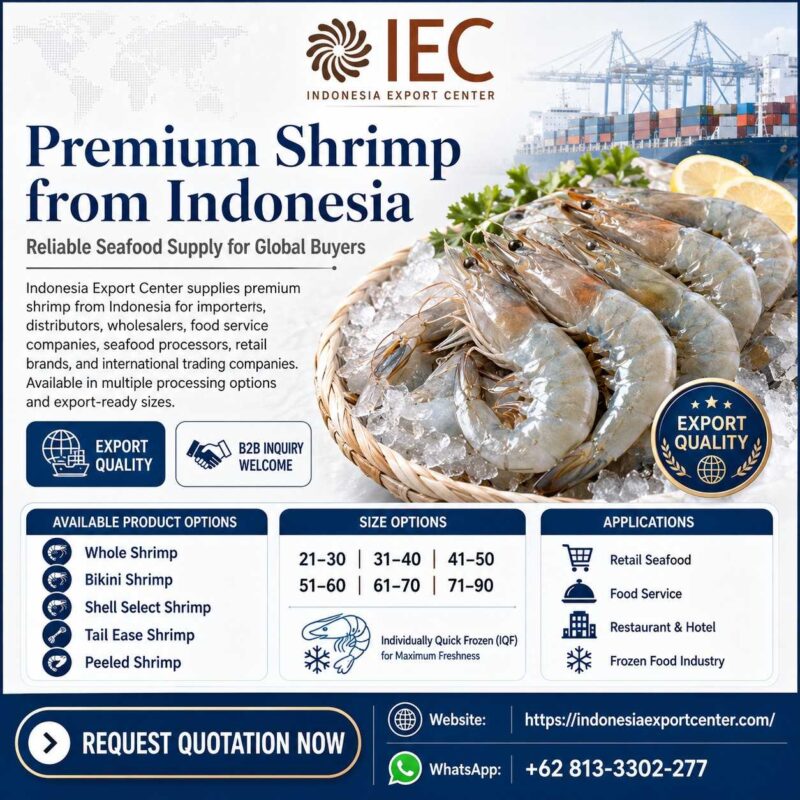
Source Indonesian Frozen Vannamei Shrimp for South Korea
Indonesia Export Center (IEC) welcomes inquiries from South Korean seafood importers, frozen food manufacturers, wholesale distributors, restaurant suppliers, supermarket businesses, and international trading companies seeking Indonesian vannamei shrimp.
Our B2B sourcing services help buyers communicate their required shrimp specifications, processing preferences, packaging configurations, quality requirements, and commercial shipment schedules to potential Indonesian suppliers.
Whether your business requires peeled shrimp for Korean prepared meals, IQF shrimp for restaurant distribution, whole shrimp for seafood markets, or industrial ingredients for frozen food manufacturing, IEC can facilitate the sourcing inquiry process.
All supplier capabilities and South Korean import eligibility must be confirmed.
Indonesian Vannamei Shrimp for Korean Seafood Applications
Vannamei shrimp is a versatile farmed seafood species used in a wide range of commercial food products.
South Korean buyers may evaluate Indonesian shrimp for frozen seafood retail, seafood restaurants, ready meals, convenience food manufacturing, dumplings, seafood pancakes, noodle products, rice dishes, and value-added seafood.
The appropriate product form depends on the buyer’s preparation requirements, desired presentation, processing yield, and quality specification.
Product Options for South Korean Importers
| Shrimp Product | Potential Commercial Application |
|---|---|
| Whole Vannamei Shrimp | Seafood markets and restaurants |
| HOSO | Whole shrimp distribution |
| HLSO | Further processing |
| Peeled Deveined | Ready meals and commercial kitchens |
| Peeled Tail-Off | Dumplings and industrial ingredients |
| PDTO | Foodservice and seafood presentation |
| IQF Shrimp | Flexible portioning |
| Cooked Frozen Shrimp | Selected prepared food applications |
| Breaded Shrimp | Frozen convenience food inquiries |
Availability depends on supplier capability and the requested technical specification.
Peeled Shrimp for Korean Food Manufacturing
Peeled shrimp may be considered by Korean food manufacturers seeking ingredients that require less additional preparation than whole shrimp.
Potential applications include frozen fried rice, seafood noodles, dumplings, seafood fillings, prepared sauces, and frozen meal combinations.
The buyer should define the required deveining quality, tail condition, size grading, shell fragment tolerance, glaze, and net weight.
Actual processing performance should be evaluated through representative samples.
IQF Shrimp for Korean Foodservice
Individually Quick Frozen shrimp may be suitable for restaurant distributors and commercial kitchens requiring flexible portioning.
IQF products may allow users to select individual pieces without handling an entire frozen block.
Actual product separation depends on freezing, glazing, packaging, and storage conditions.
The buyer should verify the product’s appearance, physical condition, size consistency, and handling performance.
Shrimp Size Options
IEC’s preliminary promotional information includes:
| Size Reference | Potential Application |
|---|---|
| 21–30 | Larger restaurant portions |
| 31–40 | Foodservice and retail |
| 41–50 | Prepared seafood dishes |
| 51–60 | Frozen meal manufacturing |
| 61–70 | Seafood ingredient processing |
| 71–90 | Smaller ingredient applications |
The counting unit must be established for each product.
Buyers should specify whether the requested grade is measured in pieces per pound or pieces per kilogram.
Additional size requirements may be submitted for supplier evaluation.
Technical Product Specification
A complete procurement specification may include:
| Parameter | Buyer Requirement |
|---|---|
| Species | Litopenaeus vannamei |
| Origin | Indonesia |
| Processing Form | Buyer-defined |
| Size Grade | Buyer-defined |
| Count Basis | Confirmed commercial unit |
| Raw or Cooked | According to intended use |
| Freezing Method | IQF or other confirmed format |
| Glaze | Agreed target or maximum |
| Net Weight | Approved commercial basis |
| Ingredients | Supplier declaration |
| Additives | According to approved requirements |
| Packaging | Industrial, foodservice or retail |
| Storage | Product-specific requirements |
| MOQ | Supplier confirmation |
| Price | Current quotation |
South Korean Food Import Requirements
South Korean seafood importers should verify applicable requirements administered by the Ministry of Food and Drug Safety and other relevant authorities.
Depending on the product and transaction, requirements may include foreign food facility registration, import declarations, food safety inspections, laboratory testing, ingredient compliance, and Korean-language labeling.
The importer should confirm the actual requirements before approving a supplier.
IEC does not independently register overseas food facilities or guarantee South Korean import clearance.
Foreign Processing Facility Verification
A seafood trader may source products from more than one manufacturing establishment.
Buyers should therefore identify the actual processing facility rather than relying only on the trading company’s name.
Relevant verification may include legal identity, production address, facility registration status, approved product scope, food safety documentation, and traceability capability.
The buyer should verify current facility eligibility for South Korea.
Microbiological and Residue Testing
South Korean buyers may request laboratory reports addressing relevant microbiological parameters, veterinary drug residues, contaminants, and other regulated substances.
The testing panel and acceptance limits should reflect the actual product and applicable regulations.
Cooked or ready-to-eat products may require different food safety assessments from raw frozen shrimp.
A reference laboratory report should not automatically be treated as evidence for a different commercial batch.
Korean-Language Food Labeling
Frozen shrimp distributed in South Korea may require Korean-language product information.
Potential labeling requirements include product name, ingredients, allergen information, net quantity, origin, storage instructions, date marking, and responsible business information.
The exact obligations depend on the product and distribution channel.
The importer should approve all required label information before commercial production.
Traceability for Korean Seafood Distributors
Traceability helps connect the finished shrimp product with its raw material source, processing facility, production lot, packaging records, and export shipment.
Buyers may request farm information, receiving records, production batch details, laboratory reports, and lot identification.
The supplier should demonstrate its ability to retrieve relevant traceability information.
Claims regarding farm origin, responsible aquaculture, or sustainability require supporting documentation.
Packaging for South Korean Buyers
Potential packaging requirements include retail pouches, foodservice bags, industrial inner packs, bulk master cartons, and private-label packaging.
Buyers should establish net weight per pack, inner packs per carton, carton dimensions, material requirements, label language, and storage conditions.
Private-label capability and customized packaging MOQ must be confirmed.
Glazing, Net Weight and Manufacturing Yield
Food manufacturers should evaluate the quantity of actual shrimp available for production.
Protective glaze, packaging weight, shells, tails, and processing losses can affect the relationship between purchased weight and usable ingredient weight.
A buyer should compare quotations using the same net weight basis and processing form.
Representative production trials may help determine actual usable yield.
Quality Inspection Before Export
Pre-shipment inspection may include product identity, count grading, physical defects, deveining quality, glaze, net weight, packaging, label accuracy, temperature, quantity, and batch identification.
The buyer and supplier should agree on sampling methods and acceptance criteria.
Independent inspection may be requested subject to commercial agreement.
Shipping Frozen Shrimp to South Korea
Potential destination-port inquiries include Busan, Incheon, Gwangyang, and other suitable ports.
These are examples for commercial quotation requests, not confirmed shipping routes.
Frozen shrimp shipments require appropriate temperature-controlled logistics.
The parties should confirm reefer availability, cargo loading, temperature settings, monitoring, transit schedules, and destination handling.
FOB and CIF Quotations
South Korean buyers may request FOB Indonesia or CIF quotations to a named destination port.
The quotation should identify the product, size, processing form, packaging, commercial weight basis, quantity, currency, payment terms, delivery terms, and validity period.
CIF quotations require confirmed freight availability.
For containerized shipments, alternative Incoterms may be considered where appropriate.
Indonesian Shrimp Price for South Korea
Export prices may depend on shrimp size, raw material availability, processing yield, labor, freezing method, glaze, packaging, quality testing, order quantity, and freight.
The importer should also evaluate customs duties, import taxes, local handling, inspection, storage, and domestic distribution expenses.
Any preferential tariff treatment should be verified against applicable origin rules and trade agreements.
Recurring Supply for Korean Food Manufacturers
Industrial food manufacturers may require regular shipments to support production planning.
Buyers should communicate their initial order quantity, estimated monthly consumption, preferred delivery frequency, approved specifications, and target inventory levels.
Supplier capacity and production schedules must be confirmed before entering into recurring supply agreements.
How IEC Supports South Korean Buyers
IEC provides independent sourcing assistance, supplier matching, product specification coordination, documentation inquiries, sample requests, commercial quotations, and export logistics discussions.
We help buyers communicate their technical and commercial requirements to potential Indonesian seafood suppliers.
Final supplier approval and regulatory compliance remain the responsibility of the relevant transaction parties.
Frequently Asked Questions
Can I request peeled shrimp for Korean frozen food manufacturing?
Yes. Peeled deveined and tail-off shrimp inquiries are welcome.
Can I request IQF shrimp?
Yes, subject to the required product form and supplier availability.
Can I request Korean-language packaging?
Yes, subject to supplier capability and importer-approved artwork.
Can IEC arrange CIF Busan quotations?
IEC can coordinate quotation inquiries subject to current supplier and freight offers.
Can I request monthly shipments?
Yes. Submit your estimated monthly volume and delivery schedule.
Are all Indonesian suppliers approved for South Korea?
No. The actual production establishment and product eligibility must be verified.
Can I request laboratory testing?
Yes. Please specify the required tests and acceptance criteria.
Request a South Korea Vannamei Shrimp Quotation
| RFQ Field | Buyer Requirement |
|---|---|
| Company Name | |
| Intended Application | |
| Product Form | |
| Size Grade | |
| Count Basis | |
| Raw or Cooked | |
| Freezing Method | |
| Glaze | |
| Net Weight | |
| Packaging | |
| Label Language | |
| Initial Quantity | |
| Monthly Volume | |
| Destination Port | |
| Preferred Incoterms | |
| Facility Documentation | |
| Laboratory Requirements | |
| Shipment Schedule |
Contact Indonesia Export Center
INDONESIA EXPORT CENTER (IEC)
Website: https://indonesiaexportcenter.com/
WhatsApp: +62 813-3302-277
Direct inquiry: https://wa.me/628133302277
Request Your Indonesian Frozen Vannamei Shrimp Quotation for South Korea Today.
Related sourcing pages:
- Vannamei Shrimp Supplier Indonesia
- Peeled Tail-Off Shrimp Indonesia
- Vannamei Shrimp 31/40 Supplier
- Vannamei Shrimp 51/60 Supplier
- Vannamei Shrimp Export Quotation
Product availability, facility eligibility, South Korean import requirements, laboratory results, MOQ, prices, and shipment arrangements require verification.
