

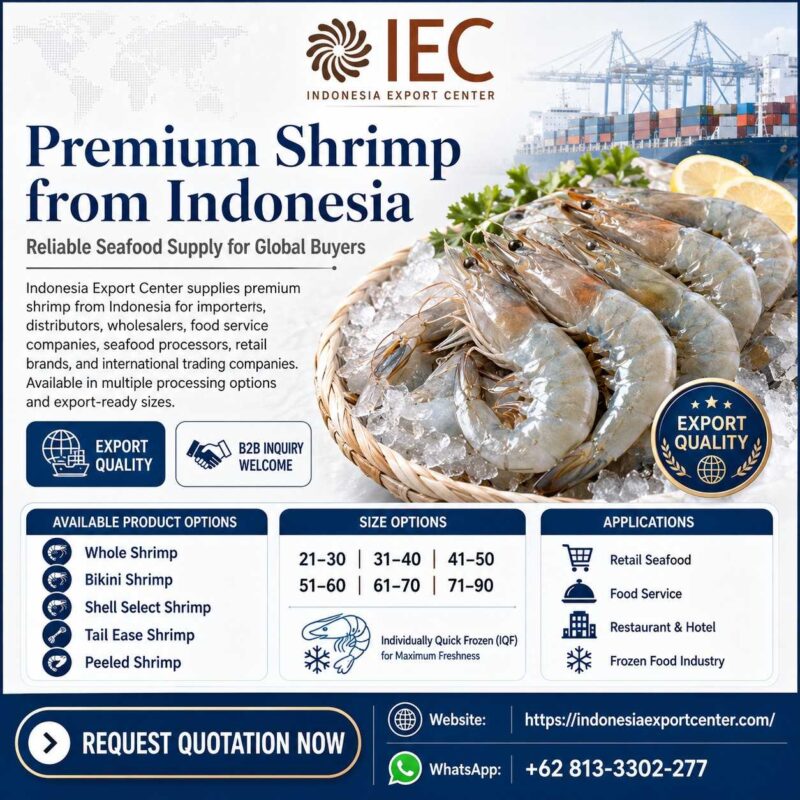
Indonesian Vannamei Shrimp 51/60 for International Food Manufacturers
Indonesia Export Center (IEC) supports international seafood importers, industrial food manufacturers, frozen food companies, seafood processors, and wholesale distributors searching for Vannamei Shrimp 51/60 suppliers in Indonesia.
The 51/60 category may be considered for commercial applications requiring smaller individual shrimp pieces, standardized ingredient distribution, and efficient portion planning.
Food manufacturers in China, South Korea, Southeast Asia, and other international markets may submit sourcing inquiries according to their required processing form, product quality, packaging, and purchase volume.
IEC assists with supplier matching, technical specification coordination, commercial quotation requests, and export sourcing discussions.
Understanding the 51/60 Shrimp Size
Vannamei shrimp is scientifically known as Litopenaeus vannamei.
When a count-per-pound system is used, 51/60 shrimp generally refers to approximately 51 to 60 pieces per pound.
This corresponds to an approximate individual piece weight of 7.6 to 8.9 grams and approximately 112 to 132 pieces per kilogram.
These figures are mathematical conversions rather than guaranteed supplier specifications.
The preliminary IEC promotional material includes the 51–60 size range. The counting unit and specific product availability must be confirmed.
Product Specification Overview
| Parameter | Specification for Inquiry |
|---|---|
| Product | Vannamei Shrimp 51/60 |
| Species | Litopenaeus vannamei |
| Origin | Indonesia |
| Grade | 51/60 |
| Count Basis | To be confirmed |
| Processing Form | Whole, shell-on, peeled, PD, PDTO, tail-off |
| Product Condition | Raw or cooked |
| Freezing | IQF or block frozen inquiry |
| Glaze | According to agreed specification |
| Net Weight | Buyer-approved weight basis |
| Packaging | Bulk or industrial packaging |
| Storage | Product-specific frozen storage requirements |
| MOQ | Request supplier confirmation |
| Price | Current quotation required |
| Shipping | FOB, CIF, or other agreed terms |
Why Consider 51/60 Shrimp for Industrial Manufacturing?
Industrial food manufacturers frequently require ingredients that can be incorporated into standardized recipes and production systems.
The 51/60 category may be relevant where smaller shrimp pieces are desirable for ingredient distribution throughout the finished product.
Its commercial suitability depends on size accuracy, product form, net weight, processing yield, and the manufacturer’s own production requirements.
The size category should not be selected solely because it is assumed to be less expensive.
Applications in Value-Added Food Manufacturing
Frozen Rice Products
Peeled shrimp may be evaluated for frozen fried rice, prepared rice meals, and seafood rice combinations.
Noodle and Pasta Products
Food manufacturers may consider smaller shrimp pieces for frozen noodle dishes, seafood pasta, and prepared sauces.
Seafood Dumplings and Fillings
Depending on the formulation, shrimp may be used as an ingredient in seafood fillings and value-added products.
The manufacturer should establish appropriate texture, processing, and safety requirements.
Frozen Seafood Mixes
The 51/60 category may be evaluated for seafood mixes containing other marine ingredients.
Ingredient declarations and allergen controls must be appropriate for the finished product.
Catering and Institutional Foodservice
Commercial catering businesses may require standardized shrimp ingredients for large-volume meal preparation.
Prepared Seafood Snacks
Food manufacturers may evaluate suitable shrimp formats for breaded, coated, or other prepared seafood products.
Selecting the Appropriate Processing Form
HOSO Shrimp
Whole shrimp may be suitable for buyers that prefer to perform their own processing.
However, head and shell removal can affect usable yield.
HLSO Shrimp
Headless shell-on shrimp may provide a different balance between raw material price and preparation requirements.
Peeled Deveined Shrimp
Peeled deveined shrimp may help reduce additional preparation at the buyer’s facility.
The exact vein removal and trimming specification should be documented.
Peeled Tail-Off Shrimp
Tail-off shrimp may be convenient for prepared food applications where shell or tail material is undesirable.
PDTO Shrimp
Tail-on shrimp may be considered for selected foodservice and retail products.
The supplier must confirm each requested product combination.
Understanding Peeling Yield
Peeling yield is the proportion of purchased shrimp weight remaining after the required shell and other material have been removed.
Actual yield depends on species, shrimp size, starting product form, processing method, and quality requirements.
Buyers should request representative product samples and conduct their own production evaluation.
A fixed peeling yield should not be assumed across all suppliers.
Calculating the Cost per Usable Kilogram
A useful commercial comparison considers usable ingredient cost rather than purchase price alone.
The simplified formula is:
Cost per Usable Kilogram = Purchase Cost per Kilogram ÷ Usable Yield Fraction
Consider the following hypothetical example:
| Cost Factor | Offer A | Offer B |
|---|---|---|
| Purchase Price per KG | USD 3.50 | USD 4.50 |
| Illustrative Usable Yield | 70% | 95% |
| Cost per Usable KG | USD 5.00 | USD 4.74 |
The figures are illustrative only and do not represent current market prices or expected shrimp yields.
The example demonstrates how a higher purchase price may result in a lower usable ingredient cost.
Additional processing, labor, freight, and storage costs should also be considered.
IQF Shrimp for Industrial Portioning
Individually Quick Frozen shrimp may support flexible handling and weighing.
For industrial food manufacturers, individually frozen pieces may be useful where ingredients are added in standardized quantities.
The actual handling performance depends on product quality, glazing, freezing, and storage.
Buyers should verify product separation and suitability for their manufacturing equipment.
Block Frozen Shrimp for Bulk Processing
Block-frozen shrimp may be considered by manufacturers that process larger quantities at a time.
The buyer should establish the block weight, net shrimp content, thawing requirements, and handling procedures.
Supplier capability must be confirmed.
Glaze and Net Weight Specifications
Protective glaze may be applied to frozen shrimp to support product protection during storage.
Buyers should specify the maximum or target glaze percentage and its calculation method.
The net shrimp weight should be distinguished from packaging and protective ice.
For industrial production, accurate net weight is essential for calculating batch ingredient requirements.
Packaging for Food Manufacturing
Industrial buyers may request packaging that supports efficient warehouse and production handling.
Potential requirements include standardized inner packs, durable master cartons, clear lot identification, and suitable frozen storage instructions.
The actual packaging configuration depends on supplier capability and buyer requirements.
Quality Control Requirements
Industrial shrimp procurement may require inspection of species identity, count accuracy, product form, physical defects, shell fragments, deveining, glaze, net weight, temperature, packaging, and traceability.
Food safety requirements may include appropriate microbiological and chemical residue testing.
The applicable criteria must be determined according to destination regulations and the intended application.
Indonesian Shrimp for China Buyers
Chinese food manufacturers and seafood importers may submit inquiries for 51/60 shrimp intended for industrial processing, prepared foods, or wholesale distribution.
Importers should verify applicable establishment registration, official documentation, customs, and food safety requirements.
Indonesian Shrimp for South Korea Buyers
South Korean frozen food manufacturers may evaluate smaller shrimp grades for prepared meals and seafood ingredients.
The importer should confirm the applicable food safety, labeling, customs, and documentation requirements.
IEC does not guarantee supplier approval for any specific market.
Bulk Supply and Recurring Procurement
Food manufacturing businesses may require regular monthly shipments rather than isolated spot purchases.
A recurring procurement program should establish expected monthly volume, product specifications, delivery frequency, acceptable variation, and contingency arrangements.
Supplier capacity and lead time should be confirmed before entering into a long-term agreement.
Vannamei Shrimp 51/60 Price Factors
Export pricing may vary according to raw material availability, processing yield, product form, freezing method, glaze, packaging, order volume, inspection requirements, and shipping terms.
A current quotation should identify the price per kilogram or metric ton and the applicable weight basis.
No fixed price is published without supplier confirmation.
Supplier Qualification and Documentation
Buyers should verify the legal identity of the supplier, actual processing facility, relevant certifications, product specifications, laboratory reports, and export eligibility.
IEC can help coordinate requests for supporting documentation.
Independent inspection and sample evaluation may be appropriate before significant commercial orders.
Frequently Asked Questions
What does 51/60 shrimp mean?
When expressed per pound, it generally means approximately 51–60 shrimp pieces per pound.
Is 51/60 shrimp suitable for ready meals?
It may be suitable for selected ready-meal applications depending on the processing form and recipe.
Can I request peeled tail-off shrimp?
Yes, subject to supplier availability.
Is 51/60 always cheaper than larger shrimp?
Not necessarily. Pricing depends on several commercial and production factors.
Can IEC guarantee peeling yield?
No. Yield must be evaluated for the actual product.
Can I request recurring container shipments?
Yes. Submit your expected monthly requirements for supplier evaluation.
Is IQF available?
IQF is identified in the preliminary product material, but specific product combinations require confirmation.
Request Your 51/60 Shrimp Export Quotation
Please provide:
Company Name:
Country:
Intended Manufacturing Application:
Product Form:
Size: 51/60
Count Basis:
Raw or Cooked:
Freezing Method:
Glaze Specification:
Required Net Weight:
Packaging:
Initial Order Quantity:
Monthly Requirement:
Destination Port:
Preferred Incoterms:
Required Laboratory Documents:
Inspection Requirements:
Shipment Schedule:
Contact Indonesia Export Center
INDONESIA EXPORT CENTER (IEC)
Website: https://indonesiaexportcenter.com/
WhatsApp: +62 813-3302-277
Direct inquiry: https://wa.me/628133302277
Request Bulk Vannamei Shrimp 51/60 Pricing for Your Food Manufacturing Business.
Related pages:
- Vannamei Shrimp Supplier Indonesia
- Vannamei Shrimp 41/50 Supplier
- Peeled Deveined Vannamei Shrimp
- Vannamei Shrimp Export Quotation
Size availability, processing capability, origin, yield, quality specifications, certifications, prices, MOQ, and export arrangements require supplier verification.
