

INDONESIA EXPORT CENTER (IEC)
B2B Coconut Sugar Sourcing for Australian Food Importers, Natural Food Brands, Manufacturers and Distributors
Source Indonesian Coconut Sugar for Australia
Are you searching for a coconut sugar supplier Australia businesses can contact for commercial import inquiries?
Indonesia Export Center (IEC) facilitates sourcing inquiries for Indonesian coconut sugar granules for Australian food manufacturers, ingredient importers, distributors, and specialty food brands.
Australia has important biosecurity and imported food requirements.
Before arranging a shipment, buyers should determine whether the specific coconut sugar product is permitted for import and what conditions apply.
IEC helps buyers prepare sourcing inquiries, while importers remain responsible for confirming applicable Australian requirements.
Coconut Sugar Product Overview
Coconut sugar is made from coconut palm sap.
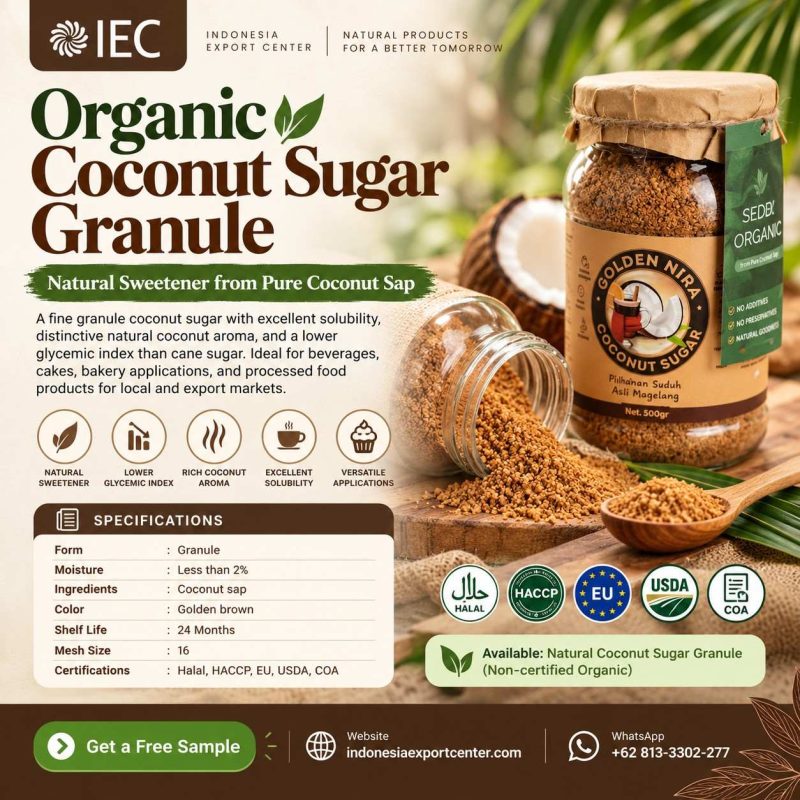
The IEC promotional flyer describes a golden-brown granulated sweetener with a distinctive coconut aroma and good solubility.
Potential applications include:
- Bakery products.
- Coffee and tea.
- Breakfast cereals.
- Granola.
- Snack bars.
- Beverage mixes.
- Specialty retail sweeteners.
- Selected processed foods.
Manufacturers should test the ingredient in their intended formulations.
IEC Reference Specifications
| Parameter | Promotional Information |
|---|---|
| Product | Organic Coconut Sugar Granule |
| Ingredient | Coconut Sap |
| Form | Granule |
| Moisture | Less than 2% |
| Mesh Size | 16 |
| Colour | Golden Brown |
| Shelf Life | 24 Months |
| Certification References | Halal, HACCP, EU, USDA |
The flyer also identifies a natural coconut sugar variant.
Current specifications and documentation require verification.
Australian Biosecurity Requirements
Australia maintains biosecurity controls on imported goods.
Before importing coconut sugar, buyers should check the relevant import conditions through the Australian Government’s Biosecurity Import Conditions system, known as BICON.
Official resource: https://bicon.agriculture.gov.au/
The applicable conditions depend on the product’s identity, processing, composition, and other factors.
Importers should not assume that a product is automatically eligible for entry.
Imported Food Requirements
Australian importers should also assess applicable food standards and imported food controls.
Relevant matters may include:
- Product safety.
- Ingredient composition.
- Contaminants.
- Microbiological criteria.
- Food labelling.
- Traceability.
- Import inspection.
- Documentation.
Official resource: https://www.foodstandards.gov.au/
Organic Coconut Sugar for Australia
Organic claims require appropriate substantiation and compliance with the rules applicable to the intended market and sales channel.
The IEC flyer references USDA and EU organic certification.
However, these references do not automatically establish the product’s eligibility for every Australian organic marketing arrangement.
Buyers should verify certification status and applicable claim requirements.
Quality Testing
Australian buyers may request:
- Current COA.
- Moisture analysis.
- Particle-size information.
- Microbiological testing.
- Relevant contaminant testing.
- Foreign matter inspection.
- Traceability.
- Packaging documentation.
The actual testing program should reflect product risk and regulatory requirements.
Product Labelling
Retail products sold in Australia may need to comply with the Australia New Zealand Food Standards Code and other applicable requirements.
Potential information includes:
- Product name.
- Ingredient declaration.
- Nutrition information.
- Net quantity.
- Date marking.
- Storage instructions.
- Country-of-origin information.
- Supplier details.
- Applicable allergen declarations.
The buyer should review the specific requirements before approving packaging artwork.
Country-of-Origin Claims
Australian food businesses should ensure origin claims are accurate and consistent with applicable rules.
A product’s Indonesian origin should be supported by appropriate supply-chain documentation.
Packaging for Australian Importers
Packaging considerations may include:
- Food-grade materials.
- Moisture protection.
- Packaging integrity.
- Lot identification.
- Palletization.
- Transport durability.
- Biosecurity-related packaging requirements.
Supplier packaging options must be confirmed.
Organic and Natural Product Variants
The IEC flyer references both organic and natural coconut sugar.
The natural variant should not be marketed as certified organic without valid certification evidence.
Australian Importer Procurement Process
Step 1: Define the product specification.
Step 2: Check BICON conditions.
Step 3: Review applicable food standards.
Step 4: Verify supplier identity.
Step 5: Request quality documentation.
Step 6: Review organic claims where relevant.
Step 7: Evaluate samples.
Step 8: Confirm packaging.
Step 9: Agree shipping terms.
Step 10: Arrange import clearance.
Shipping to Australia
Buyers should request quotations identifying:
- Product quantity.
- Packaging.
- Indonesian loading port.
- Australian destination.
- Incoterm.
- Freight assumptions.
- Insurance.
- Lead time.
- Documentation responsibilities.
No particular shipping route or port is confirmed by the IEC flyer.
Australian Coconut Sugar RFQ Template
Subject: Indonesian Coconut Sugar Import Inquiry – Australia
Company: [Name]
Country: Australia
Application: [Details]
Product Variant: [Organic / Natural]
Initial Quantity: [KG or MT]
Monthly Demand: [Quantity]
Required Certifications: [Details]
Maximum Moisture: [Specification]
Required Mesh: [Specification]
Packaging: [Details]
Destination Port: [Port]
Preferred Incoterm: [Term]
Please provide product specifications, processing details, current COA, certification information, sample feasibility, MOQ, lead time, and export quotation.
Frequently Asked Questions
Can coconut sugar be imported into Australia?
Eligibility and conditions must be checked for the specific product.
What is BICON?
Australia’s Biosecurity Import Conditions system.
Does coconut sugar need food safety documentation?
Applicable imported food and buyer requirements must be satisfied.
Is the product automatically approved because it is plant-derived?
No.
Does the IEC flyer reference organic certification?
Yes, but current status requires verification.
Can Australian buyers request bulk quantities?
Yes, subject to supplier capacity and MOQ.
Can the supplier provide retail packaging?
Capability requires confirmation.
Does IEC guarantee customs clearance?
No.
Request Coconut Sugar Export Quotation for Australia
Looking for Indonesian coconut sugar for Australian food manufacturing or distribution?
Contact IEC with your product specifications, volume, packaging needs, and destination.
REQUEST AUSTRALIA COCONUT SUGAR EXPORT QUOTATION
INDONESIA EXPORT CENTER (IEC)
Website: https://indonesiaexportcenter.com/
WhatsApp: +62 813-3302-277
Biosecurity eligibility, food import requirements, certifications, product specifications, MOQ, prices, and shipment arrangements require verification.
Related Resources
How to Import Coconut Sugar from Indonesia
Coconut Sugar COA and Quality Testing
Bulk Coconut Sugar Packaging Options
