

INDONESIA EXPORT CENTER (IEC)
B2B Sourcing Support for U.S. Organic Ingredient Importers, Food Manufacturers, Distributors and Private-Label Brands
Source USDA Organic Coconut Sugar from Indonesia
Are you looking for a USDA organic coconut sugar supplier in Indonesia for food manufacturing, wholesale distribution, retail packaging, or private-label product development?
Indonesia Export Center (IEC) facilitates international sourcing inquiries for Indonesian coconut sugar granules, including products promoted as organic.
Coconut sugar is produced from coconut palm sap and is used as a sweetening ingredient in selected food and beverage applications.
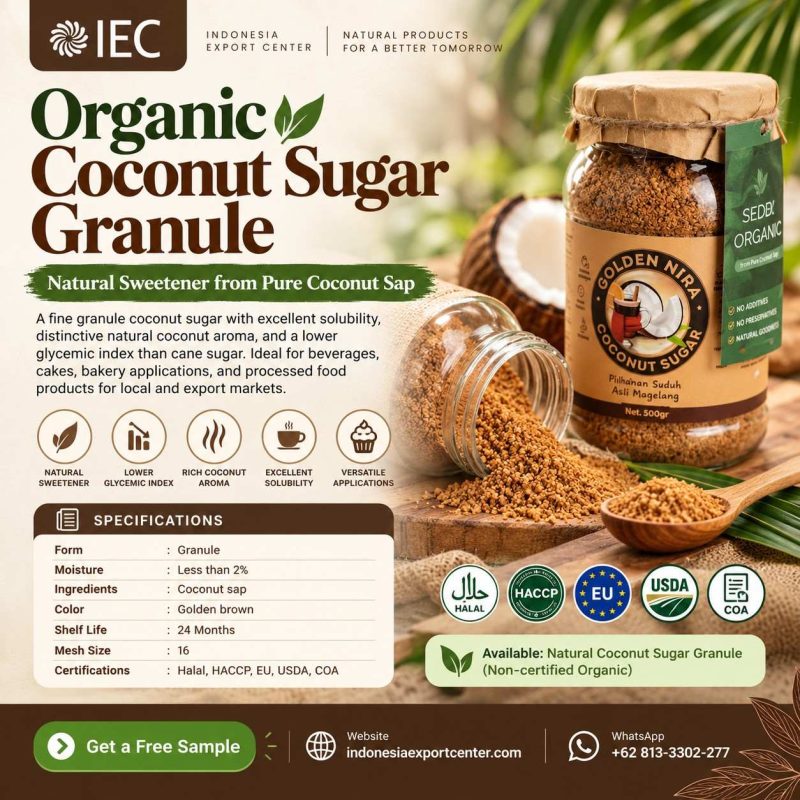
The IEC product flyer describes an organic coconut sugar granule with golden-brown colour, distinctive coconut aroma, good solubility, moisture below 2%, and mesh size 16.
The flyer also references USDA certification.
However, a USDA logo or certification reference in promotional material does not independently establish that the current supplier, processing facility, product, and export transaction satisfy the requirements of the USDA National Organic Program.
For U.S. importers, certification verification should take place before making an organic purchase commitment.
Understanding USDA Organic Coconut Sugar
USDA Organic refers to organic products that meet the applicable requirements of the United States Department of Agriculture’s National Organic Program (NOP).
For imported coconut sugar to be marketed as organic in the United States, the relevant production, handling, certification, import, and labelling requirements must be satisfied.
Organic status should be verified through official certification records and supporting transaction documentation.
An Indonesian origin does not automatically establish USDA Organic eligibility.
Why U.S. Buyers Source Coconut Sugar from Indonesia
Indonesia is an established producer of coconut-derived agricultural products.
Coconut sugar may be evaluated by American businesses seeking:
- Coconut-derived sweeteners.
- Organic food ingredients.
- Specialty bakery ingredients.
- Beverage sweeteners.
- Private-label retail products.
- Foodservice sweeteners.
- Ingredients for snack and cereal manufacturing.
Supplier selection should consider product quality, certification, commercial reliability, and import compliance.
IEC Coconut Sugar Product Reference
| Parameter | IEC Promotional Information |
|---|---|
| Product | Organic Coconut Sugar Granule |
| Ingredient | Coconut Sap |
| Form | Granules |
| Moisture | Less than 2% |
| Mesh Size | 16 |
| Colour | Golden Brown |
| Shelf Life | 24 Months |
| Aroma | Distinctive Coconut Aroma |
| Certification References | USDA, EU, Halal, HACCP |
| COA | Referenced in Flyer |
These are promotional references, not independently verified current-lot specifications or certification evidence.
How to Verify USDA Organic Certification
U.S. importers should establish a structured verification procedure.
1. Identify the Certified Operator
Request the legal name and address of the relevant certified producer or handler.
The operator named on the certificate should correspond to the actual supply arrangement.
2. Identify the Certifying Agent
Determine which USDA-accredited certifying agent issued the organic certificate.
Verify its status through appropriate official sources.
3. Check the Organic Integrity Database
The USDA Organic Integrity Database is a useful official resource for checking organic operation information.
Buyers should review the current record and supporting certification documents.
Official resource: https://organic.ams.usda.gov/integrity/
4. Confirm Product Scope
The certificate should cover the relevant coconut sugar product and applicable activities.
A certificate covering another commodity or unrelated facility does not establish certification for the offered coconut sugar.
5. Verify Handling and Supply Chain
Organic integrity can depend on processing, storage, handling, and other activities along the supply chain.
Buyers should confirm which parties require certification and how organic identity is maintained.
6. Confirm Shipment Documentation
U.S. importers should check the applicable requirements for a NOP Import Certificate and ensure the relevant shipment documentation is correctly arranged.
The exact procedures should be confirmed against current USDA requirements.
NOP Import Certificate Considerations
Organic imports into the United States are subject to specific import documentation requirements.
The NOP Import Certificate is an important part of this process.
Buyers should coordinate with the certified exporter, certifying agent, importer, and customs service providers to establish the correct procedures.
Important information may include:
- Certified exporter identity.
- Product description.
- Shipment details.
- Organic certification information.
- Import certificate reference.
- Quantity.
- Relevant transaction identification.
The availability of an organic product sample does not guarantee that a commercial shipment can be imported as organic.
Organic Certificate vs Certificate of Analysis
A USDA Organic certificate and a Certificate of Analysis serve different purposes.
An organic certificate concerns compliance with the applicable organic certification requirements.
A COA reports analytical information about a sample or lot.
Buyers may need both.
| Document | Primary Purpose |
|---|---|
| Organic Certificate | Organic certification status and scope |
| NOP Import Certificate | Organic import documentation |
| Product Specification | Contractual quality requirements |
| COA | Analytical results |
| Packing List | Shipment identification |
| Commercial Invoice | Commercial transaction |
| Traceability Records | Product and lot history |
Quality Testing for Organic Coconut Sugar
Organic certification does not eliminate the need for food safety controls.
U.S. food ingredient buyers may require:
- Moisture testing.
- Particle-size analysis.
- Microbiological testing.
- Relevant contaminant testing.
- Foreign matter inspection.
- Lot traceability.
- Packaging verification.
The specific testing program should be based on product risk and buyer requirements.
FDA Import Compliance
USDA Organic certification is not a substitute for applicable U.S. food import requirements.
Importers should assess relevant FDA obligations, including facility registration, prior notice, importer responsibilities, and Foreign Supplier Verification Program requirements where applicable.
The exact obligations depend on the product and transaction.
Official information: https://www.fda.gov/food
Organic Coconut Sugar for U.S. Food Manufacturers
Potential applications include:
- Bakery products.
- Breakfast cereals.
- Snack bars.
- Coffee and tea.
- Beverage mixes.
- Specialty confectionery.
- Selected processed foods.
Manufacturers should verify ingredient suitability through formulation trials.
USDA Organic Labelling
Organic labelling must accurately reflect the product and its certification status.
Buyers should review the applicable USDA organic labelling categories, certification requirements, and product composition.
The term “organic” should not be used merely because the ingredient is plant-derived or described as natural.
The use of the USDA Organic seal must comply with applicable rules.
Organic Chain of Custody
Traceability and segregation help maintain organic identity.
Relevant controls may include:
- Supplier identification.
- Product lot records.
- Certified operator records.
- Organic inventory identification.
- Storage segregation.
- Processing records.
- Shipment documentation.
- Transaction reconciliation.
Commercial Quotation Requirements
U.S. importers should request a quotation that identifies:
- Exact product variant.
- Certified operator.
- Applicable organic certificate.
- Product specification.
- Available packaging.
- Minimum order quantity.
- Order volume.
- Lead time.
- Incoterm.
- Loading port.
- Destination.
- Payment terms.
- Quotation validity.
- Documentation responsibilities.
USDA Organic Coconut Sugar RFQ Template
Subject: USDA Organic Coconut Sugar Sourcing Inquiry – Indonesia to USA
Company: [Company Name]
Country: United States
Application: [Food Manufacturing / Wholesale / Retail]
Product: Organic Coconut Sugar Granules
Required Quantity: [KG or MT]
Monthly Demand: [Quantity]
Required Moisture: [Specification]
Required Mesh: [Specification]
Packaging: [Details]
Destination Port: [Port]
Preferred Incoterm: [FOB / CIF / Other]
Please provide:
- Current product specification.
- USDA organic certification details.
- Certified operator information.
- Applicable product scope.
- NOP Import Certificate arrangements.
- Representative COA.
- Sample feasibility.
- MOQ.
- Lead time.
- Export quotation.
Frequently Asked Questions
Does IEC offer USDA Organic coconut sugar?
The supplied flyer promotes an organic coconut sugar product and references USDA certification. Current certification and supplier availability require verification.
Is a USDA logo sufficient proof?
No. Buyers should verify certification status and scope.
Do organic coconut sugar imports need a NOP Import Certificate?
Applicable U.S. organic import documentation requirements must be followed, including the NOP Import Certificate requirements.
Is organic coconut sugar automatically FDA compliant?
No. Applicable food import requirements must be assessed separately.
Can U.S. manufacturers request samples?
Sample feasibility requires supplier confirmation.
Is coconut sugar sugar-free?
No.
Can buyers request private-label packaging?
Packaging capability requires supplier confirmation.
Are prices and MOQ fixed?
No verified prices or MOQ are supplied.
Request USDA Organic Coconut Sugar Supplier Verification and RFQ
Looking for Indonesian coconut sugar for the U.S. organic ingredient market?
Contact Indonesia Export Center with your required certification, application, quantity, packaging, and destination.
REQUEST USDA ORGANIC COCONUT SUGAR DOCUMENTS & RFQ
INDONESIA EXPORT CENTER (IEC)
Website: https://indonesiaexportcenter.com/
WhatsApp: +62 813-3302-277
IEC facilitates sourcing inquiries. Certification, transaction eligibility, specifications, samples, prices, MOQ, and availability require verification. Importers should confirm current requirements with USDA, FDA, CBP, their certifying agent, and qualified import advisers.
Related Resources
Organic Coconut Sugar Supplier Indonesia
Coconut Sugar COA and Quality Testing
Organic vs Natural Coconut Sugar
