

IEC | INDONESIA EXPORT CENTER
Natural Goodness from Indonesia to the World
A Practical Inspection Guide for Cleaned Edible Swiftlet Bird’s Nest
Inspecting cleaned edible bird’s nest before shipment can help buyers assess whether the offered material matches the agreed commercial specification.
Inspection may involve visual checks, packaging verification, document review, lot identification, and laboratory testing.
Indonesia Export Center (IEC) facilitates inquiries involving potential Indonesian edible swiftlet bird’s nest suppliers.
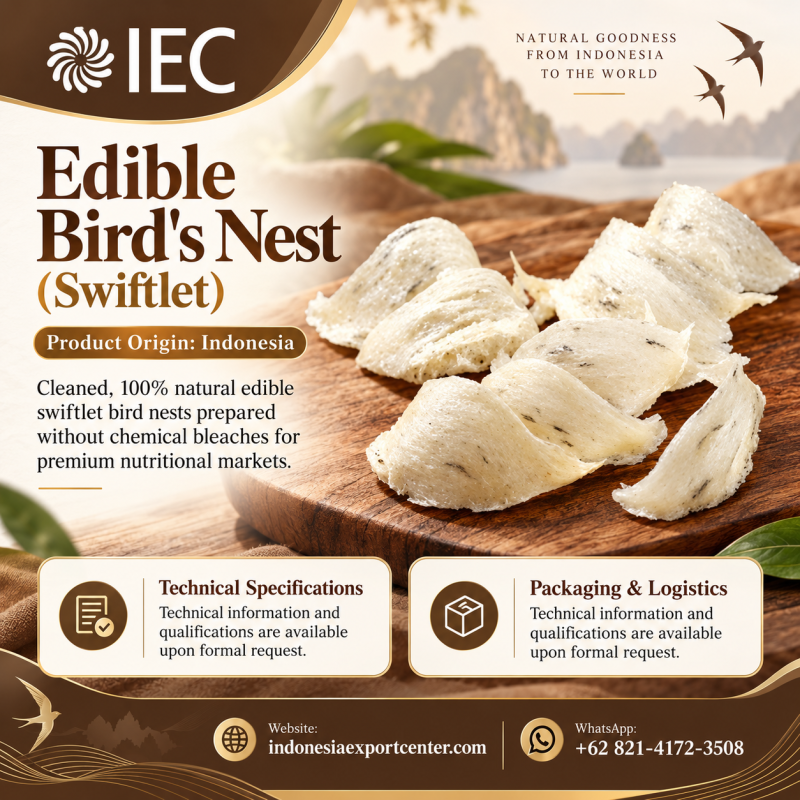
The IEC brochure describes cleaned, natural Indonesian edible bird’s nest prepared without chemical bleaches.
No specific inspection service, inspection result, or third-party surveyor arrangement is confirmed by the brochure.
Why Pre-Shipment Inspection Matters
A buyer may receive samples and photographs during negotiation, but the actual commercial lot still requires appropriate verification.
Pre-shipment inspection can help identify:
- Incorrect product form.
- Unexpected breakage.
- Visible foreign matter.
- Packaging defects.
- Incorrect labels.
- Quantity discrepancies.
- Lot identification problems.
- Missing quality documents.
Step 1 – Review the Purchase Specification
Before inspection, the buyer should establish:
- Product identity.
- Cleaning status.
- Required grade.
- Shape.
- Size.
- Colour.
- Completeness.
- Foreign matter criteria.
- Moisture requirements.
- Laboratory testing requirements.
- Packaging.
- Labelling.
- Quantity.
The inspection team needs written acceptance criteria.
Step 2 – Verify Lot Identity
Inspectors should record:
- Supplier name.
- Processing establishment.
- Product name.
- Lot number.
- Production or processing date, where applicable.
- Package identification.
- Quantity.
- Shipment reference.
Lot traceability is important for linking physical material to laboratory documentation.
Step 3 – Conduct Visual Inspection
Visual inspection may include:
Shape and Completeness
Compare actual material with the agreed product form.
Colour
Assess whether the product falls within the agreed appearance range.
Surface Condition
Inspect for visible foreign matter and unexpected defects.
Breakage
Evaluate damage against the agreed acceptance criteria.
Consistency
Review representative material from different packages or locations within the lot.
Step 4 – Inspect Cleanliness
Cleaned bird’s nest should be assessed against the agreed cleanliness requirements.
The inspector should document:
- Visible unwanted material.
- Surface condition.
- Evidence of contamination.
- Unusual appearance.
- Deviations from approved samples.
Visual inspection alone cannot establish microbiological or chemical safety.
Step 5 – Establish a Batch Photography Protocol
Photographs can support transparent communication.
A useful photo set may include:
- Full lot overview.
- Carton arrangement.
- Packaging labels.
- Inner packaging.
- Representative nests.
- Close-up of appearance.
- Examples of defects.
- Scale reference.
- Sample identification.
Photographs should be associated with the inspected lot.
Step 6 – Verify Packaging
Check:
- Inner packaging.
- Outer cartons.
- Seal integrity.
- Product protection.
- Food-contact suitability documentation where required.
- Net weight labels.
- Lot identification.
- Storage instructions.
- Shipping marks.
Step 7 – Verify Quantity
Compare:
- Purchase order.
- Packing list.
- Package count.
- Net weight.
- Gross weight.
- Shipment preparation records.
Any discrepancy should be documented.
Step 8 – Review Laboratory Documents
Depending on the specification, relevant reports may include:
- Moisture.
- Nitrite.
- Microbiological testing.
- Heavy metal testing.
- Other applicable quality parameters.
Confirm that the reports relate to the inspected material.
Step 9 – Consider Independent Inspection
A buyer may request third-party inspection when commercially appropriate.
Before appointing an inspector, agree on:
- Inspection scope.
- Sampling method.
- Acceptance criteria.
- Reporting format.
- Fees.
- Inspection location.
- Timing.
- Authority to place material on hold.
- Responsibility for corrective actions.
Third-party inspection availability is not guaranteed.
Step 10 – Document Findings
An inspection report may include:
| Section | Information |
|---|---|
| Supplier | Identified |
| Product | Identified |
| Lot | Identified |
| Inspection Date | Recorded |
| Quantity | Checked |
| Appearance | Findings |
| Cleaning Status | Findings |
| Packaging | Findings |
| Labels | Findings |
| Laboratory Documents | Reviewed |
| Deviations | Listed |
| Photos | Attached |
| Conclusion | Based on agreed criteria |
Inspection Decision Categories
A buyer may define internal decisions such as:
- Accepted.
- Accepted subject to corrective action.
- On hold.
- Rejected.
These are example workflow categories, not a universal inspection standard.
What Inspection Cannot Guarantee
An inspection does not automatically prove:
- Full shipment sterility.
- Absence of every contaminant.
- Authenticity without appropriate verification.
- Compliance with every destination law.
- Future supplier performance.
- Successful customs clearance.
Pre-Shipment Inspection RFQ Template
Subject: Cleaned Edible Bird’s Nest Pre-Shipment Inspection Inquiry
Company: [Name]
Country: [Country]
Product Form: [Details]
Required Grade: [Details]
Commercial Quantity: [KG]
Lot Identification: [If Known]
Inspection Scope: [Details]
Visual Criteria: [Details]
Packaging Requirements: [Details]
Laboratory Reports Required: [Details]
Third-Party Inspector Required: [Yes / No]
Destination: [Country / Port]
Please advise whether suitable supplier inspection information, representative photographs, documentation, and inspection arrangements can be discussed.
Frequently Asked Questions
Can buyers inspect cleaned bird’s nest before shipment?
Inspection arrangements may be discussed with the supplier.
Does IEC provide confirmed third-party inspection services?
No such service is confirmed.
Can photographs replace laboratory testing?
No.
Should the inspector check every nest?
The inspection scope and sampling plan should be agreed in advance.
Is a pre-shipment inspection the same as customs approval?
No.
Can buyers reject material that fails agreed specifications?
Contractual rights and procedures should be established before purchase.
Request Cleaned Bird’s Nest Inspection Information
Need inspection documents, batch photographs, or supplier quality verification before purchasing Indonesian edible bird’s nest?
Contact IEC with your inspection criteria, quantity, and destination.
REQUEST BIRD’S NEST INSPECTION INFORMATION
IEC | INDONESIA EXPORT CENTER
Website: https://indonesiaexportcenter.com/
WhatsApp: +62 821-4172-3508
Related Resources
Cleaned Swiftlet Bird’s Nest Supplier
Edible Bird’s Nest Quality Specifications
Bird’s Nest Certificate of Analysis Guide
