

IEC | INDONESIA EXPORT CENTER
Natural Goodness from Indonesia to the World
Traceability in Indonesian Edible Swiftlet Bird’s Nest Sourcing
Traceability is an important consideration for international buyers purchasing edible swiftlet bird’s nest from Indonesia.
A traceability system should help businesses identify where material originated, how it was handled and processed, which commercial lot it belongs to, and where it was distributed.
Indonesia Export Center (IEC) facilitates B2B sourcing inquiries involving potential Indonesian edible bird’s nest suppliers.
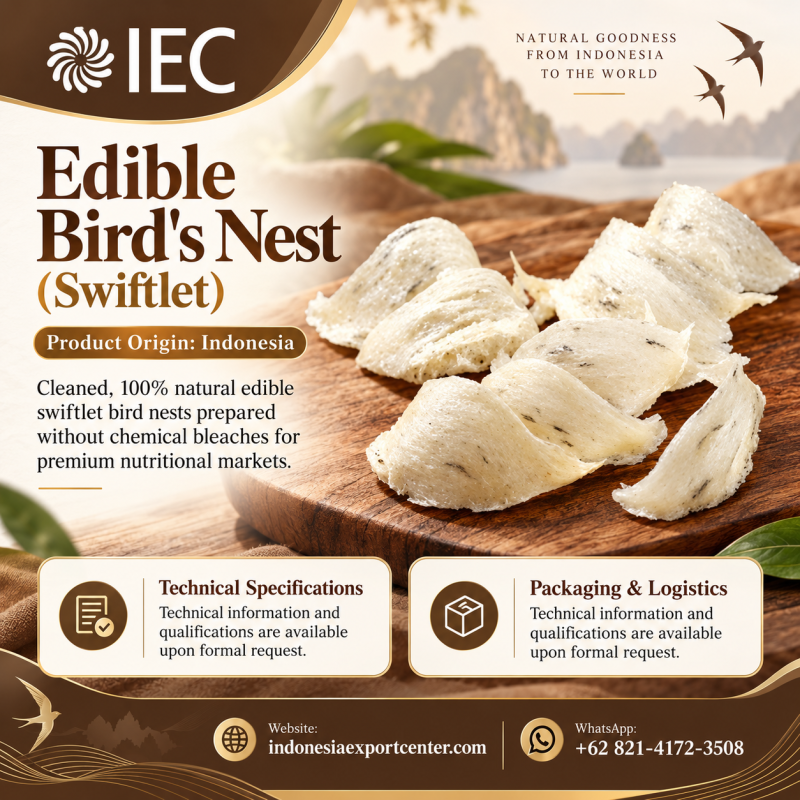
The IEC brochure identifies Indonesia as the product origin and describes cleaned edible swiftlet nests prepared without chemical bleaches.
The brochure does not provide specific source locations, establishment registrations, lot records, or an independently verified chain of custody.
These details must be requested and checked.
What Is Edible Bird’s Nest Traceability?
Traceability is the ability to follow a product through relevant stages of its supply chain.
For edible bird’s nest, these stages may include:
Source → Collection → Receiving → Cleaning → Processing → Grading → Packing → Storage → Export → Import
The actual sequence depends on the supplier’s business model.
Why Traceability Matters
Traceability can support:
- Food safety investigations.
- Product recalls.
- Supplier verification.
- Origin claims.
- Quality consistency.
- Regulatory compliance.
- Lot-specific testing.
- Customer confidence.
- Supply chain accountability.
Step 1 – Identify the Source
Buyers should request information about:
- Country of origin.
- Source location where available.
- Source operator.
- Collection records.
- Applicable registrations or approvals.
- Product identity.
The level of source disclosure may depend on legal requirements and supplier arrangements.
Step 2 – Verify the Processing Establishment
Important questions include:
- Who cleans the bird’s nest?
- Where is the facility?
- Is the facility legally registered?
- Does it hold relevant food processing permissions?
- Is it approved for the destination market where required?
- What hygiene controls apply?
- Are processing records maintained?
Step 3 – Review Lot Identification
A lot number should help identify material handled under defined conditions.
A buyer should ask:
- How are lots created?
- Can source lots be linked to finished lots?
- Can multiple source lots be combined?
- How are mixed lots documented?
- How are reworked materials tracked?
- How are rejected materials segregated?
Step 4 – Link Laboratory Results to Lots
Quality documents should ideally identify the tested lot.
For example:
Processing Lot → Sample ID → Laboratory Report → Packed Lot → Shipment Reference
A laboratory report with no clear lot relationship may provide limited evidence about the actual shipment.
Step 5 – Verify Packaging Records
Packaging information may include:
- Product name.
- Net weight.
- Lot number.
- Packing date.
- Processing establishment.
- Storage instructions.
- Destination-specific labels.
Exact requirements depend on the market.
Step 6 – Review Shipping Documents
Documents may include:
- Commercial invoice.
- Packing list.
- Transport document.
- Certificate of origin where applicable.
- Health or sanitary documentation.
- Laboratory reports.
- Import permits.
- Other regulatory records.
The buyer should verify consistency between documents.
Traceability Documentation Matrix
| Supply Chain Stage | Potential Evidence |
|---|---|
| Source | Source declaration or records |
| Collection | Collection documentation |
| Receiving | Incoming lot records |
| Processing | Batch records |
| Cleaning | Processing records |
| Quality Testing | Lot-linked laboratory reports |
| Packing | Packing records |
| Storage | Inventory records |
| Shipment | Invoice and packing list |
| Import | Customs and receiving records |
Document availability is subject to supplier confirmation.
Origin Statements vs Verified Origin
An origin statement is a claim that should be supported by suitable evidence.
Buyers should distinguish between:
- Seller declaration.
- Source records.
- Processing location.
- Country-of-origin documentation.
- Independent verification.
Processing in one country does not necessarily establish the origin of all incoming raw materials.
Traceability and Food Safety
Traceability does not itself guarantee product safety.
It supports the ability to identify affected material if a quality or safety issue occurs.
Preventive controls and appropriate testing remain necessary.
Traceability and Responsible Sourcing
Buyers may also ask:
- Is the source legally operated?
- Are collection practices documented?
- Are relevant environmental and wildlife rules followed?
- Can source operators be identified?
- Are supplier audits possible?
No sustainability certification is claimed by IEC.
Supplier Traceability Questionnaire
- Can you identify the source?
- Is the processing facility identifiable?
- Are incoming lots recorded?
- Are finished lots labelled?
- Are source lots mixed?
- Can test reports be linked to lots?
- Can shipping documents be matched?
- Are records retained?
- Is a recall procedure maintained?
- Can supporting documents be reviewed?
Traceability RFQ Template
Subject: Indonesian Edible Bird’s Nest Traceability Documentation Inquiry
Company: [Name]
Destination Country: [Country]
Product Form: [Details]
Required Source Information: [Details]
Required Facility Documentation: [Details]
Lot Traceability Requirements: [Details]
Laboratory Reports Required: [Details]
Origin Documentation: [Details]
Commercial Quantity: [KG]
Destination Port: [Port]
Please provide available source information, processing establishment details, traceability procedures, and export documentation feasibility.
Frequently Asked Questions
Does IEC confirm that every bird’s nest lot is fully traceable?
No such guarantee is provided.
Can buyers request source information?
Yes, subject to supplier disclosure and applicable requirements.
Is country of origin the same as processing location?
Not necessarily.
Can laboratory reports support traceability?
Yes, when they can be linked to identified lots.
Does traceability prove food safety?
No.
Are all source documents available automatically?
No. Availability must be confirmed.
Request Indonesian Bird’s Nest Traceability Information
Need source verification and lot documentation for Indonesian edible bird’s nest?
Contact IEC with your traceability requirements, quantity, and destination market.
REQUEST BIRD’S NEST TRACEABILITY DOCUMENTATION
IEC | INDONESIA EXPORT CENTER
Website: https://indonesiaexportcenter.com/
WhatsApp: +62 821-4172-3508
Related Resources
Indonesian Swiftlet Bird’s Nest Sourcing
Edible Bird’s Nest Quality Specifications
Swiftlet Species and Product Identification
