

IEC | INDONESIA EXPORT CENTER
Natural Goodness from Indonesia to the World
Understanding Moisture Content in Edible Bird’s Nest
Moisture management is an important consideration in the quality, storage, and distribution of edible swiftlet bird’s nest.
International importers and warehouse operators should understand how moisture is measured, how storage conditions may affect the product, and what information should be requested from suppliers.
Indonesia Export Center (IEC) facilitates sourcing inquiries involving potential Indonesian edible bird’s nest suppliers.
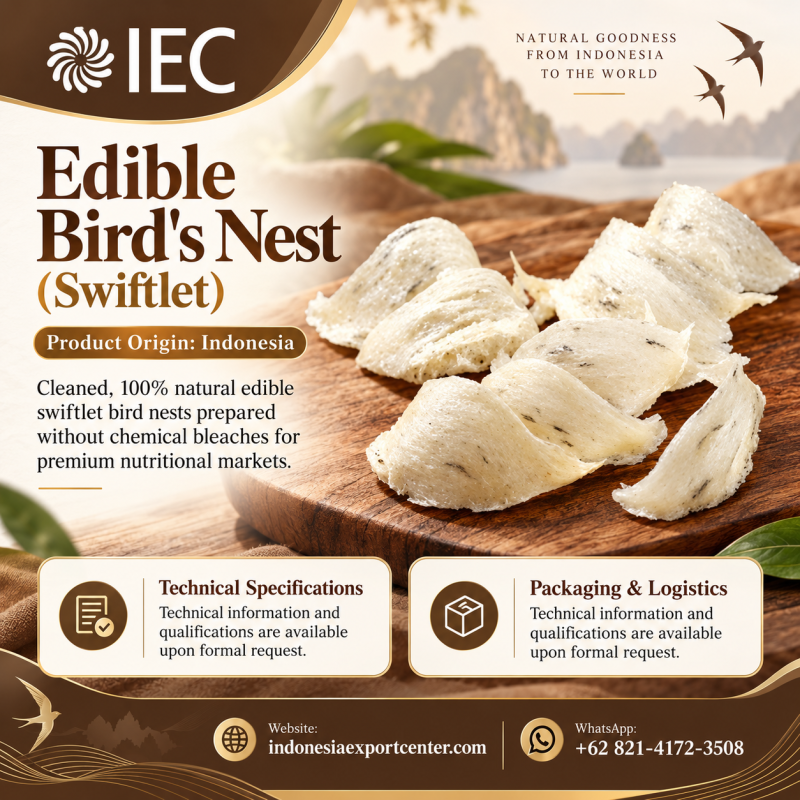
The IEC brochure describes cleaned, natural edible swiftlet bird’s nest originating from Indonesia.
No numerical moisture specification, validated storage temperature, relative humidity range, or shelf-life period is provided in the brochure.
These details must be established for the actual product.
What Is Moisture Content?
Moisture content describes the amount of water present in a material, generally expressed relative to its mass.
It is a useful quality parameter, but its interpretation depends on the measurement method.
A buyer should request the actual method used and the basis on which results are reported.
Why Moisture Matters
Moisture can influence:
- Product stability.
- Storage performance.
- Physical characteristics.
- Packaging requirements.
- Quality consistency.
- Certain microbiological risks.
- Commercial weight comparisons.
The effect depends on the material, its water activity, packaging, and storage environment.
Moisture Content vs Water Activity
Moisture content and water activity are different measurements.
Moisture content describes how much water is present.
Water activity describes the availability of water for certain physical, chemical, and microbiological processes.
A product’s moisture percentage alone cannot fully establish its microbiological stability.
Where relevant, buyers should consider both measurements.
Moisture Testing Methods
A laboratory may use an appropriate validated method to determine moisture.
The buyer should ask:
- What method is used?
- Is the method suitable for edible bird’s nest?
- How is the sample prepared?
- How is the result calculated?
- What units are reported?
- Is the result lot-specific?
- What acceptance limit applies?
Loss-on-drying and other analytical approaches may not produce interchangeable results.
Supplier Moisture Specification
| Parameter | Buyer Requirement |
|---|---|
| Product Form | Confirm |
| Moisture Test Method | Specify |
| Result | Actual laboratory value |
| Reporting Unit | Confirm |
| Acceptance Limit | Agree |
| Sampling Method | Document |
| Lot Number | Identify |
| Storage Instructions | Verify |
| Packaging | Approve |
Storage Environment
Warehouse operators should assess:
- Cleanliness.
- Moisture exposure.
- Temperature fluctuations.
- Condensation.
- Pest prevention.
- Chemical contamination.
- Packaging integrity.
- Product segregation.
- Traceability.
Storage requirements should follow verified supplier instructions and the buyer’s food safety program.
Humidity and Condensation
Environmental moisture may affect stored goods, particularly when packaging is damaged or unsuitable.
Condensation can occur when temperature and humidity conditions change.
Warehouse teams should assess the risk during receiving, storage, loading, and transportation.
Packaging Protection
Packaging should be evaluated for:
- Food-contact suitability.
- Protection from contamination.
- Moisture barrier properties.
- Seal integrity.
- Physical protection.
- Lot labelling.
- Transport suitability.
No specific packaging material is confirmed as available from IEC suppliers.
Storage Inspection Checklist
During routine warehouse inspections, review:
- Carton condition.
- Inner packaging.
- Signs of moisture exposure.
- Evidence of condensation.
- Pest activity.
- Product identification.
- Lot segregation.
- Storage records.
- Shelf-life information.
- Any unusual odour or visible change.
Suspect material should be assessed under the warehouse’s quality procedures.
Receiving Quality Control
On arrival, compare:
Purchase Order → Product Specification → Packing List → Lot Labels → Quality Documents → Physical Shipment
If the packaging is damaged or moisture exposure is suspected, the receiving team should document the condition and determine whether further inspection or testing is necessary.
Storage and Shelf Life
Shelf life should be supported by product-specific evidence.
Buyers should request:
- Shelf-life declaration.
- Storage conditions.
- Packaging information.
- Stability evidence where relevant.
- Date marking.
- Lot identification.
No universal storage period should be assumed.
Transport Considerations
International transport may expose goods to changing environmental conditions.
Buyers should discuss:
- Packaging protection.
- Container cleanliness.
- Moisture control.
- Handling instructions.
- Transit duration.
- Loading conditions.
- Insurance and claims procedures.
Any proposed protective measures should be evaluated for suitability and food safety.
Common Storage Mistakes
- Assuming a universal moisture limit.
- Treating moisture and water activity as identical.
- Ignoring damaged packaging.
- Storing food near incompatible chemicals.
- Failing to monitor warehouse conditions.
- Using unverified shelf-life claims.
- Mixing lots without traceability.
- Ignoring condensation risks.
Moisture and Storage RFQ Template
Subject: Edible Bird’s Nest Moisture and Storage Information Request
Company: [Name]
Country: [Country]
Product Form: [Details]
Required Moisture Specification: [Details]
Required Test Method: [Details]
Water Activity Requirement: [If Applicable]
Required Packaging: [Details]
Storage Conditions Requested: [Details]
Shelf-Life Documentation: [Details]
Sample Quantity: [KG]
Commercial Quantity: [KG]
Destination: [Country / Port]
Please provide available moisture test information, packaging specifications, storage instructions, and quotation feasibility.
Frequently Asked Questions
What is the moisture content of IEC edible bird’s nest?
No measured value is provided in the brochure.
Is there a universal storage temperature?
No product-specific temperature is confirmed.
Is moisture content the same as water activity?
No.
Can I request moisture testing?
Yes, subject to supplier and laboratory arrangements.
Does dry-looking bird’s nest necessarily have safe moisture levels?
No. Visual appearance is not a substitute for testing.
Can IEC guarantee a specific shelf life?
No.
Request Bird’s Nest Moisture and Storage Specifications
Need Indonesian edible bird’s nest with defined moisture, packaging, and storage requirements?
Contact IEC with your technical specification, quantity, destination, and documentation needs.
REQUEST MOISTURE & STORAGE INFORMATION
IEC | INDONESIA EXPORT CENTER
Website: https://indonesiaexportcenter.com/
WhatsApp: +62 821-4172-3508
Related Resources
Edible Bird’s Nest Quality Specifications
How to Inspect Cleaned Bird’s Nest
Cleaned Swiftlet Bird’s Nest Supplier
