

IEC | INDONESIA EXPORT CENTER
Your Global Sourcing Partner
Responsible Sourcing Considerations for Indonesian Gum Copal
Companies purchasing natural resin increasingly need to understand the origin, collection practices, supplier chain, and environmental and social risks associated with their raw materials.
For Gum Copal, responsible sourcing begins with a fundamental question:
What is the actual resin, where did it come from, and what evidence supports the supplier’s claims?
Indonesia Export Center (IEC) facilitates inquiries involving potential Indonesian Gum Copal suppliers.
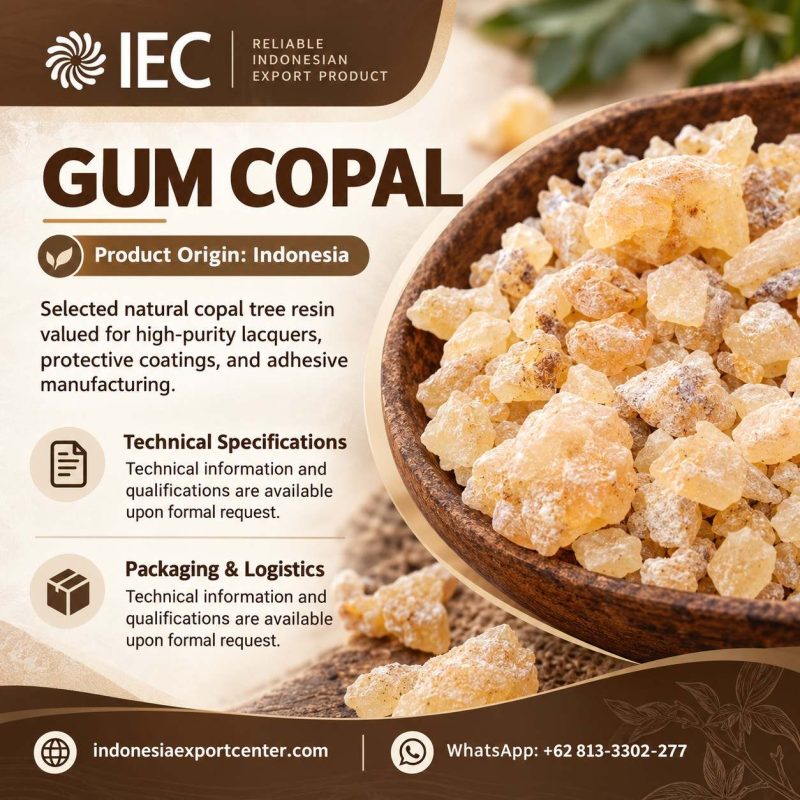
The IEC brochure identifies the product as selected natural copal tree resin originating from Indonesia.
However, the brochure does not establish:
- A specific botanical species.
- A verified forest collection location.
- A sustainability certification.
- A chain-of-custody certification.
- A verified carbon footprint.
- A confirmed harvesting practice.
- An independently audited supplier network.
These details require separate investigation.
What Is Responsible Gum Copal Sourcing?
Responsible sourcing is a procurement approach that evaluates more than product price and technical quality.
It may consider:
- Raw material origin.
- Environmental risks.
- Legal compliance.
- Worker conditions.
- Community impacts.
- Traceability.
- Supplier governance.
- Transparency.
- Verification.
The appropriate requirements depend on the buyer’s policies, risk assessment, and applicable laws.
Why Natural Origin Is Not Enough
A material being natural or tree-derived does not automatically prove that it was responsibly sourced.
Important unanswered questions may include:
- Where was the resin collected?
- What species produced it?
- Was collection authorized?
- Were trees managed appropriately?
- Were workers protected?
- Were local communities affected?
- Can the material be traced through intermediaries?
- Is documentary evidence available?
Responsible sourcing claims should be supported by verifiable information.
1. Verify Botanical Identity
Ask the supplier:
- What is the resin’s botanical source?
- Is the species identified?
- How was the identity established?
- Is supporting evidence available?
- Are different resin sources mixed?
Botanical identity is relevant to material verification and sourcing risk.
2. Verify Geographic Origin
Potential information includes:
- Country.
- Province or region.
- Collection area.
- Processing location.
- Supplier location.
- Aggregation point.
The required level of detail depends on the buyer’s sourcing policy and legal obligations.
3. Investigate Collection Practices
Questions may include:
- Is the resin collected from living trees, naturally fallen material, or another source?
- What collection method is used?
- Are collection practices documented?
- Is harvesting authorized?
- Are there procedures intended to reduce tree damage?
- Is collection monitored?
Do not assume any particular collection method without supplier evidence.
4. Assess Land and Forest-Related Risks
Depending on the supply chain, relevant issues may include:
- Land access.
- Collection permissions.
- Protected-area restrictions.
- Habitat impacts.
- Forest management.
- Land-use changes.
- Applicable forestry regulations.
These risks should be assessed using relevant local information.
5. Review Labour Practices
Supplier questionnaires may address:
- Worker safety.
- Fair compensation.
- Working conditions.
- Child labour prevention.
- Forced labour prevention.
- Grievance mechanisms.
- Relevant legal compliance.
Supplier declarations should be evaluated for credibility.
6. Review Community Considerations
Where collection involves local communities, buyers may investigate:
- Access rights.
- Community participation.
- Compensation arrangements.
- Dispute mechanisms.
- Relevant customary or legal rights.
The appropriate questions depend on the actual sourcing model.
7. Map the Supply Chain
A possible natural resin supply chain may involve:
Collector → Local Aggregator → Trader → Processor → Export Seller → International Buyer
This is an illustrative structure, not a confirmed IEC supplier chain.
Each intermediary may create traceability challenges.
8. Establish Chain-of-Custody Evidence
Relevant records may include:
- Collection records.
- Purchase records.
- Supplier invoices.
- Lot identifiers.
- Warehouse records.
- Processing records.
- Transport documents.
- Shipment records.
The buyer should assess whether these records support the claimed origin and material identity.
9. Evaluate Sustainability Certifications
If a supplier claims certification, request:
- Certification name.
- Certificate number.
- Issuing organization.
- Certified entity.
- Scope.
- Validity period.
- Product coverage.
- Verification source.
A certification held by one company does not automatically cover every product or supplier in a trading chain.
IEC does not claim that the Gum Copal described in its brochure is sustainability-certified.
10. Evaluate Environmental Claims
Claims such as:
- Sustainably harvested.
- Deforestation-free.
- Carbon neutral.
- Environmentally friendly.
- Low carbon.
- Biodiversity positive.
should not be used without appropriate supporting evidence and a clearly defined scope.
Natural origin alone does not validate these statements.
11. Review Regulatory Obligations
Depending on the destination, the buyer may need to evaluate:
- Import regulations.
- Product-specific environmental requirements.
- Chemical regulations.
- Forestry-related controls.
- Due diligence obligations.
- Customs documentation.
Regulatory applicability must be assessed for the actual material.
12. Establish a Supplier Risk Rating
A practical supplier evaluation may consider:
| Risk Area | Suggested Review |
|---|---|
| Botanical Identity | Evidence available? |
| Geographic Origin | Traceable? |
| Collection Rights | Documented? |
| Environmental Practices | Supported by evidence? |
| Labour Practices | Assessed? |
| Intermediaries | Identified? |
| Lot Traceability | Established? |
| Certifications | Independently verified? |
| Legal Compliance | Reviewed? |
| Corrective Actions | Documented? |
A buyer may classify issues as low, medium, or high risk according to its own methodology.
13. Develop a Corrective Action Process
If documentation is incomplete:
- Identify the missing evidence.
- Request clarification.
- Set reasonable verification requirements.
- Review supplier responses.
- Decide whether further assessment is needed.
- Document the procurement decision.
Incomplete information should not automatically be presented as verified compliance.
14. Responsible Sourcing Questionnaire
Supplier Identification
Legal Company Name: [Name]
Business Location: [Location]
Contact Person: [Name]
Product Identity
Commercial Name: Gum Copal
Botanical Species: [If Known]
Physical Form: [Details]
Grade: [Details]
Origin
Country: [Country]
Collection Region: [If Available]
Processing Location: [If Available]
Collection and Governance
Collection Method: [Details]
Collection Authorization: [Details]
Environmental Management Practices: [Details]
Labour Policies: [Details]
Community Considerations: [Details]
Traceability
Number of Intermediaries: [If Known]
Lot Identification System: [Details]
Available Origin Documents: [List]
Certification
Certification Claimed: [Yes / No]
Certification Scheme: [Details]
Certificate Number: [Details]
Verification Method: [Details]
Additional Information
[Details]Frequently Asked Questions
Is Indonesian Gum Copal automatically sustainably sourced?
No.
Does IEC guarantee sustainability certification?
No certification is established in the brochure.
Can buyers request forest-origin information?
Yes, subject to supplier records and availability.
Does natural resin automatically have a low carbon footprint?
No. A defensible claim requires appropriate assessment.
Is chain-of-custody documentation always available?
Availability must be verified.
Can responsible sourcing be assessed without certification?
Buyers may use risk-based due diligence and documentary verification, although this does not replace any legally required certification or compliance process.
Request Responsible Sourcing Information for Gum Copal
Does your company require origin transparency, supplier due diligence, or responsible sourcing documentation for Indonesian Gum Copal?
Contact IEC with your procurement requirements and evidence checklist.
REQUEST GUM COPAL RESPONSIBLE SOURCING INFORMATION
IEC | INDONESIA EXPORT CENTER
Website: https://indonesiaexportcenter.com/
WhatsApp: +62 813-3302-277
Related Resources
Gum Copal Botanical Origin and Traceability
Gum Copal Supplier Verification Checklist
