

IEC | INDONESIA EXPORT CENTER
Your Global Sourcing Partner
How to Verify a Gum Copal Supplier in Indonesia
Supplier verification is an essential part of international natural resin procurement.
A professional quotation, attractive product photographs, or a supplier’s claim of having large quantities of Gum Copal does not automatically establish legitimacy, product availability, or export capability.
International buyers should conduct appropriate due diligence before making significant purchasing commitments.
Indonesia Export Center (IEC) facilitates sourcing inquiries involving potential Indonesian Gum Copal suppliers.
IEC does not claim that every potential supplier has already undergone a comprehensive independent audit.
This guide explains the verification steps buyers can use when evaluating Gum Copal sourcing opportunities.
Why Gum Copal Supplier Verification Matters
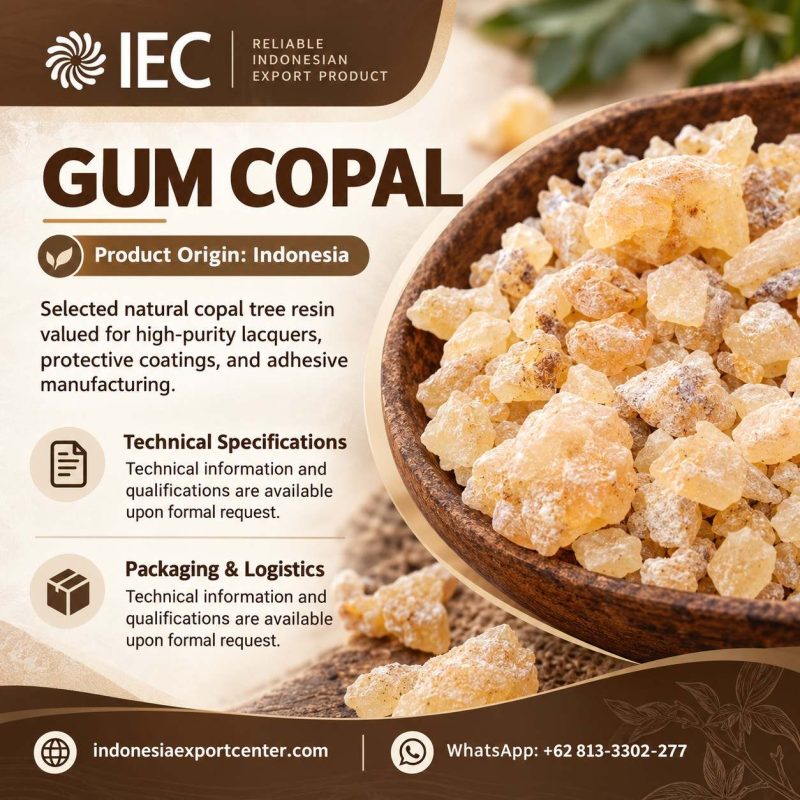
Gum Copal is a natural tree resin associated with varnish, lacquer, protective coatings, and selected adhesive formulations.
Commercial materials may vary in origin, grade, appearance, cleanliness, and processing characteristics.
Therefore, supplier verification should address both the business entity and the product being offered.
The buyer needs to establish:
- Who is selling the material?
- Does the company have authority to sell it?
- What product is actually being offered?
- Is the quantity available?
- Does the grade meet the required specification?
- Can the seller perform the agreed transaction?
- Are payment and shipping arrangements legitimate?
Step 1 – Verify the Legal Business Identity
Request the supplier’s registered legal name and relevant company registration information.
Compare the information across:
- Registration documents.
- Commercial quotations.
- Contracts.
- Invoices.
- Business communications.
- Bank beneficiary information.
Material inconsistencies should be clarified before proceeding.
Step 2 – Identify the Supplier’s Role
A Gum Copal supplier may operate as:
- Collector.
- Processor.
- Wholesaler.
- Distributor.
- Trader.
- Exporter.
- Intermediary.
These roles are not necessarily interchangeable.
A trader may legitimately sell material sourced from another company, but the buyer should understand the commercial arrangement.
Step 3 – Verify Product Origin
IEC’s brochure identifies Gum Copal as an Indonesian-origin product.
For a specific transaction, buyers may request appropriate origin documentation.
The buyer should distinguish between:
- Country of shipment.
- Location of the seller.
- Location of processing.
- Actual origin of the resin.
These may not always be identical.
Step 4 – Confirm Product Identity
The commercial term Gum Copal can refer to natural resin materials with different characteristics.
Request:
- Product description.
- Botanical identity, where available.
- Commercial grade.
- Physical form.
- Available technical data.
- Representative sample.
Step 5 – Review Technical Documentation
The IEC brochure states that technical information and qualifications are available upon formal request.
Buyers should request available documents and assess whether they are sufficient for the intended application.
Relevant information may include:
- Moisture.
- Foreign matter.
- Colour.
- Appearance.
- Particle size.
- Thermal characteristics.
- Acid value, where relevant.
- Processing behavior.
Do not assume that numerical results exist unless supplied and verified.
Step 6 – Verify Product Availability
Ask whether the material is:
- Currently available.
- Under preparation.
- Subject to collection or procurement.
- Expected to become available later.
These situations involve different levels of supply certainty.
Request evidence appropriate to the transaction.
Step 7 – Request Samples
Representative samples may help confirm the material’s identity and suitability.
Where possible, establish:
- Sample source.
- Grade.
- Lot identification.
- Sampling method.
- Sample preparation.
- Relationship to the proposed shipment.
A satisfactory sample does not automatically guarantee that future shipments will be identical.
Step 8 – Evaluate Packaging and Storage
Confirm:
- Packaging material.
- Package weight.
- Product protection.
- Storage conditions.
- Labelling.
- Lot identification.
- Shipment preparation.
Step 9 – Verify Export Capability
Ask:
- Who will act as exporter of record?
- Can the seller provide required export documents?
- Is the product correctly classified?
- Are permits required?
- Can the proposed shipment be arranged?
Applicable requirements must be checked for the actual product and destination.
Step 10 – Verify Bank Details
Before payment:
- Confirm the contracting legal entity.
- Review the beneficiary name.
- Independently verify bank instructions.
- Investigate unexplained beneficiary changes.
- Avoid relying solely on messages requesting urgent payment changes.
The appropriate payment structure depends on the transaction.
Step 11 – Review Commercial References
Where references are provided, verify them independently where feasible.
Do not treat unverified testimonials as proof of successful export performance.
Step 12 – Consider Independent Inspection
Depending on transaction size and risk, inspection may address:
- Product identity.
- Quantity.
- Packaging.
- Sampling.
- Quality.
- Loading.
Inspection scope, timing, and responsibilities should be agreed in advance.
Supplier Due Diligence Checklist
| Verification Area | Evidence or Action |
|---|---|
| Legal Identity | Registration information |
| Business Address | Independently checked |
| Supplier Role | Confirmed |
| Selling Authority | Verified |
| Product Identity | Documented |
| Origin | Supported as required |
| Grade | Defined |
| Technical Data | Reviewed |
| Samples | Evaluated |
| Quantity | Confirmed |
| Packaging | Approved |
| Exporter of Record | Identified |
| Export Documents | Requirements verified |
| Bank Beneficiary | Independently checked |
| Inspection | Agreed if required |
| Contract | Reviewed |
| Claims Procedure | Defined |
Warning Signs Requiring Further Investigation
Potential warning signs include:
- Inconsistent legal names.
- Unexplained changes to payment instructions.
- Refusal to provide basic product information.
- Pressure to pay before reasonable verification.
- Product photographs that cannot be linked to the offered material.
- Unsupported claims of unusually large inventory.
- Unclear contractual responsibilities.
- Documents containing contradictory details.
A warning sign is a reason for further investigation, not automatic proof of fraud.
Supplier Verification Questions
Subject: Gum Copal Supplier Qualification Request
Please provide:
- Registered company name.
- Business registration details.
- Business role.
- Product origin information.
- Available Gum Copal grades.
- Technical documentation.
- Sample arrangements.
- Available quantity.
- Packaging information.
- Exporter-of-record details.
- Payment beneficiary information.
- Inspection arrangements.
Frequently Asked Questions
Does IEC guarantee every Gum Copal supplier is verified?
No. Independent due diligence remains important.
Is a product photograph sufficient to verify stock?
No.
Can a trader be a legitimate supplier?
Yes, provided its identity and selling authority are established.
Should buyers verify bank details?
Yes, particularly before making payments.
Can third-party inspection reduce procurement risk?
It may provide additional evidence within the agreed inspection scope, but it cannot eliminate every risk.
Does a sample prove all future shipments will match?
No.
Request Gum Copal Supplier Information
Looking to evaluate potential Indonesian Gum Copal suppliers through a structured procurement process?
Contact IEC with your purchasing requirements and supplier documentation needs.
REQUEST GUM COPAL SUPPLIER INFORMATION
IEC | INDONESIA EXPORT CENTER
Website: https://indonesiaexportcenter.com/
WhatsApp: +62 813-3302-277
Related Resources
Gum Copal Export Sourcing Indonesia
Gum Copal RFQ Template for Importers
