

IEC | INDONESIA EXPORT CENTER
Your Global Sourcing Partner
Understanding the Botanical Origin of Indonesian Gum Copal
The term Gum Copal is widely used in commercial discussions involving natural tree resins.
However, the commercial name alone does not necessarily identify one botanical species, one chemical composition, or one uniform material grade.
For industrial buyers, accurate botanical identification can be important for technical qualification, supply chain transparency, customs research, and responsible sourcing.
Indonesia Export Center (IEC) facilitates inquiries involving potential Indonesian Gum Copal suppliers.
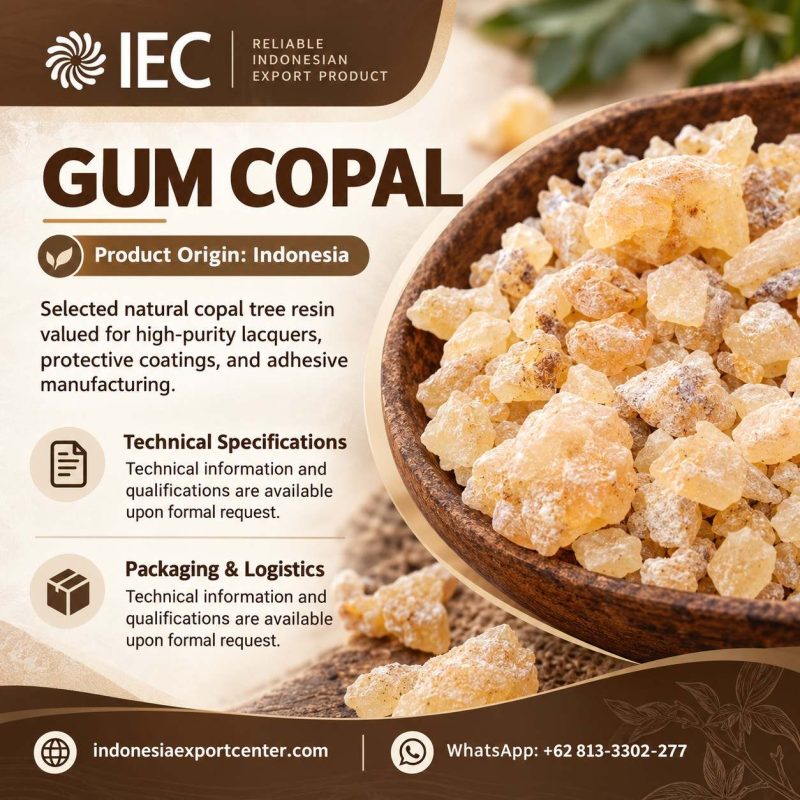
The IEC brochure identifies the product as selected natural copal tree resin originating from Indonesia.
The brochure does not confirm the botanical species, collection region, harvesting method, or complete chain of custody.
These details should be requested and verified where required.
What Does Botanical Origin Mean?
Botanical origin refers to the plant source from which a natural material is obtained.
For Gum Copal, relevant information may include:
- Botanical family.
- Genus.
- Species.
- Collection source.
- Geographic origin.
- Material preparation.
A commercial resin name may encompass materials from more than one botanical source.
Why Botanical Identity Matters
Botanical source can influence:
- Chemical composition.
- Resin characteristics.
- Solubility.
- Thermal behavior.
- Processing suitability.
- Grade consistency.
- Regulatory identification.
- Traceability.
However, species identification alone does not establish every quality parameter.
Laboratory testing may still be necessary.
Commercial Name vs Botanical Name
These are different forms of identification.
| Identification Type | Meaning |
|---|---|
| Commercial Name | Name used in trade |
| Botanical Family | Broader plant classification |
| Genus | Taxonomic grouping |
| Species | Specific botanical identification |
| Geographic Origin | Where material originated |
| Lot Number | Identifies a defined material batch |
| Grade | Supplier’s commercial quality category |
A buyer should not substitute one field for another.
Step 1 – Request Supplier Identity Information
Ask:
- What is the commercial product name?
- Is the botanical species known?
- What evidence supports that identification?
- Where was the resin collected?
- Was it processed or blended?
- Are different botanical sources combined?
- Is lot traceability maintained?
Step 2 – Review Geographic Origin
Potential records may identify:
- Country.
- Region.
- Collection area.
- Processing facility.
- Aggregation location.
- Export location.
A shipment exported from Indonesia is not necessarily sufficient evidence of where every component was originally collected.
Step 3 – Review Collection and Purchase Records
Depending on supplier practices, records may include:
- Collection logs.
- Purchase receipts.
- Aggregator records.
- Warehouse intake records.
- Supplier invoices.
- Lot assignments.
The buyer should assess whether the records are reliable and connected to the purchased material.
Step 4 – Verify Lot Identification
A traceability system should ideally connect the supplied goods to a defined lot.
Relevant information may include:
| Field | Information |
|---|---|
| Product | Gum Copal |
| Supplier | Identified |
| Lot Number | Recorded |
| Origin | Documented where available |
| Collection Date | If recorded |
| Processing Date | If applicable |
| Grade | Defined |
| Quantity | Recorded |
| Packaging | Identified |
| Shipment Reference | Linked |
Step 5 – Assess Material Mixing
Natural resin may pass through collection, aggregation, sorting, or processing stages.
Buyers should determine whether:
- Lots are mixed.
- Grades are combined.
- Material from different areas is aggregated.
- Traceability is preserved after mixing.
Mixed-origin material should not be represented as single-origin without supporting evidence.
Step 6 – Evaluate Botanical Evidence
Potential evidence may include:
- Supplier declarations.
- Collection records.
- Botanical documentation.
- Relevant expert identification.
- Analytical testing where suitable.
The appropriate method depends on the material and the confidence required.
A photograph alone may not establish botanical species.
Step 7 – Consider Laboratory Characterization
Depending on the buyer’s requirements, laboratory work may help characterize the resin.
Possible approaches include relevant chemical and physical analyses selected by qualified laboratories.
However, a laboratory result should not be described as definitive species identification unless the method and evidence support that conclusion.
Step 8 – Connect Identity to Quality
A useful qualification process combines:
Botanical Information + Origin Records + Lot Identification + Technical Testing + Supplier Verification
Each element addresses a different question.
Step 9 – Maintain Chain-of-Custody Records
Chain-of-custody documentation may help demonstrate how material moved through the supply chain.
A possible record sequence is:
Collection Record → Aggregator Receipt → Warehouse Intake → Processing Record → Export Lot → Shipment Document
This is an example, not a confirmed IEC supply chain.
Step 10 – Review Responsible Sourcing Implications
Origin information may support assessments involving:
- Legal collection.
- Environmental risk.
- Labour conditions.
- Supplier transparency.
- Buyer sourcing policies.
It does not automatically establish sustainable harvesting or regulatory compliance.
Common Botanical Identification Mistakes
Assuming Gum Copal Refers to One Species
Commercial terminology may be broader.
Treating Appearance as Definitive Identification
Different materials may look similar.
Confusing Country of Export with Collection Origin
These can be different.
Assuming a COA Proves Botanical Identity
A COA only supports the properties and tests it actually reports.
Ignoring Mixed Lots
Aggregation can complicate traceability.
Claiming Certification Without Evidence
Certification must be independently verified.
Botanical Origin Verification Checklist
- Commercial name recorded.
- Botanical identity requested.
- Source evidence reviewed.
- Country of origin documented.
- Collection area investigated.
- Processing history obtained.
- Mixing practices assessed.
- Lot number assigned.
- Shipment linked to lot.
- Technical characterization reviewed.
- Supplier identity verified.
- Unsupported origin claims avoided.
Gum Copal Botanical Information Request Template
Subject: Indonesian Gum Copal Botanical Origin and Traceability Inquiry
Company: [Name]
Country: [Country]
Product: Natural Gum Copal
Application: [Details]
Required Grade: [Details]
Botanical Identity Requirement: [Details]
Required Origin Information: [Details]
Traceability Requirements: [Details]
Sample Quantity: [KG]
Commercial Quantity: [KG / MT]
Required Documents: [List]
Please provide available botanical identification, origin records, processing information, lot traceability, and supporting technical documents.
Frequently Asked Questions
What botanical species produces IEC’s Gum Copal?
The supplied brochure does not identify a species.
Can Gum Copal come from different botanical sources?
Commercial copal terminology can encompass different natural resin sources.
Does Indonesian origin establish the botanical species?
No.
Can a COA prove species identity?
Only if suitable identity testing is included and supports that conclusion.
Is full collection-site traceability guaranteed?
No.
Can buyers request traceability documents?
Yes, subject to supplier records and availability.
Request Gum Copal Botanical Origin Information
Need verified resin identity, botanical information, or traceability records for an Indonesian Gum Copal purchase?
Contact IEC with your technical and sourcing requirements.
REQUEST GUM COPAL ORIGIN INFORMATION
IEC | INDONESIA EXPORT CENTER
Website: https://indonesiaexportcenter.com/
WhatsApp: +62 813-3302-277
Related Resources
Gum Copal Sustainable Sourcing Questions
Gum Copal Technical Specifications Guide
