

IEC | INDONESIA EXPORT CENTER
Your Global Sourcing Partner
Gum Copal and Rosin: Choosing the Right Natural Resin
Gum Copal and rosin are natural resin materials that may be considered during the development or procurement of industrial formulations.
However, they differ in origin, composition, commercial specifications, and potential processing characteristics.
Rosin is commonly associated with resin acids obtained from pine-related raw materials, while Gum Copal refers to certain natural tree resins whose exact botanical identity should be confirmed for each commercial product.
For adhesive manufacturers, varnish producers, and coating formulators, understanding these differences is essential before selecting or substituting materials.
Indonesia Export Center (IEC) facilitates inquiries involving potential Indonesian Gum Copal suppliers.
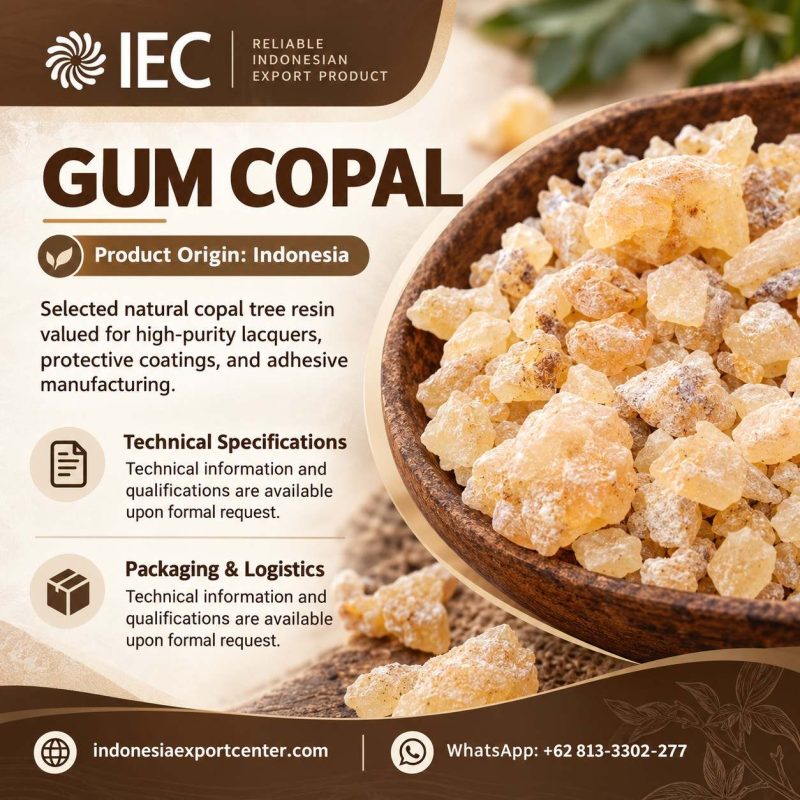
The IEC brochure describes Gum Copal as selected natural copal tree resin originating from Indonesia.
What Is Gum Copal?
Gum Copal is a natural resin commercial category associated with certain tree-derived resin materials.
Its actual properties depend on the source and grade.
Buyers should request technical information for the specific material rather than relying on a generic description.
What Is Rosin?
Rosin is a resinous material commonly produced from pine-related sources.
Commercial rosin categories include materials derived from different production streams, such as gum rosin, wood rosin, and tall oil rosin.
These materials may differ in composition and specifications.
Rosin is also used as a starting material for various modified resin products.
A buyer should distinguish unmodified rosin from rosin derivatives.
Gum Copal vs Rosin: Key Differences
| Factor | Gum Copal | Rosin |
|---|---|---|
| General Origin | Certain natural tree resins | Commonly pine-related resin sources |
| Chemical Profile | Source-dependent | Often rich in resin acids |
| Commercial Classification | Supplier-specific grades | Multiple established commercial categories |
| Acid Value | Requires actual testing | Relevant to many rosin specifications |
| Softening Behavior | Requires testing | Grade-dependent |
| Solubility | Material-dependent | Grade- and medium-dependent |
| Adhesive Suitability | Must be demonstrated | Depends on rosin type and formulation |
| Coating Suitability | Must be demonstrated | Depends on grade and formulation |
| Substitution | Requires qualification | Requires qualification |
Botanical and Chemical Differences
Material identity is fundamental to comparison.
Even if two samples have similar colour or physical form, they may contain different constituents.
These differences can affect:
- Solubility.
- Chemical reactivity.
- Thermal behavior.
- Compatibility.
- Stability.
- Finished-product properties.
Acid Value Comparison
Acid value may be particularly relevant when characterizing rosin and certain resin derivatives.
For Gum Copal, its relevance depends on the actual chemistry and intended application.
An acid value result should include:
- Test method.
- Sample identity.
- Units.
- Laboratory.
- Reporting conditions.
A single acid value does not establish that two resins are interchangeable.
Softening Point Comparison
Thermal behavior can influence manufacturing.
However, softening point results should be compared only when the test methods are suitable and sufficiently comparable.
Do not assume that all Gum Copal grades or all rosin products share the same thermal behavior.
Solubility and Processing
A formulation chemist should evaluate:
- Resin identity.
- Selected processing medium.
- Concentration.
- Temperature conditions.
- Mixing behavior.
- Undissolved residue.
- Stability.
- Compatibility with other ingredients.
A successful laboratory screening result should be followed by application testing.
Gum Copal vs Rosin in Adhesives
Rosin and certain rosin derivatives are used in various adhesive-related applications.
Their performance depends on formulation chemistry and processing.
When considering Gum Copal as a candidate ingredient, adhesive manufacturers should test:
- Tack.
- Adhesion.
- Cohesion.
- Viscosity.
- Compatibility.
- Thermal behavior.
- Storage stability.
- Aging performance.
IEC does not claim that Gum Copal is a direct replacement for rosin-based tackifiers.
Gum Copal vs Rosin in Varnish
Varnish manufacturers may compare:
- Colour.
- Clarity.
- Film formation.
- Hardness.
- Flexibility.
- Drying behavior.
- Compatibility.
- Durability.
The appropriate material depends on the intended formulation.
Gum Copal vs Rosin in Protective Coatings
Coating manufacturers should assess:
- Substrate compatibility.
- Film properties.
- Environmental exposure requirements.
- Manufacturing feasibility.
- Raw material consistency.
No universal superiority claim is justified without comparative testing.
Commercial Procurement Differences
Buyers should compare the following factors:
| Procurement Factor | Buyer Question |
|---|---|
| Identity | What exact resin is offered? |
| Grade | How is it defined? |
| Quality | What tests are available? |
| Samples | Can representative samples be supplied? |
| Quantity | What volume is available? |
| Price | What is the quotation basis? |
| Packaging | What formats are offered? |
| Consistency | How are lots controlled? |
| Documents | Are TDS and COA available? |
| Shipping | What terms are feasible? |
How to Test Gum Copal as a Rosin Alternative
A structured evaluation can include:
Stage 1 – Define the Function
Identify why rosin is used in the existing formulation.
Stage 2 – Select Candidate Gum Copal
Request identity and grade information.
Stage 3 – Conduct Analytical Comparison
Test relevant chemical and physical properties.
Stage 4 – Evaluate Compatibility
Determine whether the candidate works with the existing formulation.
Stage 5 – Test Performance
Compare finished products under equivalent conditions.
Stage 6 – Evaluate Cost
Include processing and manufacturing costs.
Stage 7 – Approve the Supplier
Establish specifications and quality controls.
Gum Copal vs Rosin Inquiry Template
Subject: Indonesian Gum Copal for Resin Substitution Evaluation
Company: [Name]
Country: [Country]
Current Resin: [Rosin Type]
Application: [Details]
Required Function: [Details]
Candidate Material: Natural Gum Copal
Technical Requirements: [Details]
Sample Quantity: [KG]
Commercial Quantity: [KG / MT]
Destination: [Port, Country]
Please provide available Gum Copal specifications, sample information, and supplier documentation for comparative testing.
Frequently Asked Questions
Are Gum Copal and rosin the same?
No.
Can Gum Copal replace rosin in adhesives?
Substitution depends on the formulation and must be tested.
Is Gum Copal always more expensive than rosin?
No verified general price comparison is provided.
Does rosin have a universal acid value?
No. Values depend on the product and grade.
Which resin is better for varnish?
Suitability depends on the formulation and required performance.
Can IEC guarantee Gum Copal compatibility with rosin-based formulations?
No.
Request Indonesian Gum Copal for Formulation Evaluation
Comparing Gum Copal with rosin for adhesives, varnishes, or coatings?
Contact IEC with your formulation requirements, testing plan, and commercial quantity.
REQUEST GUM COPAL TECHNICAL INFORMATION
IEC | INDONESIA EXPORT CENTER
Website: https://indonesiaexportcenter.com/
WhatsApp: +62 813-3302-277
Related Resources
Gum Copal for Adhesive Manufacturing
