

IEC | INDONESIA EXPORT CENTER
Your Global Sourcing Partner
Understanding the Differences Between Gum Copal and Damar Resin
Gum Copal and damar resin are natural resin materials associated with traditional and industrial applications, including certain varnishes, coatings, and specialty finishes.
Because both materials are commercially described as natural resins, buyers sometimes consider them interchangeable.
However, Gum Copal and damar resin should not automatically be treated as the same material.
They may differ in botanical source, chemical composition, physical properties, processing requirements, and application performance.
For industrial buyers, the correct choice depends on the exact resin grade and the requirements of the finished product.
Indonesia Export Center (IEC) facilitates inquiries involving potential Indonesian Gum Copal suppliers.
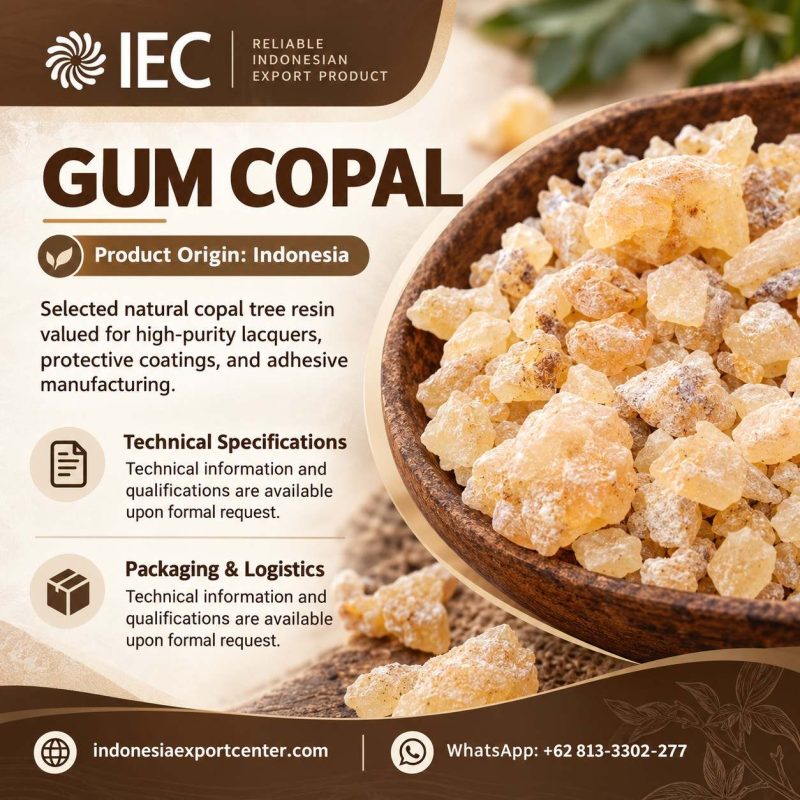
The IEC brochure identifies Gum Copal as selected natural copal tree resin originating from Indonesia. It does not identify a particular botanical species or provide a comparative performance study against damar resin.
What Is Gum Copal?
Gum Copal is a commercial term associated with certain natural tree resins.
The exact botanical origin and chemical characteristics may vary among materials sold under the copal name.
For procurement purposes, buyers should request:
- Resin identity.
- Botanical source, where available.
- Geographic origin.
- Grade.
- Physical form.
- Technical properties.
- Representative samples.
The term “copal” alone is not a complete technical specification.
What Is Damar Resin?
Damar, also spelled dammar, is a commercial name used for natural resins obtained from certain tree sources, notably species within the Dipterocarpaceae family in Southeast Asia.
However, commercial damar products may also vary in identity and quality.
Buyers should confirm the actual damar material being offered rather than relying solely on the common name.
Gum Copal vs Damar Resin: Comparison
| Comparison Factor | Gum Copal | Damar Resin |
|---|---|---|
| Material Category | Natural tree resin | Natural tree resin |
| Botanical Identity | Must be verified for offered material | Must be verified for offered material |
| Commercial Grades | Supplier-specific | Supplier-specific |
| Appearance | Material-dependent | Material-dependent |
| Colour | Grade-dependent | Grade-dependent |
| Solubility | Requires testing | Requires testing |
| Thermal Behavior | Requires testing | Requires testing |
| Traditional Applications | Certain varnishes and finishes | Certain varnishes and finishes |
| Modern Industrial Suitability | Formulation-dependent | Formulation-dependent |
| Substitution | Not automatically equivalent | Not automatically equivalent |
This table describes procurement considerations rather than verified comparative test results.
1. Botanical Origin
Botanical identity is one of the first differences to investigate.
The names Gum Copal and damar do not, by themselves, establish that two commercial samples come from the same species or resin family.
Botanical source may influence chemical composition and processing characteristics.
Where identity is important, request supporting supplier information.
2. Chemical Composition
Natural resins contain mixtures of organic constituents.
Their chemical profiles may differ depending on botanical source, age, processing, and storage.
A formulation that performs well with one resin may not behave identically with another.
Laboratory characterization may be necessary.
3. Colour and Appearance
Both materials can exhibit variation in physical appearance.
Buyers may compare:
- Colour.
- Transparency.
- Lump size.
- Surface condition.
- Visible foreign matter.
- Uniformity.
Visual similarity does not establish chemical equivalence.
4. Solubility
Solubility is a critical parameter for varnish and lacquer development.
The buyer should determine:
- Which formulation medium is used.
- Whether the resin dissolves.
- Whether residue remains.
- Whether the solution remains stable.
- Whether additional processing is required.
No universal solvent compatibility is guaranteed for either material.
5. Thermal Behavior
Different resins may exhibit different softening and thermal characteristics.
Relevant tests may include:
- Appropriate softening point methods.
- Thermal analysis.
- Processing trials.
- Stability assessment.
No numerical thermal comparison is claimed without test data.
6. Varnish Manufacturing
A varnish formulator may compare Gum Copal and damar according to:
- Processing behavior.
- Colour.
- Clarity.
- Film formation.
- Adhesion.
- Hardness.
- Flexibility.
- Drying characteristics.
- Aging behavior.
The finished varnish formulation must be tested.
7. Protective Coatings
Protective coating manufacturers may prioritize:
- Substrate adhesion.
- Resistance to relevant exposure.
- Mechanical properties.
- Formulation stability.
- Application performance.
Neither resin should be declared universally superior without application-specific evidence.
8. Specialty and Traditional Finishes
Both natural resin categories have associations with traditional or specialty finishing applications.
However, historical use does not establish suitability for a modern industrial process.
Manufacturers should qualify the actual resin under their current formulation and performance requirements.
9. Cost and Procurement Considerations
A purchasing decision should compare more than price per kilogram.
Relevant factors include:
- Material identity.
- Supplier reliability.
- Grade consistency.
- Processing requirements.
- Quality documentation.
- Available quantity.
- Packaging.
- Freight.
- Manufacturing yield.
- Finished-product performance.
A lower purchase price does not automatically result in a lower total production cost.
10. How to Evaluate Substitution
If a manufacturer is considering replacing damar with Gum Copal, or vice versa, the following workflow may be useful:
Material Identification → Sample Qualification → Laboratory Characterization → Formulation Trial → Performance Testing → Cost Evaluation → Supplier Approval
The formulation should not be changed without appropriate technical evaluation.
Recommended Resin Comparison Test Matrix
| Test Area | Evaluation |
|---|---|
| Identity | Confirm both materials |
| Appearance | Compare |
| Moisture | Test if relevant |
| Foreign Matter | Test |
| Acid Value | Evaluate if relevant |
| Solubility | Compare under identical conditions |
| Thermal Behavior | Characterize |
| Formulation Stability | Test |
| Film Properties | Test |
| Application Performance | Test |
| Batch Consistency | Review |
Gum Copal vs Damar RFQ Template
Subject: Indonesian Gum Copal for Natural Resin Comparison
Company: [Name]
Country: [Country]
Current Resin: [Damar Grade / Other]
Proposed Resin: Gum Copal
Industrial Application: [Details]
Required Properties: [Details]
Testing Requirements: [Details]
Sample Quantity: [KG]
Commercial Quantity: [KG / MT]
Destination: [Port, Country]
Please provide available Gum Copal grade information, technical documentation, and sample options for comparative evaluation.
Frequently Asked Questions
Are Gum Copal and damar the same resin?
No. They should be identified and evaluated separately.
Can Gum Copal replace damar in varnish?
Possibly in a particular formulation, but substitution requires testing.
Is Gum Copal always harder than damar?
No universal comparison is established here.
Is damar always more soluble?
No. Actual solubility depends on the material and test conditions.
Which resin is better for protective coatings?
The answer depends on the formulation and performance requirements.
Can IEC supply both materials?
IEC’s supplied brochure identifies Gum Copal. Availability of damar or any other resin must be separately confirmed.
Request Indonesian Gum Copal for Comparative Testing
Comparing Gum Copal with damar resin for varnish, coatings, or specialty finishes?
Contact IEC with your current formulation requirements, preferred grade, testing needs, and commercial quantity.
REQUEST GUM COPAL COMPARISON INFORMATION
IEC | INDONESIA EXPORT CENTER
Website: https://indonesiaexportcenter.com/
WhatsApp: +62 813-3302-277
Related Resources
Gum Copal Solubility and Compatibility
