

IEC | INDONESIA EXPORT CENTER
Your Global Sourcing Partner
How to Research the Correct HS Code for Gum Copal
Customs classification is an essential step when importing natural resin products such as Gum Copal from Indonesia.
International buyers need an appropriate Harmonized System (HS) classification to prepare customs declarations, assess import duties, identify potential regulatory requirements, and maintain accurate trade documentation.
However, a commercial product name does not always provide enough information to determine the correct tariff classification.
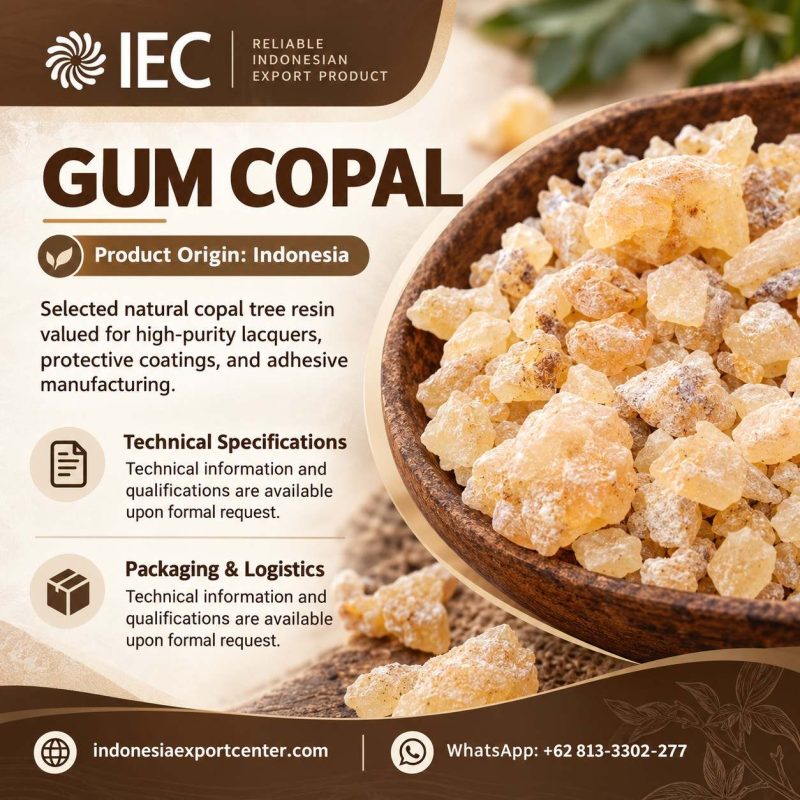
Gum Copal is described in the Indonesia Export Center (IEC) brochure as selected natural copal tree resin originating from Indonesia.
The brochure does not provide a verified HS code, detailed botanical identification, or complete processing description.
IEC does not assign a definitive Gum Copal HS code. The correct classification must be verified using the actual material and applicable customs tariff.
What Is an HS Code?
The Harmonized Commodity Description and Coding System is an international system used to classify traded goods.
It is administered internationally through the World Customs Organization framework.
HS classifications provide a common structure for identifying products in customs procedures.
The internationally harmonized portion generally uses six digits. Countries may apply additional digits for national tariff and statistical purposes.
Consequently, an importer’s complete national tariff code may differ from the code used in another country, even when the international six-digit classification is aligned.
Why Gum Copal Classification Requires Care
The term Gum Copal can be used commercially for natural resin materials.
A classification decision may depend on:
- Botanical identity.
- Material composition.
- Whether the material is a natural resin.
- Processing history.
- Physical form.
- Chemical modification, if any.
- Mixture composition.
- Applicable legal tariff descriptions.
A raw natural resin, chemically modified resin, and formulated coating product should not automatically be treated as the same customs product.
Step 1 – Obtain the Full Product Description
Ask the proposed supplier for:
- Commercial product name.
- Botanical identity, where available.
- Natural or processed status.
- Physical appearance.
- Product composition.
- Manufacturing or preparation process.
- Intended industrial use.
- Available technical documentation.
A precise description supports classification research.
Step 2 – Determine the Material’s Actual Form
Confirm whether the offered product is:
- Natural resin in lumps.
- Crushed or powdered natural resin.
- Cleaned or sorted resin.
- Chemically processed resin.
- A resin blend.
- A finished industrial formulation.
Processing can affect classification, so the actual condition of the goods matters.
Step 3 – Review the Applicable Tariff Schedule
The importer should consult the official tariff schedule for the destination country.
The review should consider:
- Relevant headings.
- Subheadings.
- Section notes.
- Chapter notes.
- General Rules for Interpretation.
- Applicable explanatory materials.
- National classification guidance.
The final determination should follow the relevant legal framework.
Step 4 – Verify the Export-Side Classification
The Indonesian exporter should also verify the classification used in export documentation.
The importer’s classification and the exporter’s classification should be reviewed for consistency, while recognizing that national tariff extensions can differ.
Step 5 – Request Professional Confirmation
Where classification is uncertain, consult:
- Licensed or qualified customs brokers.
- Trade compliance specialists.
- The relevant customs authority.
Where available, a binding classification ruling may provide greater certainty for the specific product and jurisdiction.
Step 6 – Check Tariff and Tax Consequences
After classification, verify:
- Applicable customs duty.
- Import taxes.
- Preferential tariff eligibility.
- Documentary requirements.
- Import restrictions.
- Other product-specific obligations.
An HS code alone does not establish eligibility for reduced tariffs.
Step 7 – Maintain Classification Records
A useful classification file may include:
| Document | Purpose |
|---|---|
| Product Description | Identifies the material |
| Technical Data Sheet | Supports product characteristics |
| Supplier Declaration | Describes composition and processing |
| Photographs | Supports physical description |
| Laboratory Report | Provides analytical evidence |
| Customs Tariff Research | Records classification rationale |
| Customs Ruling | Formal determination, where obtained |
| Review Date | Supports periodic updates |
Classification Research vs Product Quality Testing
These are separate activities.
A quality laboratory may establish chemical or physical characteristics, but that does not automatically make the laboratory responsible for determining the customs classification.
Similarly, a customs code does not guarantee product purity or manufacturing suitability.
Both tasks require appropriate expertise.
Common HS Code Mistakes
Copying a Competitor’s Code
Another company’s product may differ in composition or processing.
Relying Only on Online Marketplaces
Marketplace descriptions are not authoritative classification rulings.
Assuming All Natural Resins Have One Code
Different materials may require different classifications.
Ignoring Processing History
Processing may be relevant to tariff classification.
Using an Export Code Without Destination Verification
National tariff schedules can contain additional subdivisions.
Assuming Classification Never Changes
Tariff schedules and official interpretations may be updated.
Gum Copal HS Code Research Checklist
- Product identity confirmed.
- Botanical source investigated where relevant.
- Composition described.
- Processing history documented.
- Physical form recorded.
- Technical information collected.
- Destination tariff schedule consulted.
- Classification rules reviewed.
- Customs professional consulted if necessary.
- Applicable duties checked.
- Import requirements checked.
- Classification decision documented.
Gum Copal Classification Information Request
Subject: Indonesian Gum Copal Product Identification for Customs Classification
Company: [Name]
Destination Country: [Country]
Product: Natural Gum Copal
Supplier: [Name, if known]
Required Grade: [Details]
Physical Form: [Details]
Processing Status: [Details]
Quantity: [KG / MT]
Intended Use: [Details]
Please provide the product description, botanical information where available, composition details, processing information, technical documents, and any supplier classification references.
The importer will independently verify the applicable customs classification.
Frequently Asked Questions
What is the HS code for Gum Copal?
The appropriate code must be verified against the actual product and applicable customs tariff. IEC does not provide a confirmed code in its brochure.
Can the supplier suggest an HS code?
Yes, but the buyer should verify it.
Is the same code used worldwide?
The international six-digit structure is harmonized, while national extensions and interpretations may vary.
Does an HS code establish the import duty?
It helps determine tariff treatment, but origin, trade agreements, and other rules may also matter.
Can Gum Copal be classified solely from a photograph?
Not reliably.
Does IEC provide binding customs rulings?
No.
Request Indonesian Gum Copal Product Information
Need technical and product identification details for Gum Copal customs research?
Contact IEC with your destination country, required material, and documentation needs.
REQUEST GUM COPAL CLASSIFICATION INFORMATION
IEC | INDONESIA EXPORT CENTER
Website: https://indonesiaexportcenter.com/
WhatsApp: +62 813-3302-277
Related Resources
Gum Copal Import Documentation Checklist
Gum Copal Technical Specifications Guide
