

IEC | INDONESIA EXPORT CENTER
Your Global Sourcing Partner
How to Plan Storage and Handling for Natural Gum Copal
Effective storage and handling practices are important for companies purchasing Gum Copal for industrial manufacturing or wholesale distribution.
Natural resin materials should be managed in ways that protect their identity, prevent avoidable contamination, preserve traceability, and support safe warehouse operations.
For importers and manufacturing facilities, storage planning begins before the cargo arrives.
Indonesia Export Center (IEC) facilitates B2B sourcing inquiries involving potential Indonesian Gum Copal suppliers.
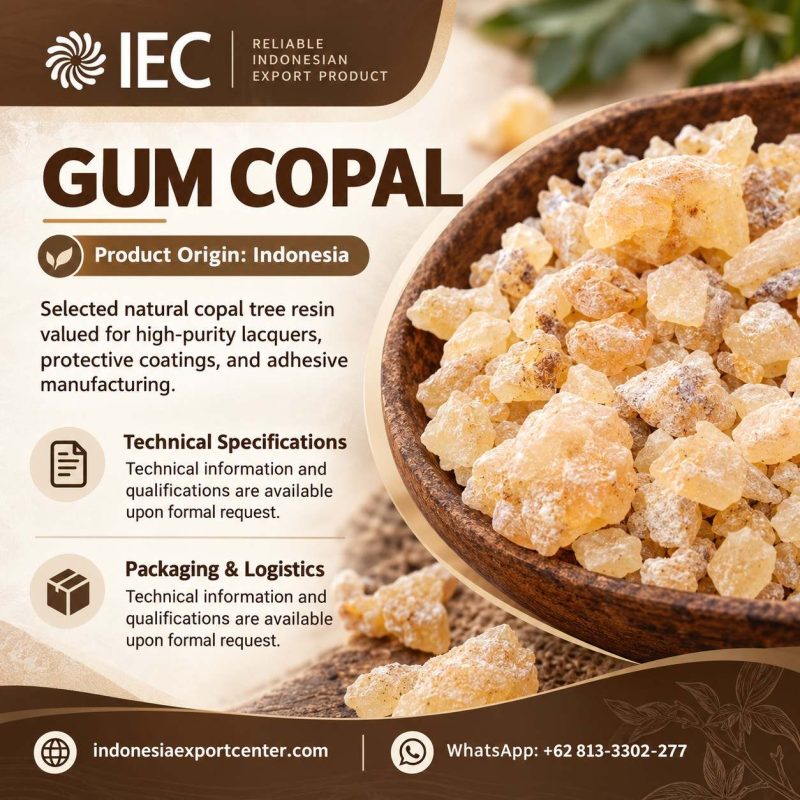
The IEC brochure describes the product as selected natural copal tree resin originating from Indonesia.
The brochure does not provide verified storage temperatures, humidity limits, shelf life, or specific handling conditions. These requirements should be confirmed using supplier documentation and appropriate technical assessment.
Why Gum Copal Storage Conditions Matter
Storage conditions may influence:
- Product cleanliness.
- Physical condition.
- Exposure to moisture.
- Packaging integrity.
- Batch identification.
- Processing suitability.
- Workplace safety.
- Inventory control.
The significance of each factor depends on the material and its intended use.
Step 1 – Confirm Product Identity and Grade
Before accepting a shipment, warehouse personnel should verify:
- Product name.
- Supplier.
- Commercial grade.
- Lot number.
- Package count.
- Net weight.
- Available technical documentation.
Different resin grades should not be mixed without technical approval.
Step 2 – Review Supplier Handling Information
Request available information about:
- Recommended storage conditions.
- Packaging.
- Moisture sensitivity.
- Temperature sensitivity.
- Dust generation.
- Fire and safety considerations.
- Shelf-life information, if established.
- Relevant SDS information, where applicable.
Do not invent numerical storage limits when the supplier has not supplied them.
Step 3 – Prepare the Storage Area
The warehouse should be suitable for the actual product and packaging.
General considerations include:
- Cleanliness.
- Protection from water ingress.
- Appropriate ventilation.
- Suitable flooring.
- Access for handling equipment.
- Segregation from incompatible materials.
- Fire prevention measures.
- Pest management where relevant.
Step 4 – Control Moisture Exposure
Moisture protection may be relevant to maintaining product condition.
Warehouse personnel should check:
- Roof and wall integrity.
- Floor condition.
- Package closures.
- Signs of condensation.
- Water damage.
- Packaging deterioration.
Any humidity limits should be based on verified material requirements.
Step 5 – Prevent Contamination
Potential contamination sources include:
- Dust.
- Soil.
- Packaging fragments.
- Unrelated chemicals.
- Cleaning residues.
- Foreign particles.
Handling procedures should minimize contact with unwanted material.
Step 6 – Maintain Lot Segregation
Lot segregation supports traceability.
A warehouse record may include:
| Field | Information |
|---|---|
| Product | Gum Copal |
| Grade | Supplier-defined |
| Supplier | Identified |
| Lot Number | Recorded |
| Receipt Date | Recorded |
| Package Count | Recorded |
| Net Weight | Verified |
| Storage Location | Assigned |
| Inspection Status | Recorded |
| Release Status | Approved or held |
Step 7 – Establish Inventory Rotation
Inventory rotation should reflect the supplier’s recommendations and the buyer’s quality system.
FIFO, meaning first in, first out, may be considered where appropriate.
FEFO, meaning first expired, first out, is relevant only where an established expiry or retest system applies.
Do not assign an arbitrary shelf life.
Step 8 – Use Appropriate Handling Equipment
The correct handling method depends on:
- Package weight.
- Package dimensions.
- Pallet configuration.
- Warehouse equipment.
- Worker safety requirements.
Personnel should follow applicable manual-handling and equipment procedures.
Step 9 – Manage Dust and Housekeeping
If the actual material or handling process generates dust, the facility should assess relevant occupational and fire risks.
Appropriate controls may involve:
- Housekeeping.
- Exposure assessment.
- Suitable ventilation.
- Equipment selection.
- Safe cleaning methods.
- Applicable workplace procedures.
Do not assume a particular dust hazard classification without evaluating the material and process.
Step 10 – Review Fire Safety
Storage and processing should follow applicable fire safety requirements.
Relevant considerations may include:
- Ignition source control.
- Housekeeping.
- Emergency access.
- Appropriate extinguishing arrangements.
- Safety information.
- Personnel training.
The facility should base controls on the actual material hazards and operations.
Step 11 – Inspect Packages Regularly
A warehouse inspection may check:
- Damaged packaging.
- Open packages.
- Water exposure.
- Unusual contamination.
- Missing labels.
- Mixed lots.
- Inventory discrepancies.
Nonconforming material should be identified and managed under the facility’s quality procedures.
Step 12 – Prepare Material for Manufacturing
Before releasing material to production:
- Confirm the correct grade.
- Verify the lot.
- Check packaging condition.
- Review quality approval status.
- Follow the approved material preparation procedure.
- Record material consumption.
Gum Copal Storage and Handling Checklist
| Area | Verification |
|---|---|
| Product Identification | Confirmed |
| Grade | Recorded |
| Lot Traceability | Established |
| Storage Conditions | Reviewed |
| Moisture Protection | Evaluated |
| Packaging Integrity | Checked |
| Contamination Prevention | Implemented |
| Safety Documentation | Reviewed as applicable |
| Fire Safety | Assessed |
| Handling Equipment | Suitable |
| Inventory Rotation | Defined |
| Quality Release | Documented |
Handling Gum Copal During International Transport
Storage planning should also consider the journey from Indonesia to the receiving facility.
Potential concerns include:
- Package damage.
- Water exposure.
- Cargo movement.
- Contamination.
- Temperature variation.
- Delayed unloading.
- Inadequate receiving arrangements.
The appropriate controls should be determined with logistics providers and technical personnel.
Common Storage Mistakes
Storing Different Grades Together
This can create traceability problems.
Using Unverified Temperature Limits
A general recommendation may not suit the actual resin.
Ignoring Damaged Packaging
Package damage may increase contamination risk.
Failing to Maintain Lot Records
This complicates quality investigations.
Assuming a Universal Shelf Life
Shelf-life information should be supported by relevant evidence.
Gum Copal Storage Information Request
Subject: Indonesian Gum Copal Storage and Handling Information
Company: [Name]
Country: [Country]
Product: Natural Gum Copal
Required Grade: [Details]
Quantity: [KG / MT]
Packaging: [Details]
Warehouse Conditions: [Details]
Industrial Application: [Details]
Please provide available supplier information concerning storage, handling, packaging, material safety, and quality preservation.
Frequently Asked Questions
What temperature should Gum Copal be stored at?
No verified numerical temperature range is provided in IEC’s brochure.
Does Gum Copal require moisture protection?
Moisture-related requirements should be evaluated for the actual product and packaging.
Can different grades be mixed in storage?
They should remain segregated unless mixing is technically approved.
Does Gum Copal have a fixed shelf life?
No verified shelf life is provided.
Is an SDS required for warehouse operations?
The applicability and availability of an SDS should be checked under the relevant safety framework.
Can IEC guarantee storage performance?
No.
Request Gum Copal Storage and Handling Information
Preparing to receive Indonesian Gum Copal for industrial processing or distribution?
Contact IEC with your grade, quantity, packaging, and warehouse requirements.
REQUEST GUM COPAL HANDLING INFORMATION
IEC | INDONESIA EXPORT CENTER
Website: https://indonesiaexportcenter.com/
WhatsApp: +62 813-3302-277
Related Resources
Gum Copal Packaging for Export
Gum Copal TDS and SDS Request Guide
