

IEC | INDONESIA EXPORT CENTER
Your Global Sourcing Partner
Prepare the Documents Required to Import Gum Copal from Indonesia
International procurement of Gum Copal involves commercial, logistics, customs, and potentially product-specific documentation.
For importers, a complete and accurate document package can help support customs processing, cargo identification, payment procedures, and shipment traceability.
However, document requirements are not identical in every country.
They depend on factors such as:
- Product identity.
- Customs classification.
- Origin.
- Destination country.
- Intended use.
- Transport mode.
- Contractual terms.
- Applicable import regulations.
Indonesia Export Center (IEC) facilitates inquiries involving potential Indonesian Gum Copal suppliers.
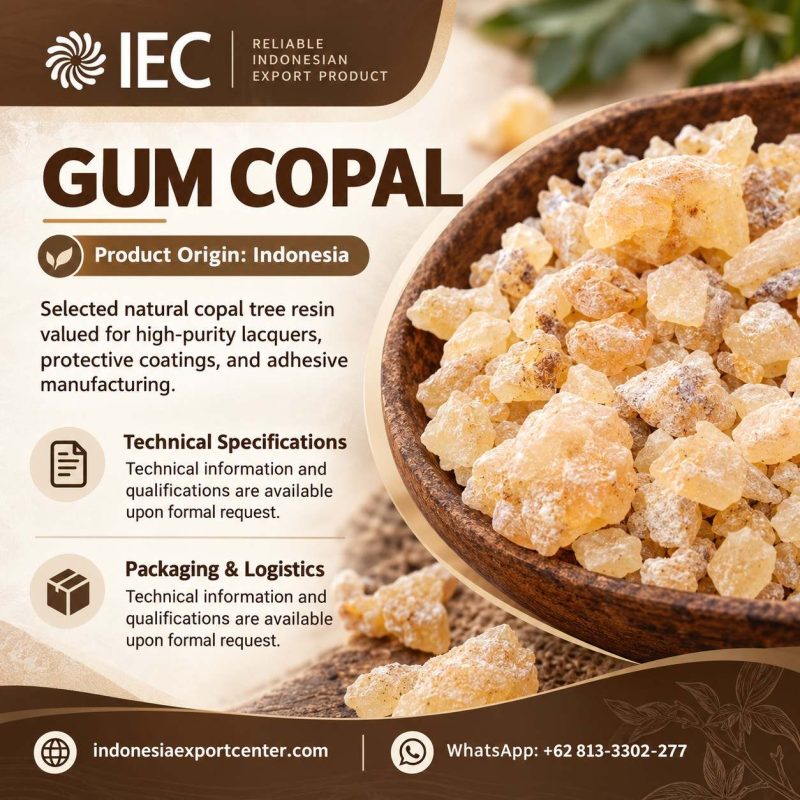
The IEC brochure identifies the product as selected natural copal tree resin originating from Indonesia.
Importers must verify current requirements with their destination customs authority and qualified compliance professionals.
Why Import Documentation Matters
Documentation helps establish:
- Who sold the goods.
- Who purchased the goods.
- What material is being shipped.
- How much material is included.
- Where the goods originate.
- How the cargo is transported.
- What commercial terms apply.
- Whether required regulatory procedures have been completed.
Incomplete or inconsistent documents may cause delays, additional costs, or requests for clarification.
1. Commercial Invoice
A commercial invoice generally records the transaction.
Relevant information may include:
- Seller.
- Buyer.
- Product description.
- Quantity.
- Unit price.
- Total value.
- Currency.
- Incoterm.
- Country of origin.
- Invoice number.
- Invoice date.
The product description should be sufficiently precise for commercial and customs purposes.
2. Packing List
A packing list describes how the shipment is packed.
It may identify:
- Number of packages.
- Packaging type.
- Net weight.
- Gross weight.
- Package marks.
- Dimensions, where relevant.
- Lot numbers.
The packing list should be consistent with the physical cargo and commercial invoice.
3. Transport Document
Depending on the transport arrangement, relevant documents may include:
- Bill of lading.
- Sea waybill.
- Air waybill.
- Other appropriate carriage documents.
The document should reflect the agreed shipping arrangement.
4. Certificate of Origin
A certificate of origin may be requested or required in certain transactions.
It provides information about the origin of goods under the applicable framework.
The exact form, issuing procedure, and eligibility for any preferential treatment must be verified.
A product being sourced from Indonesia does not automatically establish eligibility for preferential tariffs.
5. Product Specification
A product specification can help define the purchased material.
For Gum Copal, it may include:
- Resin identity.
- Commercial grade.
- Appearance.
- Physical form.
- Moisture requirements.
- Foreign matter limits.
- Other agreed analytical parameters.
The IEC brochure does not publish verified numerical specifications.
6. Certificate of Analysis
A COA may be requested when laboratory evidence is relevant.
Buyers should confirm:
- Sample identity.
- Lot number.
- Test methods.
- Results.
- Laboratory.
- Date.
Availability must be verified.
7. Safety Data Sheet
An SDS may be relevant or required depending on product classification and destination regulations.
Its applicability should be evaluated for the actual material.
8. Import Permit or Registration
Certain jurisdictions may require product-specific permissions, importer registration, or other regulatory procedures.
These requirements cannot be assumed universally.
9. Customs Declaration
The importer or authorized representative normally submits the required customs declaration under the destination country’s procedures.
The declaration must use an appropriately verified customs classification.
10. Insurance Documents
Insurance documentation may be relevant depending on the Incoterm and commercial arrangements.
For example, CIF includes a specified seller cargo-insurance obligation.
Gum Copal Import Documentation Matrix
| Document | Main Function | Verification |
|---|---|---|
| Commercial Invoice | Transaction details | Normally relevant |
| Packing List | Cargo details | Normally relevant |
| Transport Document | Carriage evidence | According to transport mode |
| Certificate of Origin | Origin support | Check requirements |
| Product Specification | Quality description | Buyer-defined |
| COA | Analytical evidence | If requested or required |
| SDS | Safety information | Check applicability |
| Import Permit | Regulatory authorization | Country-specific |
| Customs Declaration | Import clearance | Applicable procedure |
| Insurance Document | Cargo insurance evidence | Contract-dependent |
| Inspection Report | Quality or quantity evidence | If agreed |
Document Consistency Checklist
Before shipment, compare:
- Seller names.
- Buyer names.
- Product descriptions.
- Quantity.
- Package counts.
- Weights.
- Currency.
- Invoice value.
- Origin.
- Shipment references.
- Incoterm.
- Destination.
Differences should be resolved before customs submission where possible.
Destination-Country Compliance Planning
Product Classification
Determine the appropriate HS classification.
Duties and Taxes
Verify applicable tariff and tax treatment.
Product Restrictions
Check whether the resin is subject to any restrictions.
Safety and Chemical Requirements
Determine whether relevant chemical regulatory requirements apply.
Origin Documentation
Confirm what evidence is required.
Importer Responsibilities
Identify who must obtain registrations, permits, or other approvals.
Common Import Documentation Mistakes
Using a Vague Product Description
“Natural resin” may not provide sufficient detail for some customs procedures.
Assuming a Universal HS Code
Classification must reflect the actual product.
Missing Lot Identification
This may complicate quality traceability.
Inconsistent Weight Information
Differences between documents may trigger questions.
Assuming the Exporter Handles Import Permits
Import responsibilities depend on applicable law and contract terms.
Relying on Outdated Regulations
Requirements can change.
Gum Copal Import Documentation Request Template
Subject: Indonesian Gum Copal Import Document Inquiry
Company: [Name]
Country: [Country]
Product: Natural Gum Copal
Required Grade: [Details]
Quantity: [KG / MT]
Destination Port: [Port]
Preferred Incoterm: [Term]
Required Import Documents: [List]
Required Quality Documents: [List]
Customs Classification: [To Be Verified]
Special Destination Requirements: [Details]
Please confirm which documents the proposed supplier can provide and identify any items requiring additional arrangements.
Frequently Asked Questions
What documents are needed to import Gum Copal?
Requirements vary by destination and transaction.
Is a certificate of origin always required?
Not universally.
Does every shipment need a COA?
That depends on contractual and regulatory requirements.
Is an SDS mandatory?
Applicability must be checked.
Can IEC guarantee customs clearance?
No.
Can import requirements change?
Yes. Buyers should verify current rules.
Request Gum Copal Import Documentation Information
Preparing to import Gum Copal from Indonesia?
Contact IEC with your destination country, quantity, required documents, and product specifications.
REQUEST GUM COPAL IMPORT DOCUMENT INFORMATION
IEC | INDONESIA EXPORT CENTER
Website: https://indonesiaexportcenter.com/
WhatsApp: +62 813-3302-277
Related Resources
Gum Copal Customs HS Code Research Guide
Gum Copal Shipping and Logistics
