

IEC | INDONESIA EXPORT CENTER
Your Global Sourcing Partner
Choosing a Suitable Shipping Arrangement for Indonesian PFAD
International buyers of Palm Fatty Acid Distillate may evaluate tank containers and flexibags when planning certain containerized shipments.
Both options can be relevant to liquid bulk logistics, but they differ in equipment design, handling procedures, cost structure, and operational limitations.
Because PFAD may be solid or highly viscous at some temperatures, its suitability for either option must be established before shipment.
A packaging method that works for one cargo composition or route may not be appropriate for another.
Indonesia Export Center (IEC) facilitates inquiries involving potential Indonesian PFAD suppliers and does not guarantee carrier acceptance, packaging suitability, or equipment availability.
What Is a Tank Container?
A tank container is an intermodal transport unit designed to carry compatible bulk liquids or other approved cargoes.
A suitable tank container may include equipment or arrangements for handling temperature-sensitive products, depending on its design.
Tank containers must be approved for the cargo and intended transport route.
What Is a Flexibag?
A flexibag is a flexible liquid cargo containment system installed within a suitable shipping container.
Flexibags are used for certain compatible non-hazardous bulk liquid cargoes.
However, their use depends on:
- Cargo compatibility.
- Manufacturer approval.
- Container condition.
- Carrier acceptance.
- Filling limitations.
- Temperature requirements.
- Destination discharge capability.
Not every PFAD grade is suitable for flexibag transportation.
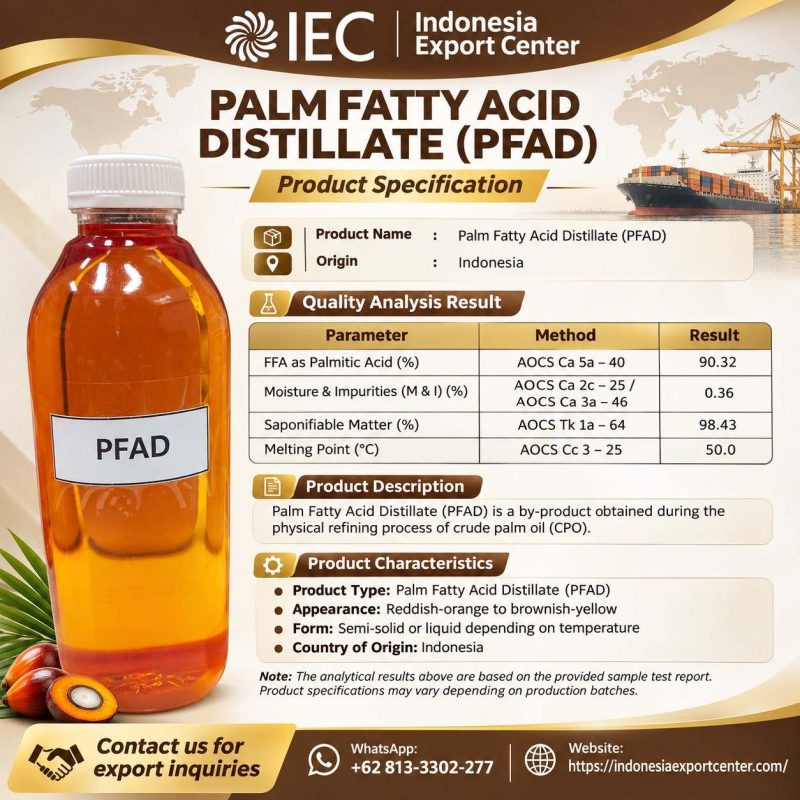
IEC PFAD Reference Specifications
| Parameter | Reference |
|---|---|
| FFA, as Palmitic | Minimum 90% |
| Moisture & Impurities | Maximum 1.0% |
| Iodine Value | Maximum 50 |
| Melting Point | 36–46°C |
| Gardner Colour | Maximum 7 |
| Appearance | White / Off White Solid |
The brochure lists both bulk tank and flexibag packaging concepts.
This does not establish universal technical approval.
Tank Container vs Flexibag Comparison
| Consideration | Tank Container | Flexibag |
|---|---|---|
| Equipment | Dedicated tank unit | Flexible liner within container |
| Cargo Compatibility | Must be confirmed | Must be confirmed |
| Heating Capability | Depends on tank design | Depends on approved system |
| Reuse | Often reusable after appropriate cleaning | Generally single-use cargo containment |
| Cleaning | Tank cleaning required | Disposal and container restoration considerations |
| Carrier Acceptance | Required | Required |
| Discharge | Requires suitable transfer equipment | Requires suitable approved discharge system |
| Cost Structure | Equipment, freight, cleaning, positioning | Flexibag, installation, freight, disposal |
| PFAD Suitability | Cargo-specific | Cargo-specific |
Technical Feasibility Assessment
Before choosing either option, buyers should request information about:
- Actual PFAD composition.
- Melting characteristics.
- Viscosity.
- Loading condition.
- Expected transit temperatures.
- Discharge requirements.
- Container or tank compatibility.
- Carrier restrictions.
- Cleaning and contamination control.
- Emergency handling procedures.
Heating and Solidification Risks
PFAD may become difficult to pump when its temperature decreases.
This can affect:
- Loading.
- Transit.
- Destination discharge.
- Residual cargo recovery.
- Equipment turnaround.
A heating plan, if required, must be developed by qualified operators using approved equipment.
Tank Container Advantages and Limitations
Potential advantages include:
- Dedicated liquid cargo equipment.
- Established handling procedures for suitable cargoes.
- Potential compatibility with certain heating arrangements.
- Reusable equipment systems.
Potential limitations include:
- Equipment availability.
- Cleaning costs.
- Positioning charges.
- Rental or demurrage exposure.
- Cargo compatibility restrictions.
Flexibag Advantages and Limitations
Potential advantages include:
- Use of approved container-based systems.
- Potential logistical flexibility on suitable routes.
- Different equipment cost structure.
Potential limitations include:
- Cargo compatibility.
- Carrier approval.
- Temperature sensitivity.
- Installation requirements.
- Discharge equipment.
- Container restrictions.
- Disposal costs.
- Risk of leakage if improperly selected or handled.
No universal cost advantage can be claimed.
Cost Comparison
Buyers should compare the total shipment cost rather than only the quoted packaging price.
Potential cost components include:
| Cost Component | Tank Container | Flexibag |
|---|---|---|
| Equipment | Tank rental or service | Flexibag and installation |
| Freight | Route-dependent | Route-dependent |
| Loading | Facility-dependent | Facility-dependent |
| Heating | If required | If approved and required |
| Discharge | Facility-dependent | Facility-dependent |
| Cleaning / Disposal | Tank cleaning | Flexibag disposal |
| Detention | Possible | Possible |
| Insurance | Contract-dependent | Contract-dependent |
Risk Allocation
The sales contract should identify which party is responsible for:
- Packaging approval.
- Equipment selection.
- Loading.
- Transport.
- Insurance.
- Discharge.
- Damage claims.
- Cargo loss.
- Cleaning or disposal.
The chosen Incoterm does not automatically resolve every operational responsibility.
Questions for Suppliers and Freight Providers
- Is the proposed PFAD grade approved for this equipment?
- Is viscosity data available?
- What are the loading conditions?
- Is heating required?
- Does the carrier accept the cargo?
- Is the destination equipped for discharge?
- Are there equipment restrictions?
- What costs are excluded?
- What insurance is required?
- Who is responsible for cleaning or disposal?
PFAD Packaging RFQ Template
Subject: PFAD Tank Container vs Flexibag Shipping Inquiry
Company: [Name]
Country: [Country]
Product: Palm Fatty Acid Distillate
Quantity: [MT]
Required Specifications: [Details]
Melting / Viscosity Data: [If Available]
Preferred Packaging: [Tank Container / Flexibag / Both for Evaluation]
Loading Port: [Port]
Destination Port: [Port]
Shipment Period: [Dates]
Incoterm: [Term]
Discharge Facilities: [Details]
Please provide supplier information and confirm whether the proposed cargo and route are technically suitable for the requested packaging.
Frequently Asked Questions
Can PFAD be shipped in tank containers?
Potentially, where equipment and cargo compatibility are confirmed.
Can PFAD be shipped in flexibags?
Only when the cargo, system, carrier, and discharge arrangement are approved.
Which option is cheaper?
Costs depend on the route, equipment, quantity, and handling requirements.
Can every flexibag be heated?
No. Heating must be specifically approved for the system.
Is a tank container always safer?
No universal safety comparison can be made without evaluating the cargo and operating conditions.
Does IEC guarantee equipment availability?
No. Availability must be confirmed.
Request PFAD Shipping and Supplier Information
Comparing tank container and flexibag options for Indonesian PFAD imports?
Send your cargo specifications, quantity, route, and receiving requirements to IEC.
REQUEST PFAD LOGISTICS QUOTATION INFORMATION
IEC | INDONESIA EXPORT CENTER
Website: https://indonesiaexportcenter.com/
WhatsApp: +62 813-3302-277
Related Resources
