

IEC | INDONESIA EXPORT CENTER
Your Global Sourcing Partner
Can Palm Fatty Acid Distillate Be Shipped in Flexibags?
Flexibags are used for certain approved non-hazardous bulk liquid cargoes transported in freight containers.
However, not every PFAD cargo is suitable for flexibag transportation.
Palm Fatty Acid Distillate can have physical characteristics that complicate container loading and unloading, especially where the material becomes solid or highly viscous at lower temperatures.
For importers evaluating PFAD flexibag packaging, technical approval should be obtained before making a purchase commitment.
Indonesia Export Center (IEC) facilitates sourcing inquiries involving potential Indonesian PFAD suppliers.
IEC does not guarantee flexibag suitability, carrier acceptance, or the availability of specialized heating and unloading equipment.
What Is a Flexibag?
A flexibag is a flexible bulk liquid containment system installed inside a suitable freight container.
It is intended for cargoes approved by the flexibag manufacturer and relevant transport providers.
Flexibag systems differ in design, material, capacity, temperature limitations, and permitted cargo types.
Why PFAD Flexibag Suitability Is Conditional
PFAD may become solid or difficult to pump depending on temperature and composition.
This creates questions about:
- Filling conditions.
- Product temperature.
- Flexibag material compatibility.
- Heating limitations.
- Container payload.
- Transit temperature.
- Unloading procedures.
- Cargo residue.
- Equipment safety.
The fact that a product brochure lists flexibags as a packaging option does not establish approval for every shipment.
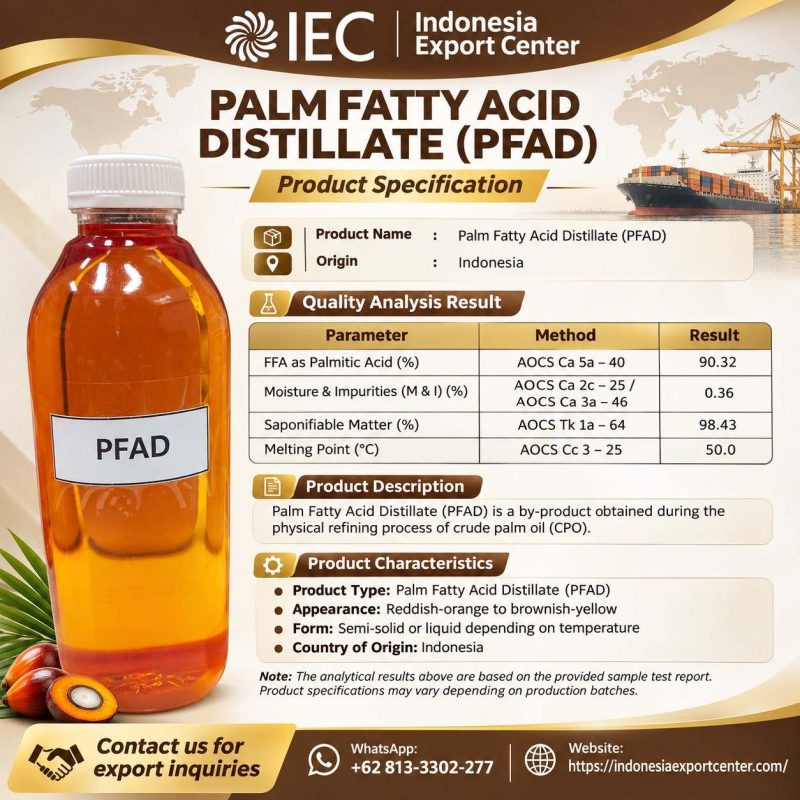
IEC PFAD Reference Specifications
| Parameter | Reference Target |
|---|---|
| FFA, as Palmitic | Minimum 90% |
| Moisture & Impurities | Maximum 1.0% |
| Iodine Value | Maximum 50 |
| Melting Point | 36–46°C |
| Gardner Colour | Maximum 7 |
| Appearance | White / Off White Solid |
These values are reference targets, not a complete transport suitability assessment.
1. Product Compatibility Assessment
The flexibag manufacturer should evaluate whether the proposed PFAD cargo is compatible with the system.
This assessment may consider:
- Chemical composition.
- Physical state.
- Temperature behavior.
- Viscosity.
- Loading conditions.
- Contact material compatibility.
- Intended transport duration.
2. Carrier Approval
The shipping line or carrier must permit the proposed cargo and equipment arrangement.
Carrier requirements may vary by route, container type, and operational policy.
Approval should be obtained for the actual shipment rather than assumed from previous transactions.
3. Container Suitability
The selected container must meet the relevant structural, operational, and payload requirements.
The logistics provider should confirm:
- Container condition.
- Approved installation procedure.
- Weight distribution.
- Payload limits.
- Door protection.
- Securing requirements.
- Other applicable operational controls.
4. Heating and Temperature Requirements
PFAD may require special handling because of its melting characteristics.
However, flexibag systems have specific thermal limitations.
Any heating method must be approved by the flexibag manufacturer, carrier, and qualified operator.
Improvised heating arrangements should not be used.
5. Loading Procedure
An approved loading plan should establish:
- Cargo identity.
- Flexibag compatibility.
- Container inspection.
- Installation approval.
- Filling temperature.
- Filling rate.
- Maximum permitted load.
- Seal and closure procedures.
- Documentation.
- Emergency response requirements.
6. Transit Planning
During transport, the parties should consider:
- Route.
- Expected ambient conditions.
- Transit duration.
- Container handling.
- Carrier restrictions.
- Product behavior.
- Arrival unloading readiness.
7. Destination Unloading
The receiving party should confirm whether it has equipment suitable for unloading the actual cargo.
Potential considerations include:
- Pump compatibility.
- Approved heating arrangements.
- Hose and connection suitability.
- Receiving tank readiness.
- Discharge time.
- Residual product handling.
8. Flexibag vs Bulk Tank Shipping
| Factor | Flexibag | Bulk Tank |
|---|---|---|
| Transport Format | Containerized cargo | Bulk tank or vessel arrangement |
| Suitability | Cargo-specific approval required | Cargo-specific approval required |
| Heating | Subject to strict equipment approval | Depends on tank system |
| Discharge | Container unloading procedure | Terminal or tank discharge procedure |
| Capacity | Container payload constraints | Depends on bulk system |
| Main Concern | Compatibility and unloading feasibility | Tank and terminal capability |
Neither method should be selected solely on apparent freight cost.
9. Flexibag Approval Checklist
| Verification Question | Required Status |
|---|---|
| Is the PFAD grade identified? | Confirm |
| Is a current COA available? | Confirm |
| Has the flexibag manufacturer approved the cargo? | Confirm |
| Has the carrier approved the arrangement? | Confirm |
| Is the container suitable? | Confirm |
| Are thermal requirements approved? | Confirm |
| Is the payload compliant? | Confirm |
| Can the cargo be loaded safely? | Confirm |
| Can the destination unload it? | Confirm |
| Are insurance conditions understood? | Confirm |
| Is the contingency procedure documented? | Confirm |
10. Common Flexibag Shipping Risks
Product Solidification
Cargo may become difficult to discharge if temperature conditions are unsuitable.
Equipment Incompatibility
The cargo may not be compatible with a particular flexibag material or system.
Heating Limitations
The required heating arrangement may exceed the equipment’s approved limits.
Cargo Leakage
Equipment or handling failures can result in leakage and associated losses.
Discharge Delays
Insufficient receiving equipment may increase unloading time and cost.
Carrier Rejection
A carrier may decline a cargo or packaging arrangement that does not meet its policies.
11. Alternative Shipping Options
Where flexibag transport is unsuitable, buyers may evaluate other approved options, such as appropriate bulk tank systems or specialized tank equipment.
The alternative must be technically and commercially feasible for the actual route.
12. Supplier and Logistics Questions
Before confirming a flexibag shipment, ask:
- Has this exact PFAD grade been approved for the proposed flexibag?
- Who is the flexibag manufacturer?
- Which carrier will transport the cargo?
- Is written carrier acceptance available?
- What are the permitted filling conditions?
- Are heating arrangements necessary?
- What heating equipment is approved?
- What is the maximum permitted payload?
- Can the destination safely discharge the cargo?
- Who is responsible for equipment failure and cargo loss?
PFAD Flexibag Shipping RFQ Template
Subject: PFAD Flexibag Shipping Feasibility – Indonesian Supplier Inquiry
Company: [Name]
Country: [Country]
Product: Palm Fatty Acid Distillate
Quantity: [MT]
Required Specifications: [Details]
Preferred Packaging: Flexibag, Subject to Approval
Loading Port: [Port]
Destination Port: [Port]
Expected Shipment Period: [Dates]
Receiving Facility: [Details]
Heating or Unloading Equipment: [Details]
Preferred Incoterm: [Term]
Please confirm whether the proposed PFAD cargo is technically suitable for flexibag transport and identify the required manufacturer, carrier, and logistics approvals.
Frequently Asked Questions
Can all PFAD be shipped in flexibags?
No. Suitability must be confirmed for the specific cargo and transport system.
Does the IEC brochure mention flexibags?
Yes. It lists flexibag as a packaging option, subject to actual feasibility.
Does PFAD need heating during unloading?
It may, depending on its properties and conditions. Any heating arrangement must be approved.
Can a standard flexibag handle every heating requirement?
No. Equipment-specific temperature limits must be respected.
Is carrier approval necessary?
Yes. The proposed arrangement must comply with the carrier’s requirements.
Is flexibag shipping always cheaper?
Not necessarily. Total costs depend on freight, equipment, handling, delays, and risk.
Can IEC guarantee flexibag acceptance?
No. Approval must come from the relevant technical and logistics parties.
What happens if flexibag shipping is unsuitable?
The buyer should evaluate another approved transport arrangement.
Request PFAD Flexibag Feasibility Information
Explore PFAD container shipping options while verifying cargo compatibility, carrier acceptance, heating requirements, and destination unloading capability.
REQUEST PFAD FLEXIBAG SOURCING INFORMATION
IEC | INDONESIA EXPORT CENTER
Website: https://indonesiaexportcenter.com/
WhatsApp: +62 813-3302-277
Related Resources
