

IEC | INDONESIA EXPORT CENTER
Your Global Sourcing Partner
Safe and Effective Storage Planning for Palm Fatty Acid Distillate
Palm Fatty Acid Distillate requires careful handling because its physical properties can change significantly with temperature.
For industrial storage operators, refinery logistics teams, warehouse managers, and chemical manufacturers, temperature management is an important part of PFAD receiving, storage, transfer, and dispatch planning.
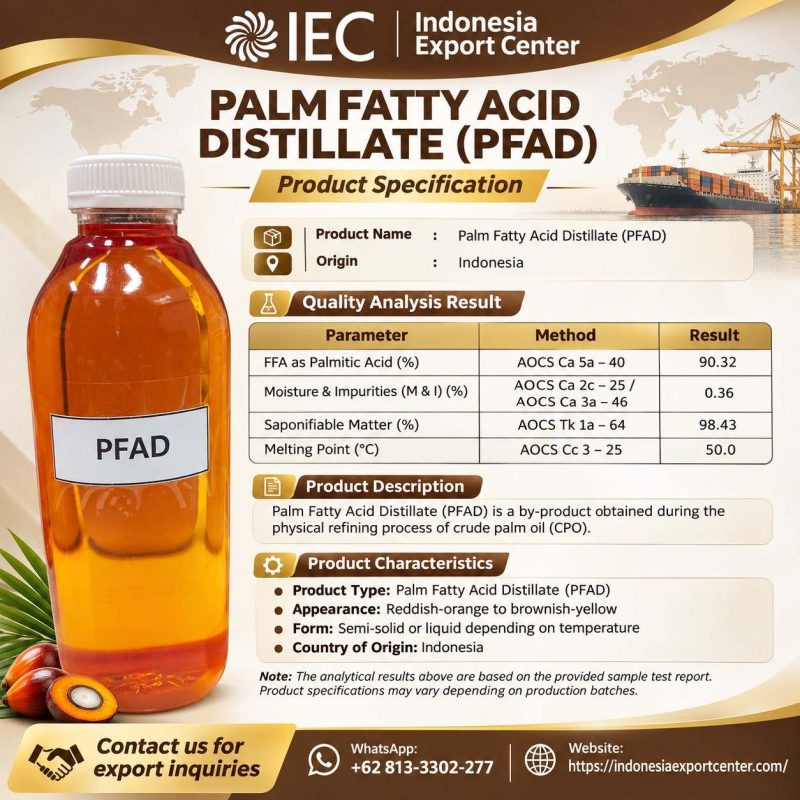
The IEC product brochure describes PFAD as a white or off-white solid with a reference melting range of 36–46°C.
However, this range does not establish a universal storage, pumping, or heating temperature.
The correct operating conditions depend on the actual cargo composition, equipment design, viscosity, storage duration, and safety requirements.
Indonesia Export Center (IEC) facilitates sourcing inquiries involving potential Indonesian PFAD suppliers. IEC does not operate storage facilities or prescribe cargo-specific heating procedures.
Why PFAD Storage Conditions Matter
Poor storage management may contribute to:
- Product solidification.
- Restricted transfer.
- Equipment fouling.
- Contamination.
- Unplanned heating.
- Increased handling costs.
- Product quality deterioration.
- Operational delays.
Storage procedures should be developed by qualified facility personnel.
IEC PFAD Reference Specifications
| Parameter | Reference |
|---|---|
| FFA, as Palmitic | Minimum 90% |
| Moisture & Impurities | Maximum 1.0% |
| Iodine Value | Maximum 50 |
| Melting Point | 36–46°C |
| Gardner Colour | Maximum 7 |
| Appearance | White / Off White Solid |
These values are references and must be verified for the actual cargo.
Understanding PFAD Melting Behavior
PFAD is a mixture rather than a pure single-component chemical.
Its melting and crystallization characteristics depend on composition.
A cargo may become increasingly viscous as temperature falls, even before it becomes fully solid.
Therefore, the facility should distinguish between:
- Melting behavior.
- Pourability.
- Pumpability.
- Transfer temperature.
- Storage temperature.
These are related but not identical concepts.
Storage Tank Selection
Tank selection should consider:
Material Compatibility
Tank construction materials and internal components must be compatible with the product.
Tank Capacity
The facility should provide sufficient operational capacity for the proposed volume.
Heating System
If heating is required, the system must be approved for the cargo and equipment.
Temperature Measurement
Monitoring equipment should be suitable for the process.
Transfer Connections
Pipelines, valves, and pumps should support safe product transfer.
Cleaning
The tank should be prepared to avoid unacceptable contamination.
Heating Risks
Heating may improve fluidity, but inappropriate heating can introduce risks.
Potential concerns include:
- Localized overheating.
- Quality changes.
- Equipment damage.
- Excessive energy consumption.
- Unsafe pressure or operating conditions.
- Personnel exposure to hot materials.
Heating must follow the facility’s approved engineering and safety procedures.
Why No Universal PFAD Heating Temperature Exists
The IEC reference melting range of 36–46°C cannot be used as a universal operational setpoint.
Actual requirements depend on:
- Viscosity.
- Product composition.
- Tank configuration.
- Heating method.
- Transfer distance.
- Pump capacity.
- Ambient conditions.
- Quality limitations.
The responsible operator should establish appropriate temperatures from validated cargo data.
Oxidation and Product Integrity
Exposure to air, excessive heating, and extended storage may influence the condition of certain fatty materials.
PFAD storage plans should consider:
- Minimizing unnecessary exposure.
- Avoiding uncontrolled heating.
- Monitoring storage duration.
- Preventing contamination.
- Maintaining appropriate records.
- Conducting quality testing where needed.
No universal shelf life can be guaranteed from the brochure alone.
Hygiene and Contamination Control
Industrial storage facilities should establish appropriate cleaning and segregation procedures.
Potential contamination sources include:
- Previous cargo residues.
- Water ingress.
- Dirty pipelines.
- Incompatible cleaning chemicals.
- Foreign materials.
- Incorrect product transfer.
The required hygiene level depends on the intended industrial use.
Receiving PFAD into Storage
Before receiving a shipment:
- Confirm product identity.
- Review available COA.
- Confirm receiving tank capacity.
- Verify equipment readiness.
- Check transfer-line configuration.
- Review cargo temperature.
- Confirm sampling arrangements.
- Establish quantity measurement.
- Prepare safety procedures.
- Document the receipt.
PFAD Transfer and Pumping
Transfer planning should account for:
- Actual product viscosity.
- Pump capability.
- Line pressure.
- Transfer rate.
- Temperature monitoring.
- Shutdown procedures.
- Potential solidification.
Engineering approval is essential.
Storage Monitoring Checklist
| Item | Verification |
|---|---|
| Product Identity | Confirm PFAD |
| Tank Compatibility | Approved |
| Heating Equipment | Technically reviewed |
| Temperature Monitoring | Functional |
| Pumping System | Suitable |
| Transfer Lines | Ready |
| Cleaning Records | Reviewed |
| Contamination Control | Established |
| Sampling | Planned |
| Quality Records | Maintained |
| Safety Procedures | Approved |
Storage-Related Supplier Questions
- What is the measured melting range?
- Is viscosity data available?
- What storage conditions were used before loading?
- Is a current COA available?
- What is the proposed packaging?
- Is the material delivered solid or liquid?
- What handling recommendations are supported by product data?
- Are there any known compatibility limitations?
- Can a representative sample be provided?
PFAD Storage and Handling RFQ
Subject: PFAD Supply Inquiry with Storage and Temperature Requirements
Company: [Name]
Country: [Country]
Product: Palm Fatty Acid Distillate
Quantity: [MT]
Application: [Details]
Receiving Facility: [Location]
Storage Tank Type: [Details]
Heating Capability: [Details]
Pumping Requirements: [Details]
Required Technical Data: [Melting / Viscosity / COA]
Packaging: [Bulk Tank / Approved Alternative]
Destination Port: [Port]
Shipment Period: [Dates]
Please provide relevant product documentation and potential supplier information.
Frequently Asked Questions
What is the IEC PFAD melting range?
36–46°C as a brochure reference.
Does PFAD always require heating?
Not necessarily. Requirements depend on the actual product and handling arrangement.
What is the ideal storage temperature?
No universal temperature can be established without cargo-specific data.
Can excessive heating affect PFAD?
Improper heating may create quality and safety concerns.
Can PFAD be stored in bulk tanks?
Potentially, subject to equipment compatibility and approved procedures.
Does IEC operate PFAD storage tanks?
IEC acts as a sourcing intermediary and does not automatically operate storage facilities.
Request PFAD Supplier and Handling Information
Planning PFAD storage or import logistics for an industrial facility?
Share your technical and procurement requirements with IEC.
IEC | INDONESIA EXPORT CENTER
Website: https://indonesiaexportcenter.com/
WhatsApp: +62 813-3302-277
Related Resources
PFAD Melting Point and Handling
