

IEC | INDONESIA EXPORT CENTER
Your Global Sourcing Partner
Understanding Export Documentation for Indonesian PFAD
Importing Palm Fatty Acid Distillate (PFAD) from Indonesia requires more than identifying a supplier and negotiating a commercial price. International purchasing agents, industrial manufacturers, commodity traders, and import companies must also ensure that appropriate documentation is prepared for the proposed shipment.
Export and import documents help establish the identity of the contracting parties, describe the cargo, support customs declarations, record transport arrangements, and provide evidence of agreed product quality.
Incomplete or inconsistent documentation can create delays, additional costs, customs questions, banking discrepancies, or commercial disputes.
Indonesia Export Center (IEC) facilitates business-to-business inquiries involving potential Indonesian PFAD suppliers and helps buyers identify the documentation they may need to discuss with the contracting seller.
IEC is a sourcing intermediary and does not automatically act as the exporter of record or guarantee the issuance of shipment documents.
What Is Palm Fatty Acid Distillate?
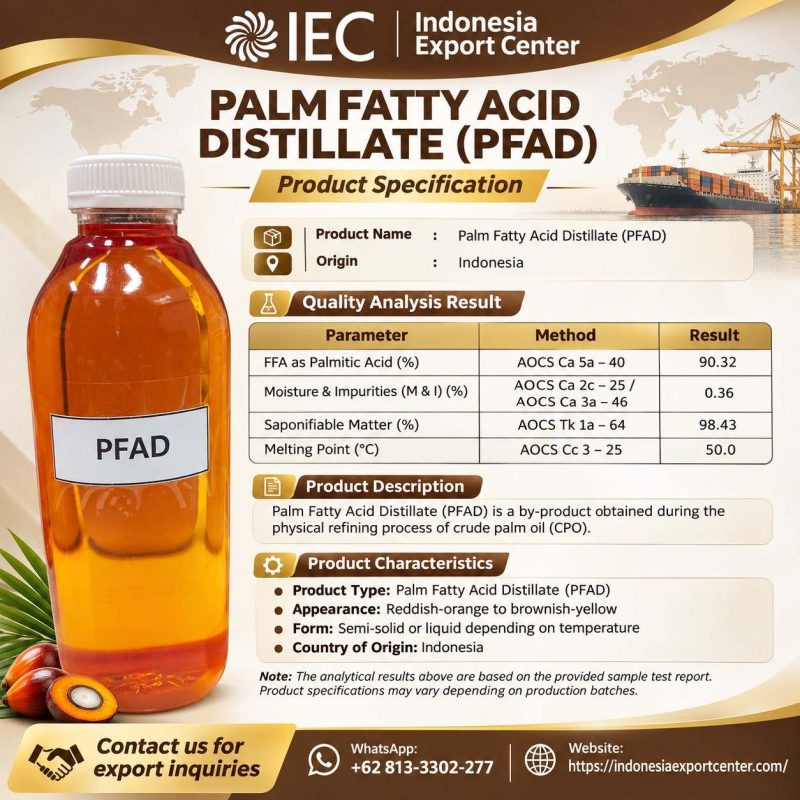
Palm Fatty Acid Distillate is a fatty acid-rich by-product generated during certain palm oil refining processes.
PFAD may be evaluated as a raw material for:
- Oleochemical manufacturing.
- Biodiesel feedstock processing.
- Fatty acid ester production.
- Industrial soap manufacturing.
- Other technically suitable chemical applications.
Its actual suitability depends on composition, manufacturing requirements, and relevant regulations.
IEC PFAD Reference Specifications
| Parameter | Reference Specification |
|---|---|
| Free Fatty Acids (as Palmitic) | Minimum 90% |
| Moisture & Impurities | Maximum 1.0% |
| Iodine Value | Maximum 50 |
| Melting Point | 36–46°C |
| Colour (Gardner) | Maximum 7 |
| Appearance | White / Off White Solid |
Available packaging concepts in the IEC brochure: Bulk in Tank and Flexibag.
These specifications and packaging descriptions are references only. Actual cargo characteristics and transport feasibility must be confirmed.
Why PFAD Export Documents Matter
Documentation supports several functions:
- Identifying the product and commercial parties.
- Recording the agreed quantity and price.
- Supporting export and import declarations.
- Confirming transportation arrangements.
- Supporting quality inspection and acceptance.
- Establishing origin where required.
- Meeting documentary payment requirements.
- Supporting customs clearance and cargo release.
The exact documents depend on the transaction, destination country, cargo classification, shipping method, and payment arrangement.
1. Commercial Invoice
A commercial invoice is a central document in international trade.
It commonly identifies:
- Seller and buyer.
- Invoice number and date.
- Product description.
- Quantity and unit.
- Unit price.
- Total invoice value.
- Currency.
- Incoterm and named place.
- Country of origin, where relevant.
- Payment information.
The description should accurately identify the material as Palm Fatty Acid Distillate when that is the product being sold.
An invoice should not misdescribe PFAD as crude palm oil or another material merely to simplify documentation.
2. Packing List or Cargo Quantity Statement
A packing list generally provides information about packages, units, weights, and shipping marks.
For bulk liquid or heated cargo, a quantity statement or other cargo-specific documentation may be more relevant than a conventional package-by-package list.
Depending on the arrangement, buyers may need:
- Net weight.
- Gross weight, where applicable.
- Number of containers or tanks.
- Container identification.
- Seal numbers.
- Cargo quantity.
- Packaging description.
The appropriate document format should match the shipment.
3. Certificate of Analysis (COA)
A COA provides laboratory results for an identified sample or lot.
For PFAD, relevant parameters may include:
| Test | Buyer Verification |
|---|---|
| FFA | Confirm percentage and as-palmitic basis |
| Moisture | Review method and result |
| Impurities | Confirm reporting convention |
| Iodine Value | Compare with agreed limit |
| Melting Characteristics | Review actual test |
| Gardner Colour | Confirm method and result |
| Additional Contaminants | Request where necessary |
A brochure specification is not a cargo-specific COA.
Buyers should verify whether the COA relates to the shipment being purchased.
4. Bill of Lading
For applicable ocean shipments, a bill of lading records important transport information.
It may identify:
- Shipper.
- Consignee.
- Notify party.
- Vessel and voyage.
- Loading port.
- Discharge port.
- Cargo description.
- Quantity or weight.
- Shipment date.
The required transport document depends on the shipment arrangement and contract.
5. Certificate of Origin
A Certificate of Origin may be required for customs, preferential tariff treatment, or contractual purposes.
Buyers should distinguish between:
- Non-preferential origin documentation.
- Preferential origin documentation under an applicable trade agreement.
A certificate should not be requested or issued under an unsupported origin claim.
Actual origin and eligibility must be established using the applicable rules.
6. Export Customs Declaration
The Indonesian exporter of record is responsible for fulfilling applicable export customs requirements.
The precise declarations, procedures, and supporting documents must be verified under the rules effective at shipment.
Buyers should confirm who is responsible for export clearance under the sales contract.
7. Export Permits and Regulatory Approvals
Certain transactions may require licenses, approvals, registrations, or other regulatory compliance measures.
Requirements may depend on:
- Product classification.
- Current Indonesian export rules.
- Destination-country requirements.
- End use.
- Applicable trade restrictions.
- Shipment date.
Do not assume that a permit is required—or unnecessary—without checking the current rules.
8. Insurance Documentation
Where insurance is required, the buyer should confirm:
- Responsible party.
- Insurer.
- Coverage.
- Insured amount.
- Covered risks.
- Policy or certificate.
- Claims procedures.
Under CIF Incoterms 2020, the seller has an insurance procurement obligation, but the standard coverage may be limited.
9. Inspection Certificate
A third-party inspection certificate may be requested under the contract.
Inspection may cover:
- Sampling.
- Quality testing.
- Quantity determination.
- Tank condition.
- Loading observation.
- Seal verification.
- Documentation review.
An inspection certificate only supports matters within the surveyor’s agreed scope.
10. Sustainability and Traceability Documents
Some buyers may require sustainability-related evidence.
Depending on the intended market and program, this could involve:
- Relevant certification.
- Chain-of-custody evidence.
- Supply-chain declarations.
- Origin records.
- Traceability information.
- Applicable due diligence documentation.
PFAD should not automatically be described as certified, sustainable, or traceable without supporting evidence.
Complete PFAD Export Documents Checklist
| Document | Main Purpose | Requirement |
|---|---|---|
| Commercial Invoice | Commercial transaction | Generally needed |
| Packing List / Quantity Statement | Cargo details | Shipment-dependent |
| COA | Analytical quality | Contract-dependent |
| Bill of Lading | Ocean transport | Transport-dependent |
| Certificate of Origin | Origin evidence | Where required |
| Export Customs Declaration | Export clearance | Applicable legal requirement |
| Export Permits | Regulatory compliance | Where applicable |
| Insurance Certificate | Coverage evidence | Contract-dependent |
| Inspection Certificate | Agreed inspection | If required |
| Sustainability Records | Buyer or regulatory requirements | Where applicable |
| Additional Import Documents | Destination clearance | Country-specific |
How to Prevent Documentation Discrepancies
Before shipment, buyers and sellers should compare:
- Legal company names.
- Product description.
- Quantity.
- Unit of measurement.
- Currency.
- Invoice value.
- Incoterm.
- Loading and destination ports.
- Shipment dates.
- Transport details.
- Certificate references.
Discrepancies should be resolved before documents are submitted to banks or customs authorities where possible.
Documentation Requirements Under a Letter of Credit
When payment uses a documentary letter of credit, the documents must satisfy the credit’s terms and applicable rules.
The parties should review document requirements before issuing the credit.
A bank’s examination of documents does not establish the physical quality of the cargo.
PFAD Export Documentation Inquiry Template
Subject: PFAD Export Documentation and Supplier Inquiry – Indonesia
Buyer Company: [Name]
Country: [Country]
Product: Palm Fatty Acid Distillate
Quantity: [MT]
Intended Application: [Details]
Destination Port: [Port]
Preferred Incoterm: [Term]
Payment Method: [Details]
Required Documents:
- Commercial invoice.
- Packing list or cargo quantity statement.
- Bill of lading.
- Current COA.
- Certificate of Origin, if applicable.
- Inspection certificate, if agreed.
- Additional import documentation.
Please confirm which documents the proposed contracting seller can provide and which regulatory requirements apply to the transaction.
Frequently Asked Questions
What documents are commonly needed for PFAD exports?
A commercial invoice, relevant cargo documentation, transport document, and applicable customs documents are common. Other documents depend on the transaction.
Is a COA mandatory?
It depends on the contract and applicable requirements, but industrial buyers commonly request one.
Does every shipment need a Certificate of Origin?
Not necessarily. Requirements vary.
Does IEC issue export permits?
IEC does not automatically act as the exporter of record or licensing authority.
Can documentation requirements change?
Yes. Customs and trade requirements can change.
Should buyers verify documents before payment?
Yes. The verification procedure should match the payment terms and transaction risk.
Request Indonesian PFAD Supplier Information
Preparing to import PFAD from Indonesia?
Share your product specifications, destination country, quantity, and documentation requirements with IEC.
REQUEST PFAD SUPPLIER INFORMATION
IEC | INDONESIA EXPORT CENTER
Website: https://indonesiaexportcenter.com/
WhatsApp: +62 813-3302-277
Related Resources
How to Import PFAD from Indonesia
PFAD HS Code and Customs Classification
