

IEC | INDONESIA EXPORT CENTER
Your Global Sourcing Partner
Comparing Palm Fatty Acid Distillate and Palm Acid Oil for Industrial Procurement
Palm Fatty Acid Distillate (PFAD) and Palm Acid Oil (PAO) are both palm-derived materials that may be considered by industrial buyers seeking fatty acid-containing feedstocks.
Although they may serve overlapping markets, the two products should not be treated as identical.
Differences in production origin, free fatty acid content, moisture, impurities, composition, and processing characteristics can influence suitability for biodiesel, oleochemical, and other industrial applications.
For international procurement teams, the correct purchasing decision depends on verified product identity and a detailed technical specification.
Indonesia Export Center (IEC) facilitates inquiries involving potential Indonesian PFAD suppliers and encourages buyers to verify the precise product offered.
What Is PFAD?
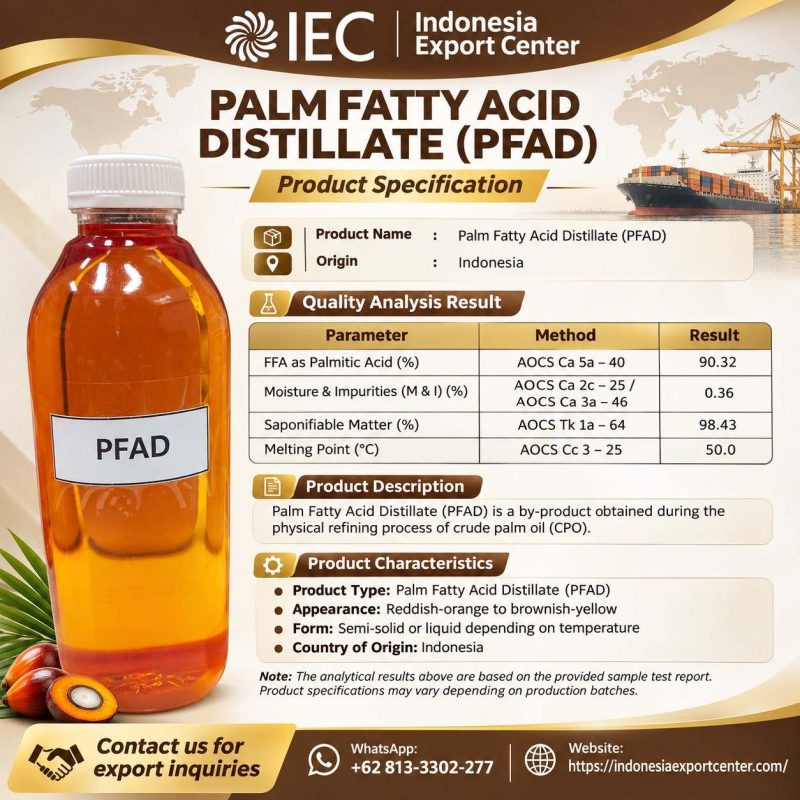
PFAD is a fatty acid-rich distillate generated during certain palm oil refining processes.
It is typically associated with physical refining operations in which free fatty acids and other volatile components are removed from palm oil.
Its composition depends on the refinery feedstock and operating conditions.
What Is Palm Acid Oil?
Palm Acid Oil is a commercial term often associated with acidic oil streams derived from palm oil refining by-products, including materials recovered through the acidulation of soapstock.
However, the term can be used differently across suppliers and markets.
Buyers should therefore request a description of the actual production process and composition rather than relying on the product name alone.
PFAD vs Palm Acid Oil: Main Differences
| Aspect | PFAD | Palm Acid Oil |
|---|---|---|
| Typical Origin | Distillate from certain palm oil refining operations | Often associated with acidulated refining by-products |
| Production Route | Distillation-related refining stream | May involve soapstock acidulation or other recovery processes |
| FFA Content | Typically high | Variable by source and process |
| Moisture | Must be tested | Must be tested |
| Impurities | Must be tested | May differ significantly by source |
| Composition | Refinery-dependent | Production-route-dependent |
| Application | Selected industrial feedstock processes | Selected industrial feedstock processes |
| Interchangeability | Not automatic | Not automatic |
Why Production Origin Matters
Production history may influence:
- Material composition.
- Residual impurities.
- Moisture content.
- Salt or inorganic residue.
- Processing requirements.
- Quality consistency.
- Traceability.
- Regulatory classification.
For applications sensitive to impurities, a supplier’s production explanation can be important.
Comparing FFA Specifications
The IEC PFAD reference identifies minimum 90% FFA as palmitic acid.
This value should not be assumed to apply to palm acid oil.
Palm acid oil suppliers may offer different FFA grades, and the buyer must review the actual laboratory results.
Comparing Moisture and Impurities
Moisture and impurities can affect:
- Storage.
- Pumping.
- Pretreatment.
- Processing efficiency.
- Equipment condition.
- Waste management.
- Finished product quality.
A buyer should request separate results where the process requires them.
IEC PFAD Reference Specifications
| Parameter | PFAD Reference |
|---|---|
| FFA, as Palmitic | Minimum 90% |
| Moisture & Impurities | Maximum 1.0% |
| Iodine Value | Maximum 50 |
| Melting Point | 36–46°C |
| Gardner Colour | Maximum 7 |
| Appearance | White / Off White Solid |
These values are not specifications for palm acid oil.
Additional Laboratory Parameters to Compare
For industrial qualification, buyers may request:
- Acid value.
- Fatty acid composition.
- Moisture.
- Insoluble impurities.
- Ash.
- Unsaponifiable matter.
- Metals.
- Other process-specific contaminants.
The exact tests should be selected according to the intended application.
PFAD vs Palm Acid Oil for Biodiesel
Both materials may be evaluated by biodiesel producers with suitable feedstock-processing technology.
However, their actual compositions may lead to different pretreatment requirements, operating costs, and processing performance.
Neither material guarantees a particular biodiesel yield.
The manufacturer should perform feedstock qualification before commercial substitution.
PFAD vs Palm Acid Oil for Oleochemicals
Oleochemical buyers may evaluate both materials for selected processing pathways.
The appropriate choice depends on:
- Required fatty acid composition.
- Impurity tolerance.
- Process equipment.
- Pretreatment capability.
- Product quality targets.
- Delivered feedstock cost.
A product suitable for one plant may not be suitable for another.
Commercial Price Comparison
The lowest price per metric ton does not necessarily represent the lowest usable feedstock cost.
A more complete comparison may consider:
Effective Feedstock Cost = Purchase Cost + Freight + Handling + Pretreatment + Processing Losses + Relevant Quality Costs
Actual calculations depend on the buyer’s process.
How to Verify a Supplier’s Product
Step 1 – Confirm the Exact Product Name
Ask whether the material is PFAD, palm acid oil, or another palm-derived stream.
Step 2 – Request Production-Origin Information
Understand how the material was generated.
Step 3 – Obtain a Current COA
Compare actual analytical results.
Step 4 – Request a Representative Sample
Conduct appropriate technical evaluation.
Step 5 – Verify Quantity and Availability
Confirm the proposed shipment.
Step 6 – Agree on Contract Specifications
Avoid contracts that identify the product only by a broad commercial name.
Product Comparison Checklist
| Question | PFAD | Palm Acid Oil |
|---|---|---|
| Is production origin documented? | Verify | Verify |
| Is FFA basis stated? | Verify | Verify |
| Is moisture tested? | Verify | Verify |
| Are impurities tested? | Verify | Verify |
| Is a current COA available? | Verify | Verify |
| Is the sample representative? | Verify | Verify |
| Has the buyer approved the material? | Verify | Verify |
| Is the shipment quantity confirmed? | Verify | Verify |
RFQ Template
Subject: PFAD vs Palm Acid Oil – Industrial Feedstock Inquiry
Company: [Name]
Country: [Country]
Intended Application: [Details]
Preferred Product: [PFAD / Palm Acid Oil / Both for Comparison]
Quantity: [MT]
FFA Requirement: [Specify Basis]
Moisture Requirement: [Specify]
Impurity Requirement: [Specify]
Additional Tests: [Details]
Destination Port: [Port]
Preferred Incoterm: [Term]
Shipment Period: [Dates]
Please provide the actual product description, production-origin information, current COA, and commercial quotation details.
Frequently Asked Questions
Is PFAD the same as palm acid oil?
No. Their production origins and characteristics can differ.
Does palm acid oil always have lower FFA?
No universal FFA level should be assumed. Actual results must be tested.
Can palm acid oil replace PFAD?
Only after technical evaluation confirms suitability.
Which product is cheaper?
Prices depend on market conditions, quality, location, and transaction terms.
Is the IEC PFAD specification applicable to palm acid oil?
No. It is a PFAD reference only.
Should buyers request separate COAs?
Yes. Each offered product should be evaluated using its own documentation.
Request PFAD Sourcing Information
Compare industrial feedstocks using verified composition, production origin, technical suitability, and delivered cost—not product names alone.
REQUEST PFAD SUPPLIER INFORMATION
IEC | INDONESIA EXPORT CENTER
Website: https://indonesiaexportcenter.com/
WhatsApp: +62 813-3302-277
Related Resources
