

IEC | INDONESIA EXPORT CENTER
Your Global Sourcing Partner
Understanding the Difference Between PFAD and Palm Stearin
Palm Fatty Acid Distillate and palm stearin are two different palm-derived materials that may be encountered in industrial commodity procurement.
Both are associated with the palm oil processing industry, but their production pathways, chemical characteristics, and commercial applications differ.
PFAD is a fatty acid-rich refining by-product, while palm stearin is a higher-melting fraction obtained through palm oil fractionation.
For industrial buyers, selecting the correct product requires understanding the manufacturing process and confirming technical specifications.
Indonesia Export Center (IEC) facilitates inquiries involving potential Indonesian PFAD suppliers.
What Is PFAD?
PFAD is generated during certain palm oil refining operations when free fatty acids and other volatile components are separated.
Its main commercial characteristic is its relatively high free fatty acid content.
It may be evaluated for suitable industrial processes involving fatty acid conversion.
What Is Palm Stearin?
Palm stearin is the higher-melting fraction separated during the fractionation of palm oil.
It is typically richer in higher-melting triglyceride components than palm olein.
Depending on its grade and quality, palm stearin may be used in food, industrial, and chemical processing applications.
Food-grade suitability must be established separately.
PFAD vs Palm Stearin Comparison
| Characteristic | PFAD | Palm Stearin |
|---|---|---|
| Origin | Refining distillate stream | Palm oil fractionation |
| Main Chemical Character | Fatty acid-rich | Predominantly triglyceride fraction |
| FFA | Typically high | Depends on grade; generally not characterized as high-FFA PFAD |
| Physical Behavior | Temperature-dependent | Higher-melting palm fraction |
| Applications | Selected industrial fatty acid feedstocks | Food and industrial uses depending on grade |
| Quality Specification | PFAD-specific | Palm stearin-specific |
| Interchangeability | Not automatic | Not automatic |
Why the Production Process Matters
PFAD and palm stearin arise from different processing operations.
In refining, the objective includes removing undesirable components from oil.
In fractionation, the objective is to separate oil fractions with different melting characteristics.
These operations produce materials with different compositions.
Understanding the FFA Difference
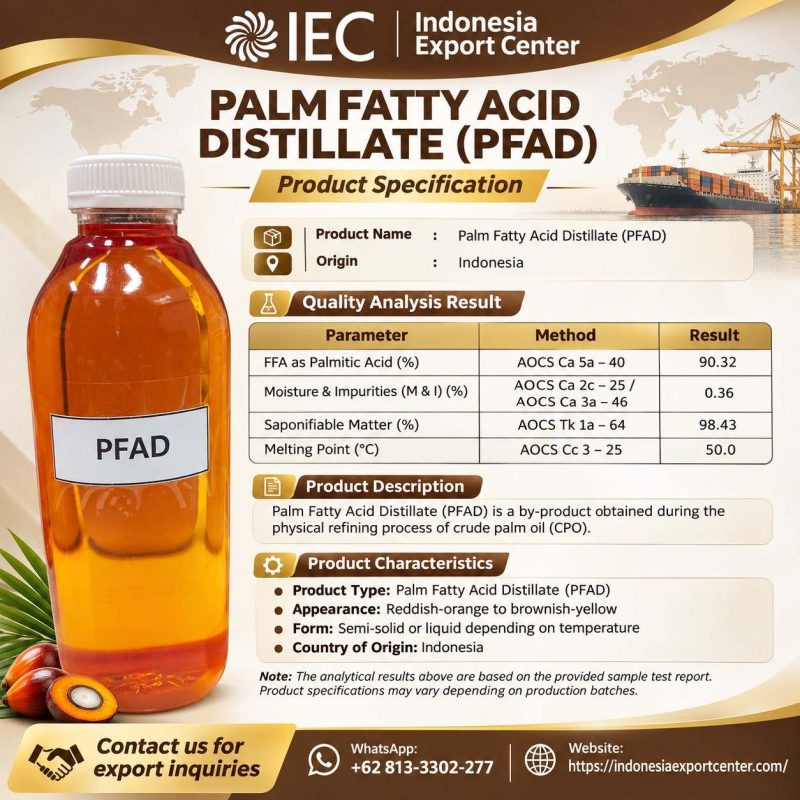
The IEC PFAD reference specifies:
FFA minimum 90%, expressed as palmitic acid.
This is not a typical palm stearin specification.
A buyer requiring triglyceride-rich feedstock should not assume that PFAD is a suitable substitute.
Likewise, a buyer requiring high free fatty acid content should not assume that palm stearin will meet the requirement.
Comparing Melting Characteristics
Both materials may require temperature management during storage and transport.
However, their melting and crystallization behavior may differ.
A similar-looking solid product is not necessarily chemically equivalent.
The buyer should evaluate the actual melting profile, viscosity, pumping requirements, and downstream process needs.
IEC PFAD Reference Specifications
| Parameter | Reference Value |
|---|---|
| FFA, as Palmitic | Minimum 90% |
| Moisture & Impurities | Maximum 1.0% |
| Iodine Value | Maximum 50 |
| Melting Point | 36–46°C |
| Gardner Colour | Maximum 7 |
| Appearance | White / Off White Solid |
These values apply only as a PFAD brochure reference.
Industrial Applications of PFAD
Potential applications include:
- Biodiesel feedstock processing.
- Oleochemical manufacturing.
- Fatty acid ester production.
- Selected industrial soap feedstock chains.
- Other suitable industrial chemical processes.
Each application requires technical qualification.
Industrial Applications of Palm Stearin
Depending on grade and specifications, palm stearin may be used in:
- Food fat formulations.
- Margarine and shortening production.
- Certain confectionery fat applications.
- Soap manufacturing.
- Other industrial processing.
A specific palm stearin grade should be evaluated against the intended application.
Selecting the Correct Feedstock
Question 1 – What Does the Process Require?
Determine whether the process is designed for free fatty acids, triglycerides, or another chemical input.
Question 2 – What Are the Critical Specifications?
Define FFA, fatty acid composition, iodine value, moisture, melting characteristics, and contaminants.
Question 3 – Is Further Processing Required?
Consider refining, pretreatment, fractionation, or chemical conversion.
Question 4 – What Is the Delivered Cost?
Evaluate freight, handling, and processing costs.
Question 5 – What Documentation Is Needed?
Obtain a current COA and appropriate supplier records.
Product Selection Matrix
| Buyer Requirement | Procurement Direction |
|---|---|
| High-FFA industrial feedstock | Evaluate PFAD |
| Triglyceride-rich higher-melting palm fraction | Evaluate palm stearin |
| Food-grade fat | Evaluate an appropriately certified and compliant grade |
| Fatty acid ester production | Confirm the required conversion pathway |
| Soap manufacturing | Evaluate formulation and process compatibility |
| Uncertain feedstock specification | Conduct technical review before purchase |
Supplier Verification
Regardless of product type, buyers should confirm:
- Legal supplier identity.
- Product source.
- Product specification.
- Actual quality.
- Available quantity.
- Storage conditions.
- Shipment feasibility.
- Contracting seller.
- Export arrangements.
- Required documentation.
RFQ Template
Subject: Indonesian PFAD or Palm Stearin – Industrial Procurement Inquiry
Company: [Name]
Country: [Country]
Required Product: [PFAD / Palm Stearin]
Intended Application: [Details]
Quantity: [MT]
Technical Requirements: [Details]
Required COA: [Parameters]
Packaging: [Details]
Destination Port: [Port]
Preferred Incoterm: [Term]
Shipment Schedule: [Dates]
Please provide product-specific supplier information and relevant technical documentation.
Frequently Asked Questions
Is PFAD a type of palm stearin?
No. They are distinct palm-derived products.
Is palm stearin a refining by-product like PFAD?
Palm stearin is a fraction obtained through fractionation, not the same distillate stream as PFAD.
Can both be used for soap manufacturing?
Potentially, depending on the formulation and processing route.
Does palm stearin have minimum 90% FFA?
That is not the IEC palm stearin specification; the 90% value is the supplied PFAD reference.
Are both solid at room temperature?
Their physical state depends on grade, composition, and temperature.
Can IEC guarantee availability of both products?
No. Availability must be confirmed with potential suppliers.
Request Indonesian PFAD Supplier Information
Select the right palm-derived feedstock by comparing actual chemical composition, industrial suitability, and verified supplier documentation.
IEC | INDONESIA EXPORT CENTER
Website: https://indonesiaexportcenter.com/
WhatsApp: +62 813-3302-277
Related Resources
