

IEC | INDONESIA EXPORT CENTER
Your Global Sourcing Partner
Preparing a Clear CPO Purchase Specification
A crude palm oil purchase contract should clearly identify the product being sold, the agreed quality parameters, the quantity, the delivery terms, and the procedures used to determine whether the cargo meets contractual requirements.
Ambiguous specifications can lead to disagreements over laboratory results, quantity measurements, shipment deadlines, and commercial acceptance.
This guide provides an illustrative contract specification schedule that international buyers can use as a starting point when preparing a CPO procurement agreement.
Important: This is an educational template, not a complete or legally reviewed sales contract. It must be adapted by the contracting parties and qualified legal counsel.
Indonesia Export Center (IEC) facilitates sourcing inquiries and does not become a contracting seller merely because this template is used.
Why a Written Quality Schedule Matters
A written specification schedule helps establish:
- Product identity.
- Agreed quality limits.
- Testing methods.
- Inspection procedures.
- Sampling requirements.
- Quantity basis.
- Shipment requirements.
- Acceptance criteria.
- Dispute procedures.
1. Identify the Contracting Parties
The contract should identify the full legal names and addresses of the buyer and seller.
It should also clarify the exporter of record where different from the seller.
2. Define the Product
Illustrative Product Description:
Crude Palm Oil (CPO), unrefined palm oil derived from oil palm fruit mesocarp, subject to the agreed quality specification and applicable regulatory requirements.
The parties should confirm that this description accurately identifies the contracted product.
3. Example Quality Specification Schedule
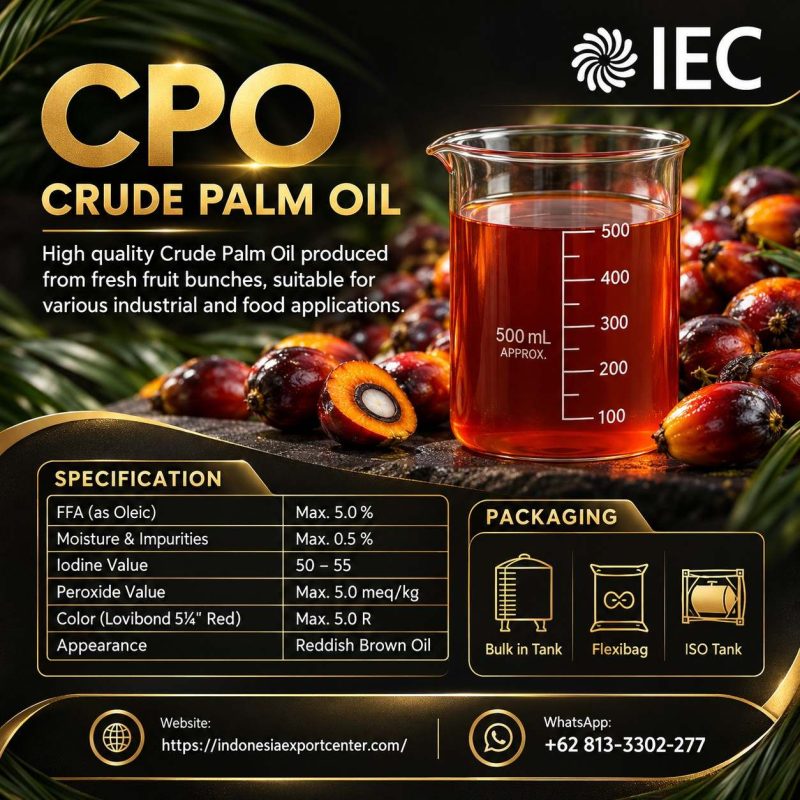
The following table is based on the supplied IEC CPO brochure.
| Quality Parameter | Illustrative Contract Target | Method / Clarification |
|---|---|---|
| FFA | Maximum 5.0%, expressed as Oleic | Specify agreed analytical method |
| Moisture & Impurities | Maximum 0.5% combined | Define test method and reporting basis |
| Iodine Value | 50–55 | Specify method and units |
| Peroxide Value | Maximum 5.0 meq/kg | Specify test method |
| Lovibond Color | Maximum 5.0 R, 5¼-inch cell | Confirm complete measurement conditions |
| Appearance | Reddish Brown Oil | Define inspection conditions if used for acceptance |
These are proposed reference values, not verified specifications for any available cargo.
The buyer and seller must agree on methods and whether the limits are technically appropriate.
4. Free Fatty Acid Reporting Basis
FFA may be reported using different reference fatty acids.
The contract must explicitly identify the reporting basis.
For this reference schedule, the supplied brochure states FFA as Oleic.
Do not silently substitute a palmitic-acid basis.
5. Moisture and Impurities
The contract should clarify:
- Whether the limit is combined.
- Whether separate limits also apply.
- Which analytical methods are accepted.
- How conflicting results will be resolved.
6. Quantity Clause
An illustrative schedule should identify:
Contract Quantity: [Number] metric tons.
Quantity Tolerance: [Agreed percentage or absolute amount].
Measurement Basis: [Agreed method].
Final Quantity Determination: [Specified location and procedure].
No tolerance should be assumed without agreement.
7. Delivery Terms
Specify:
- Incoterm.
- Incoterms version.
- Named port or place.
- Shipment period.
- Loading arrangements.
- Transport responsibilities.
- Relevant terminal requirements.
Example placeholder:
Delivery Term: FOB [Named Indonesian Port], Incoterms 2020.
This is only an illustration and must be adapted to the actual transaction.
8. Sampling Clause
A sampling clause should identify:
- Authorized sampler.
- Sampling location.
- Applicable method.
- Sample identification.
- Sealing.
- Retained samples.
- Laboratory selection.
- Reporting deadline.
9. Independent Inspection
The contract may provide for a mutually agreed inspection organization.
Its mandate should specify whether it covers:
- Quality.
- Quantity.
- Tank suitability.
- Loading supervision.
- Document review.
10. Laboratory Analysis
The parties should identify:
- Accepted laboratories.
- Applicable standards.
- Sample handling requirements.
- Test methods.
- Reporting units.
- Retesting rights.
- Result interpretation.
11. Quality Acceptance and Rejection
A contract should explain what happens if the cargo does not meet the agreed specification.
Possible negotiated outcomes may include rejection, price adjustment, replacement, or other remedies.
No specific remedy should be assumed without legal and commercial agreement.
12. Price and Payment
The commercial schedule should specify:
- Price or pricing formula.
- Currency.
- Unit of measurement.
- Incoterm basis.
- Payment method.
- Payment deadline.
- Required documents.
- Bank details verification.
13. Export and Import Compliance
The responsible parties should establish obligations relating to:
- Export authorization.
- Customs declarations.
- Applicable duties and levies.
- Import permits.
- Origin documents.
- Sustainability documentation where required.
- Applicable sanctions and trade restrictions.
14. Sustainability and Traceability
Where required, the contract should identify:
- Certification scheme.
- Chain-of-custody model.
- Origin documentation.
- Traceability level.
- Applicable legal obligations.
- Supporting evidence.
No certification should be implied without verification.
15. Dispute Resolution
The parties should obtain legal advice concerning:
- Governing law.
- Jurisdiction or arbitration.
- Arbitration institution and rules.
- Seat of arbitration.
- Language.
- Notice requirements.
- Claims deadlines.
- Available remedies.
Avoid inserting an arbitration clause without reviewing its legal consequences.
Copy-Ready Illustrative CPO Contract Specification Schedule
Schedule A – Product and Quality
Product: Crude Palm Oil (CPO)
Origin: [Verified Country / Source Details]
Seller: [Legal Entity]
Buyer: [Legal Entity]
Quantity: [MT]
Quantity Tolerance: [Agreed]
FFA: Maximum 5.0%, expressed as Oleic, subject to agreed method.
Moisture & Impurities: Maximum 0.5%, subject to agreed method.
Iodine Value: 50–55, subject to agreed method.
Peroxide Value: Maximum 5.0 meq/kg, subject to agreed method.
Lovibond Color: Maximum 5.0 R using a 5¼-inch cell, subject to confirmed testing procedure.
Appearance: Reddish Brown Oil.
Additional Specifications: [Details]
Schedule B – Shipment
Incoterm: [FOB / CFR / CIF]
Incoterms Version: [Version]
Loading Port: [Port]
Destination Port: [Port]
Shipment Period: [Dates]
Packaging / Transport: [Details]
Cargo Readiness Requirements: [Details]
Schedule C – Inspection
Inspection Organization: [Name]
Inspection Scope: [Details]
Sampling Procedure: [Method]
Testing Laboratory: [Name]
Retained Samples: [Requirements]
Quality Acceptance Procedure: [Details]
Quantity Determination: [Method]
Schedule D – Documents
Commercial Invoice: [Requirements]
Bill of Lading: [Requirements]
Certificate of Analysis: [Requirements]
Certificate of Origin: [If Applicable]
Inspection Certificate: [If Required]
Export Documents: [Applicable Requirements]
Other Documents: [Details]
Schedule E – Commercial and Legal Terms
Price: [Amount or Formula]
Currency: [Currency]
Payment Method: [Details]
Payment Deadline: [Details]
Governing Law: [Counsel to Confirm]
Dispute Resolution: [Counsel to Confirm]
Claims Procedure: [Agreed]
Other Conditions: [Details]
This schedule is incomplete until reviewed, negotiated, and incorporated into a properly executed contract.
Common Contract Specification Mistakes
- Omitting the FFA reporting basis.
- Using ambiguous test methods.
- Failing to define quantity tolerances.
- Confusing FOB with CIF obligations.
- Omitting inspection procedures.
- Assuming the brochure is a cargo-specific COA.
- Failing to identify the actual exporter.
- Including unsupported certification claims.
- Using unclear payment requirements.
- Neglecting legal review.
Frequently Asked Questions
Can buyers use this as a complete sales contract?
No. It is an illustrative specification schedule requiring legal adaptation.
Is FFA 5% guaranteed?
No. It is a brochure-derived reference target.
Should a contract specify laboratory methods?
Yes. Agreed methods help reduce disputes.
Can an independent surveyor be included?
Yes. The parties should define the surveyor’s mandate.
Is arbitration mandatory?
Not universally. Dispute resolution arrangements depend on the contract and applicable law.
Does IEC provide legal advice?
No. Buyers should consult qualified legal counsel.
Request CPO Contract and Supplier Information
Prepare your Indonesian CPO procurement inquiry with clear specifications, inspection requirements, and commercial terms.
REQUEST CPO SOURCING INFORMATION
IEC | INDONESIA EXPORT CENTER
Website: https://indonesiaexportcenter.com/
WhatsApp: +62 821-4172-3508
Related Resources
CPO Spot Purchase vs Long-Term Supply Contract
CPO Independent Surveyor Inspection Guide
CPO Payment Terms and Letter of Credit Guide
