

IEC | INDONESIA EXPORT CENTER
Your Global Sourcing Partner
Spot and Contract Crude Palm Oil Sourcing from Indonesia
International crude palm oil buyers must decide not only what product to purchase, but also how to structure their procurement.
A spot purchase may suit a buyer seeking a defined quantity for a particular shipment period. A long-term supply contract may suit a refinery, processor, or commodity trader planning recurring purchases over several months.
Both approaches have commercial advantages and risks. The appropriate choice depends on purchasing volume, market exposure, storage capacity, operational requirements, financing, and supplier performance.
Indonesia Export Center (IEC) facilitates inquiries between international buyers and potential Indonesian CPO suppliers. IEC does not guarantee product availability, recurring capacity, pricing, or direct-export status.
What Is a CPO Spot Purchase?
A spot purchase is generally a transaction for a specified quantity and shipment period, often negotiated against prevailing market conditions.
A spot contract should still define all essential commercial terms, including product specifications, quantity, pricing, payment, delivery, inspection, and dispute resolution.
Potential Advantages of Spot Purchasing
- Flexibility to evaluate different suppliers.
- Ability to respond to changing procurement needs.
- Opportunity to purchase a trial cargo.
- No automatic commitment to a lengthy recurring schedule.
- Potential to compare current commercial offers.
Potential Limitations
- Exposure to price movements.
- Uncertainty about future availability.
- Repeated supplier qualification work.
- Possible shipping or loading constraints.
- Limited continuity of supply.
What Is a Long-Term CPO Supply Contract?
A long-term supply contract establishes a framework for recurring deliveries over an agreed period.
The agreement may define total contract quantity, monthly nominations, quality specifications, pricing formulas, shipment windows, and remedies for nonperformance.
A long-term agreement does not automatically guarantee that every nominated shipment will be available. The supplier’s production, procurement, logistics, and legal capability must be assessed.
Spot Purchase vs Long-Term Contract Comparison
| Procurement Factor | Spot Purchase | Long-Term Contract |
|---|---|---|
| Purchase horizon | Defined individual transaction | Multiple scheduled deliveries |
| Quantity | Specific shipment | Total and recurring quantities |
| Price | Agreed for individual purchase | Fixed, indexed, or formula-based |
| Supply planning | Shorter-term | Longer-term |
| Supplier relationship | Transaction-specific | Continuing |
| Logistics | Shipment-specific | Coordinated recurring schedule |
| Risk | Market and availability exposure | Performance and contractual exposure |
| Quality assurance | Per cargo | Per cargo plus supplier monitoring |
| Working capital | Transaction-dependent | May require ongoing commitments |
How CPO Pricing May Be Structured
Fixed Price
The buyer and seller agree on a specified price for the relevant quantity and delivery period.
Formula-Based Price
The price may reference an agreed market benchmark with specified adjustments.
Periodic Price Negotiation
The parties may agree to negotiate pricing for each shipment or defined pricing period.
Price Review Mechanism
A contract may establish conditions under which pricing is reviewed.
No live market price or supplier-specific quotation is represented here.
Quality Specifications for Both Contract Types
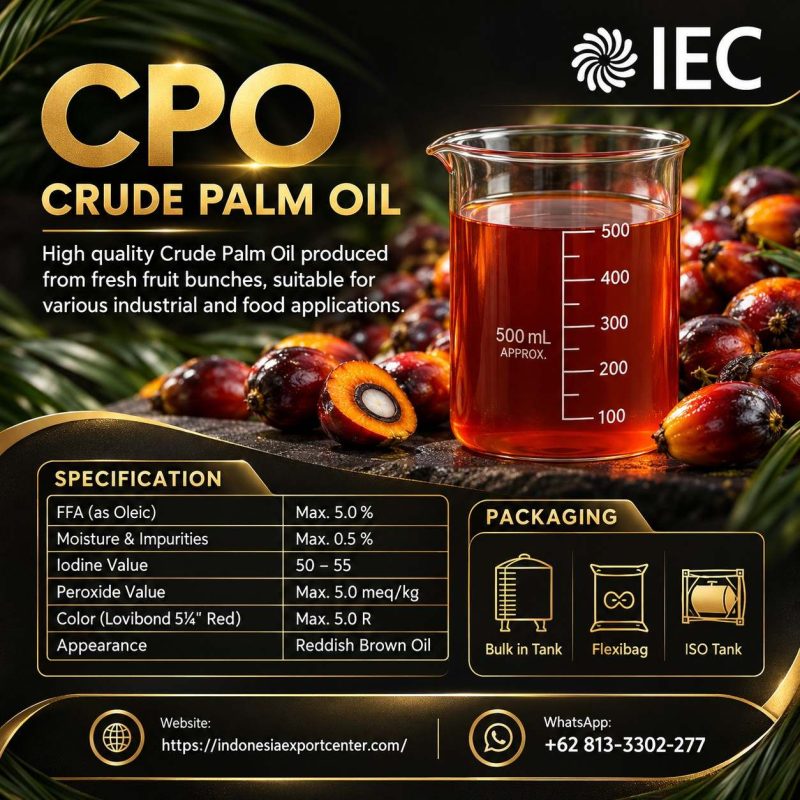
The following reference targets come from IEC’s supplied CPO product material.
| Parameter | Reference Target |
|---|---|
| FFA, as Oleic | Maximum 5.0% |
| Moisture & Impurities | Maximum 0.5% |
| Iodine Value | 50–55 |
| Peroxide Value | Maximum 5.0 meq/kg |
| Lovibond Color, 5¼-inch Red | Maximum 5.0 R |
| Appearance | Reddish Brown Oil |
The contract must identify applicable testing methods and acceptance criteria. A current cargo-specific COA is necessary to verify actual results.
Important Contract Clauses
Product Description and Quality
Define CPO grade, analytical methods, quality tolerances, and the laboratory or inspection procedure used to determine compliance.
Quantity and Tolerance
State whether the contract quantity is exact or subject to an agreed tolerance.
Shipment Schedule
Identify shipment windows, nomination deadlines, and procedures for rescheduling.
Pricing
Define the currency, unit of measurement, pricing basis, and any adjustment mechanism.
Incoterms
Specify the selected rule, named port, and Incoterms version.
Payment
Define the payment instrument, bank responsibilities, document requirements, and deadlines.
Inspection
Identify sampling procedures, inspection responsibilities, and quality acceptance rules.
Nonperformance
Establish remedies for delayed shipment, insufficient quantity, or failure to meet specifications.
Dispute Resolution
Agree on governing law and the appropriate dispute-resolution process.
Understanding Shipment Nominations
Under some recurring supply contracts, the buyer submits periodic shipment nominations.
A nomination may specify:
- Requested quantity.
- Delivery period.
- Destination.
- Vessel details where relevant.
- Loading or discharge requirements.
- Documentation instructions.
The seller must confirm whether the nomination can be fulfilled under the contract.
Supply Continuity and Supplier Qualification
Before signing a recurring agreement, buyers should evaluate the supplier’s ability to support the proposed schedule.
Relevant evidence may include:
- Legal seller identity.
- Selling authority.
- Supply arrangements.
- Historical shipment performance where verifiable.
- Storage and loading infrastructure.
- Export eligibility.
- Financial and operational capability.
- Quality assurance procedures.
Marketing claims about monthly capacity should not substitute for verification.
When a Spot Purchase May Be Appropriate
Spot procurement may be useful for:
- Initial supplier evaluation.
- Trial shipments.
- Temporary production requirements.
- Opportunistic purchases.
- Buyers unwilling to commit to recurring volumes.
When a Long-Term Contract May Be Appropriate
Recurring agreements may be considered by:
- Refineries with predictable feedstock demand.
- Industrial processors with regular consumption.
- Importers supplying established customers.
- Commodity traders with recurring delivery obligations.
Managing Commercial Risk
A procurement risk assessment should consider price volatility, counterparty performance, logistics, currency exposure, payment security, and regulatory changes.
Possible controls include independent inspection, appropriate contractual protections, supplier verification, and contingency sourcing.
Spot or Contract CPO RFQ Template
Subject: Indonesian CPO Spot Purchase / Long-Term Supply Inquiry
Company: [Name]
Country: [Country]
Buyer Type: [Refinery / Importer / Trader]
Product: Crude Palm Oil
Purchase Structure: [Spot / Long-Term]
Quantity per Shipment: [MT]
Total Contract Quantity: [MT]
Contract Duration: [Months]
Shipment Frequency: [Schedule]
Required Specifications: [Details]
Destination Port: [Port, Country]
Preferred Incoterm: [FOB / CFR / CIF]
Preferred Pricing Structure: [Fixed / Formula / Negotiated]
Inspection Requirements: [Details]
Payment Terms: [Details]
Please advise on potential suppliers, verified capacity, commercial terms, and a dated quotation.
Frequently Asked Questions
Is spot purchasing always cheaper than a long-term contract?
No. The outcome depends on market prices, contract terms, and procurement costs.
Can a long-term CPO contract use variable pricing?
Yes, if the parties agree on a clear pricing formula.
Does a term contract guarantee supply?
Only to the extent supported by the contract and actual supplier performance.
Should every shipment be inspected?
Inspection requirements should be defined in the agreement, particularly for quality-sensitive bulk cargoes.
Can a buyer begin with a trial shipment?
A trial transaction may be negotiated if the supplier agrees.
Can IEC negotiate a long-term supply inquiry?
IEC can facilitate communication with potential counterparties; the actual seller must confirm commercial commitments.
Request Spot or Long-Term CPO Sourcing Information
Explore Indonesian crude palm oil procurement arrangements that match your purchasing schedule, quality requirements, and commercial risk preferences.
REQUEST CPO CONTRACT QUOTATION
IEC | INDONESIA EXPORT CENTER
Website: https://indonesiaexportcenter.com/
WhatsApp Inquiry: +62 821-4172-3508
Related Resources
CPO Monthly Supply Planning for Industrial Buyers
CPO Request for Quotation Checklist
CPO Payment Terms and Letter of Credit Guide
