

IEC | INDONESIA EXPORT CENTER
Your Global Sourcing Partner
Protecting Crude Palm Oil Quality Across the Supply Chain
Crude palm oil quality can be influenced by processing, storage, handling, and transportation conditions.
For international importers and refinery buyers, understanding deterioration mechanisms is important when establishing product specifications and quality assurance programs.
Two relevant processes are hydrolytic deterioration, associated with the formation of free fatty acids, and oxidative deterioration, involving reactions that may produce peroxides and other oxidation products.
These processes are not identical, and no single laboratory parameter fully describes every aspect of oil condition.
Indonesia Export Center (IEC) facilitates sourcing inquiries for potential Indonesian CPO suppliers and helps buyers communicate quality requirements.
IEC does not guarantee that any cargo is free from deterioration or meets a specific laboratory limit without supporting evidence.
What Is Rancidity?
Rancidity is a general term describing undesirable deterioration in fats and oils that may affect their sensory or chemical characteristics.
Different mechanisms can contribute to deterioration.
Hydrolytic Deterioration
Hydrolysis can contribute to the formation of free fatty acids.
Oxidative Deterioration
Oxidation can produce primary and secondary oxidation compounds.
The relative importance of these processes depends on the product and conditions.
1. Free Fatty Acids and Hydrolysis
FFA is an important CPO quality parameter.
An increase in free fatty acids may be associated with hydrolytic changes occurring during fruit handling, processing, or subsequent storage.
The IEC reference specification identifies:
FFA, as Oleic: Maximum 5.0%
This is a proposed quality target, not a verified result.
The buyer must confirm the analytical method and reporting basis.
2. Peroxide Value and Oxidation
Peroxide value measures certain primary oxidation products.
The IEC reference specification identifies:
Peroxide Value: Maximum 5.0 meq/kg
PV must be interpreted carefully because primary oxidation products can form and subsequently decompose.
A low PV does not necessarily establish the complete absence of previous oxidation.
3. Factors Affecting Oil Deterioration
Potential factors include:
- Oxygen exposure.
- Temperature.
- Storage duration.
- Moisture.
- Certain contaminants.
- Metal contact.
- Product composition.
- Handling conditions.
The importance of each factor depends on the actual cargo.
4. Minimize Unnecessary Air Exposure
Storage and transfer systems should be evaluated for appropriate protection from avoidable exposure and contamination.
Any equipment modifications or operating procedures should be determined by qualified personnel.
5. Manage Temperature Appropriately
Temperature affects both cargo handling and chemical deterioration.
The storage operator should establish suitable operating conditions that support pumpability without unnecessary thermal stress.
No universal CPO heating temperature is prescribed here.
6. Control Moisture and Impurities
The IEC reference specifies:
Moisture & Impurities: Maximum 0.5%
Moisture and impurities may affect processing and storage quality.
The contract should establish how the parameter is measured and whether individual moisture and impurity limits are also required.
7. Maintain Tank Hygiene
Appropriate tank management may include:
- Cleaning verification.
- Product compatibility.
- Previous cargo review.
- Water ingress prevention.
- Maintenance.
- Contamination monitoring.
- Transfer line inspection.
8. Avoid Unnecessary Storage Delays
Long storage periods may increase exposure to conditions that influence quality.
Procurement and logistics teams should coordinate cargo readiness, shipment timing, and receiving capacity.
9. Use Appropriate Sampling Procedures
Representative sampling supports meaningful quality monitoring.
The sampling plan should address:
- Cargo identification.
- Sample location.
- Sample handling.
- Container suitability.
- Chain of custody.
- Laboratory methods.
- Retesting arrangements.
10. Monitor Multiple Quality Indicators
| Parameter | What It Helps Evaluate |
|---|---|
| FFA | Free fatty acid content |
| Peroxide Value | Certain primary oxidation products |
| Moisture | Water content |
| Impurities | Unwanted solids |
| Iodine Value | Degree of unsaturation |
| Color | Appearance under defined measurement conditions |
A comprehensive assessment may require additional tests depending on the intended application.
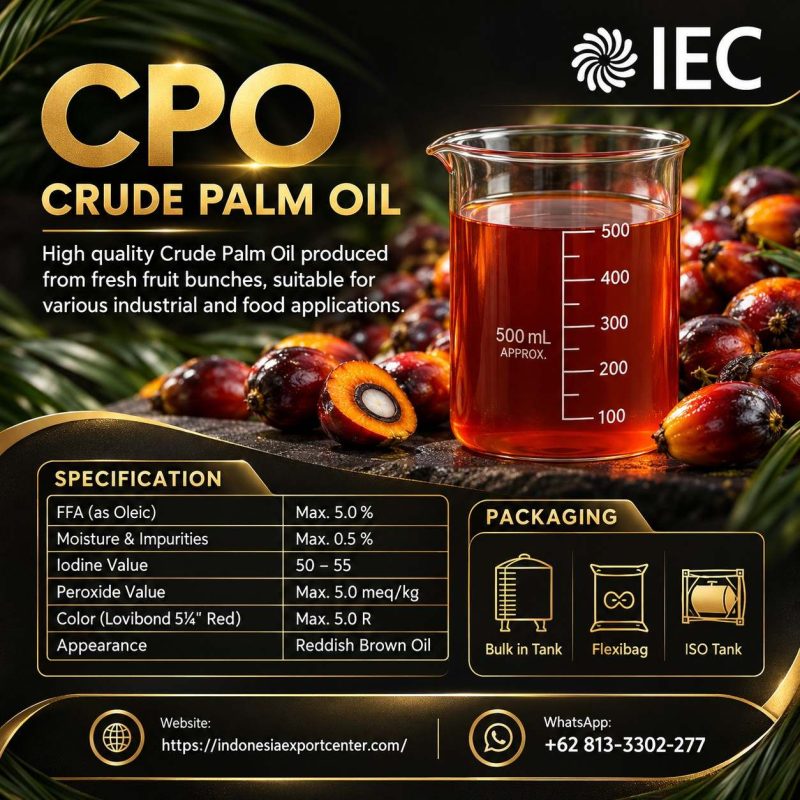
11. IEC Reference CPO Specifications
| Parameter | Reference Target |
|---|---|
| FFA, as Oleic | Maximum 5.0% |
| Moisture & Impurities | Maximum 0.5% |
| Iodine Value | 50–55 |
| Peroxide Value | Maximum 5.0 meq/kg |
| Lovibond Color, 5¼-inch Red | Maximum 5.0 R |
| Appearance | Reddish Brown Oil |
These figures are not evidence of current stock quality.
12. Quality Monitoring During Shipment
Depending on the contract, monitoring may involve:
- Pre-shipment COA.
- Independent sampling.
- Tank inspection.
- Loading survey.
- Appropriate temperature records.
- Discharge sampling.
- Laboratory comparison.
The buyer and seller should establish which results govern contractual acceptance.
13. Handling Quality Discrepancies
If results differ from agreed limits, the parties should follow the contract.
Possible steps include:
- Verify sample identity.
- Review analytical methods.
- Check laboratory reports.
- Examine chain-of-custody records.
- Apply agreed retesting procedures.
- Document findings.
- Resolve the matter through contractual mechanisms.
Quality Protection Checklist
| Area | Control Objective |
|---|---|
| Supplier Qualification | Verify credible cargo and quality evidence |
| Storage | Maintain suitable conditions |
| Temperature | Avoid unnecessary thermal exposure |
| Moisture | Minimize unwanted water contamination |
| Tank Hygiene | Reduce contamination risks |
| Sampling | Obtain representative samples |
| Testing | Use agreed analytical methods |
| Shipping | Coordinate suitable handling |
| Receiving | Verify cargo condition |
| Documentation | Preserve traceable records |
CPO Quality Protection RFQ Template
Subject: Indonesian CPO Quality and Oxidation Control Inquiry
Company: [Name]
Country: [Country]
Product: Crude Palm Oil
Quantity: [MT]
FFA Requirement: [Limit and Basis]
Peroxide Value Requirement: [Limit]
Moisture & Impurities: [Limit]
Additional Tests: [Details]
Storage and Handling Requirements: [Details]
Independent Inspection: [Details]
Destination Port: [Port]
Shipment Period: [Dates]
Please advise on potential suppliers and available cargo-specific quality documentation.
Frequently Asked Questions
Is rancidity the same as oxidation?
Not exactly. Rancidity may involve different deterioration mechanisms, including oxidation and hydrolysis.
Does FFA measure oxidation?
FFA measures free fatty acid content, not oxidation directly.
Does peroxide value provide a complete quality assessment?
No. It is one indicator among several.
Can temperature affect CPO quality?
Yes. Temperature management is relevant to handling and deterioration risks.
Does a low peroxide value guarantee fresh oil?
No. PV must be interpreted alongside other information.
Can IEC guarantee oxidation-free cargo?
No. Cargo-specific testing and verification are required.
Request CPO Quality Documentation
Explore Indonesian CPO sourcing with defined quality limits, appropriate storage considerations, and cargo-specific laboratory verification.
REQUEST CPO QUALITY AND SOURCING INFORMATION
IEC | INDONESIA EXPORT CENTER
Website: https://indonesiaexportcenter.com/
WhatsApp Inquiry: +62 821-4172-3508
Related Resources
Crude Palm Oil Peroxide Value Testing
Crude Palm Oil Moisture and Impurities Guide
CPO Storage Temperature and Heating Considerations
